

Do Microdart Pimple Patches Work Better Than Regular Patches? What the Evidence Shows
At a glance
If you’re choosing a pimple patch, the first question is what you’re treating. Hydrocolloid patches, salicylic-acid acne patches, dissolving microdarts, and dark-spot micropoint patches serve different purposes. A microdart can change ingredient delivery, but that alone doesn’t establish faster acne clearance. Your best choice depends on whether your blemish has surfaced, is just forming, is inflamed, or has already left a mark.
When you see “pimple patch,” don’t assume every product inside that category works the same way.
If your spot is already draining, a plain hydrocolloid patch can absorb fluid and protect it. If you need an acne treatment, a drug patch may contain an active such as salicylic acid. Dissolving microdarts use tiny projections that soften after application; dark-spot micropoints may instead target the mark left after a pimple.
For your skin, those formats aren’t four interchangeable versions of the same treatment.
In this Briefing
What are the four main pimple-patch formats?
| Patch type | When it fits | What not to assume |
|---|---|---|
| Plain hydrocolloid | A surfaced or draining spot that needs fluid absorption and protection from picking. | It does not necessarily unclog a deeper, closed bump. |
| OTC acne-drug patch | An acne lesion when the patch has a Drug Facts label and an appropriate active such as salicylic acid. | A Drug Facts label does not prove the patch beats other drug vehicles or constitutes FDA product approval. |
| Dissolving microdart | Targeted application to an early bump or another local concern, depending on the exact product. | More targeted delivery is not proof of faster acne clearance. |
| Dark-spot micropoint | Post-blemish discoloration after the active spot has calmed. | Brightening marks is different from treating acne. |
What do regular hydrocolloid pimple patches actually do?
If your blemish has reached the surface, is draining, or keeps tempting you to pick it, a hydrocolloid patch can be useful. The dressing absorbs fluid and creates a moist protective layer; it isn’t designed to reach every deep bump.
A 2025 dermatology review found that hydrocolloids are well established as wound-dressing materials and that early acne evidence is encouraging, while also noting that the acne-specific clinical literature remains limited compared with their use in wound care.[1]
An older randomized pilot involving 20 people with mild-to-moderate acne found improvement with a hydrocolloid acne dressing compared with skin tape over one week.[2] That study supports the idea that hydrocolloid patches can be useful, but it does not establish that every modern patch works the same way.
Your biggest potential benefit from a plain hydrocolloid patch is straightforward: protecting the spot, absorbing fluid, and making it harder to pick.
If your bump is deep and closed, there may be no fluid for a hydrocolloid patch to absorb. Don’t expect it to treat a lesion beneath the surface.
What changes when a patch contains salicylic acid?
In the United States, salicylic acid is an established OTC acne active at concentrations from 0.5% to 2% under the current acne monograph.[3]
But the ingredient name alone does not tell you whether a patch is an acne drug.
CLERIVY provides a useful labeling example. Its cosmetic Hydrocolloid Pimple Patch and Microdart Spot Patch contain less than 0.5% salicylic acid, while the separate Microdart Acne Patch lists 2% salicylic acid as an OTC acne active in Drug Facts. At this October 2026 review, the company still lists the drug patch as coming soon, not available to buy.[4]
For you, the distinction is between a cosmetic patch with a little salicylic acid and an OTC acne drug formulated and labeled with a 2% active. Don’t assume the treatment claims are the same.
When you read “microdart,” remember that delivery format and drug status are separate questions. Whether your patch is a cosmetic or an OTC drug depends on its formula, active concentration, label, and intended use.
What do dissolving microdarts actually change?
When you press a dissolving microdart patch onto your skin, its tiny soluble projections—often based on hyaluronic-acid matrices—begin softening or dissolving to release their ingredients locally.
That can give you a different delivery pattern from an ordinary flat patch or serum; it doesn’t automatically give you better acne results.
Hero Cosmetics described an earlier Micropoint for Blemishes in 2020, using dissolving tips containing salicylic acid, beta-glucan, and hyaluronic acid. That historical product example illustrates the format; it does not establish the exact formula or performance of current Hero patches.[5]
CLERIVY’s separately listed Microdart Acne Patch is designed for early-stage blemishes and labeled with 2% salicylic acid as an OTC acne active. Its available cosmetic Microdart Spot Patch contains niacinamide, tranexamic acid, a vitamin C derivative, and less than 0.5% salicylic acid. The patches do not have interchangeable regulatory claims or clinical evidence.[4]
You can take microdarts seriously as a localized delivery format. But when you shop, ask whether that delivery difference improves results compared with a conventional treatment using the same active.
Why are dark-spot microdart patches a different category?
If your pimple has healed but left discoloration, you’re dealing with a different problem from an active acne lesion.
Hero’s current Mighty Patch for Dark Spots uses 395 dissolving micropoints and is positioned for post-blemish discoloration. The current brand-listed ingredients include niacinamide, a vitamin C derivative, kojic acid, and tranexamic acid. That is a finished-product claim, not evidence that its delivery system beats a conventional dark-spot serum.[6]
If your goal is fading a mark, the target is visible discoloration—not unclogging a follicle or treating an inflamed pimple.
A targeted patch may be convenient for you without being an appropriate treatment for the breakout that came before it.
If you want to understand the evidence for a frequently used brightening ingredient, read BB’s Tranexamic Acid IngredientBrief.
Does deeper delivery mean better results?
No—when you see “deeper delivery,” don’t treat it as proof that the patch works better.
You need to separate two questions: what the microdart system delivers, and whether that changes a meaningful skin outcome.
- Does the format change delivery?
- Does that change produce a clinically meaningful benefit?
Research on microneedle systems shows that delivery can be engineered in increasingly sophisticated ways. A 2026 randomized pilot tested a wearable dissolving hyaluronic-acid microneedle patch with near-infrared photothermal activation in 20 women. The activated system accelerated tip dissolution and showed greater improvement in crow’s-feet roughness than the nonactivated comparison over four weeks.[7]
For your buying decision, this specialized study shows that light-assisted activation can affect how one microneedle system dissolves. It doesn’t establish a benefit for ordinary acne patches.
Don’t treat those wrinkle findings as acne evidence. The study involved the eye area, photothermal activation, and roughness outcomes—not salicylic acid, clogged pores, or how quickly your pimple clears.
If you’re curious about those separate eye-area findings, BB covers them in Do Microneedle Eye Patches Actually Work for Wrinkles?
You do not yet have reliable head-to-head evidence showing that a dissolving microdart patch clears your acne faster than a conventional patch or a treatment using a comparable dose of an acne active.
Until that evidence exists, view “deeper delivery” as a formula feature—not a guarantee that your skin will respond better.
Which patch makes sense for which blemish?
If you have a surfaced whitehead or draining spot: a plain hydrocolloid patch is often the most straightforward fit. You get fluid absorption and protection without adding another active.
If you have an early bump that hasn’t surfaced: a dissolving microdart may be designed more logically for that stage than a fluid-absorbing patch. Your outcome still depends on the actual ingredients and whether the finished product has supporting evidence.
If you specifically want an OTC acne treatment: look for Drug Facts and an approved acne active at a monograph concentration. Do not assume the phrase “pimple patch” means the product is an acne drug.
If you have a mark left after a breakout: look for a product intended for post-inflammatory discoloration rather than treating your skin as though the acne lesion were still active.
If you have a deep, painful, cystic lesion: a patch may protect the surface, but it probably won’t resolve deeper inflammation by itself. If your acne is recurrent, painful, or scarring, seek a more complete treatment plan.
Can microdart patches irritate skin?
Yes—your skin can become irritated by a microdart patch.
When you use a microdart patch, irritation can come from the projections touching your skin, the delivered ingredients, the adhesive, or their combination. A novel delivery system doesn’t remove those tradeoffs.
If your blemish is already inflamed or picked, ingredients such as salicylic acid or vitamin C derivatives—and the adhesive itself—can sting. Some two-step kits include cleansing pads containing alcohol or tea-tree oil, so check the whole kit before you use it, not just the microdart tips.[4]
If your skin is freshly exfoliated, abraded, or already aggressively treated, don’t layer on a microdart patch unless its directions clearly support that use.
If the patch is an OTC drug, follow its Drug Facts directions and warnings rather than assuming that a longer wear time or more frequent application will work better.
The BB Perspective
A microdart is a genuine delivery technology, but you should not treat “microdart” as a specific acne-treatment category.
When you compare formats, match their jobs to your concern: a hydrocolloid patch absorbs and protects, a labeled salicylic-acid drug patch treats acne under its directions, a dissolving microdart changes local delivery, and a dark-spot micropoint patch addresses discoloration after a breakout.
The best patch is therefore the one matched to the stage and problem you are actually treating.
Don’t pay more just because your patch has tiny projections. The extra cost makes sense only when its ingredients, dose, finished-product evidence, and convenience provide a meaningful advantage for the problem you’re treating.
Last reviewed: October 2026
Sources
Nguyen N, Dulai AS, Adnan S, Khan ZH, Sivamani RK. Narrative Review of the Use of Hydrocolloids in Dermatology: Applications and Benefits. Journal of Clinical Medicine. 2025;14(4):1345. doi:10.3390/jcm14041345.
This review explains hydrocolloid absorption, hydration, and protective properties and notes early acne evidence while emphasizing that hydrocolloid research is much stronger in wound care than acne. The review received no external funding. Coauthor Raja K. Sivamani disclosed scientific-advisory roles, stock options in Codex Labs, and consulting relationships with multiple beauty and pharmaceutical companies. Return to citation.
Chao CM, Lai WY, Wu BY, et al. A pilot study on efficacy treatment of acne vulgaris using a new method: results of a randomized double-blind trial with Acne Dressing. Journal of Cosmetic Science. 2006;57(2):95–105. PMID: 16688374.
Twenty people with mild-to-moderate acne were randomized to hydrocolloid Acne Dressing or skin tape (10 per group) over one week. The dressing group improved on several acne measures, but the study was small, short, and does not establish effectiveness for today’s retail patches. Return to citation.
U.S. Food and Drug Administration. OTC Monograph M006: Topical Acne Drug Products for OTC Human Use.
The monograph permits salicylic acid at 0.5% to 2% as an OTC acne active under the monograph conditions. This establishes the regulatory active range, not superiority of one patch-delivery system. Return to citation.
CLERIVY. Microdart Acne Patch; Salicylic Acid in a Pimple Patch: What the Label Tells You. Official U.S. brand pages. Accessed October 2026.
CLERIVY lists cosmetic patches with less than 0.5% salicylic acid separately from its Microdart Acne Patch with 2% salicylic acid in Drug Facts. The acne-drug product page currently says Coming Soon, not available for purchase. These pages document company labeling, contents and status, not independent comparative effectiveness. An OTC monograph listing does not mean FDA individually approved the product. Return to citation.
Hero Cosmetics. Introducing Micropoint for Blemishes. January 6, 2020.
This historical brand announcement describes an early dissolving micropoint format with salicylic acid, beta-glucan, and hyaluronic acid. It does not establish that the same product version is sold today or show independent superiority to other acne treatments. Return to citation.
Hero Cosmetics. Mighty Patch for Dark Spots; The Brightening Twins (full ingredient list). Current official U.S. product pages. Accessed October 2026.
Hero’s current dark-spot patch is marketed with 395 dissolving micropoints for post-blemish discoloration. The current ingredient list includes niacinamide, a vitamin C derivative, kojic acid, and tranexamic acid. These pages support current product identity and brand claims, not proof of superior clinical results. Return to citation.
Han HW, Lee DH, Joe A, et al. Wearable near-infrared LED photothermal microneedle patch reduces periorbital wrinkles in a randomized pilot clinical trial. Journal of Materials Chemistry B. 2026;14(25):7985–7999. doi:10.1039/d6tb00534a.
In a randomized, investigator-blinded pilot involving 20 women, a specialized light-activated microneedle system demonstrated different dissolution and crow’s-feet results with and without light activation. This is evidence about that wrinkle-focused engineering system, not an acne trial or proof that retail microdart pimple patches are better. Several authors listed Golden Crow Co., Ltd. among their affiliations. The study also acknowledged support from South Korean government-funded research programs. Return to citation.
Related product BeautyBriefs
These BeautyBriefs cover products relevant to the needs discussed in this Beauty Briefing. Inclusion here reflects topic relevance, not a rating or endorsement.
Obagi
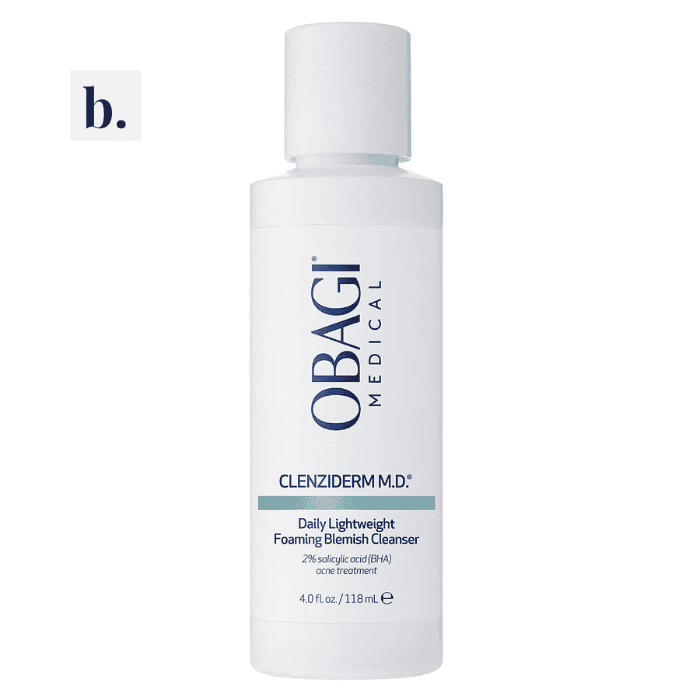
Obagi CLENZIderm M.D.® Daily Lightweight Foaming Blemish Cleanser
If your oily or acne-prone skin tolerates high-foam cleansing, this wash offers a legitimate 2% salicylic-acid acne-treatment step. Menthol, fragrance, sulfates and a dryness warning limit its fit for reactive skin, and…
Read the BeautyBrief
PCA SKIN
PCA SKIN Facial Wash Oily/Problem
If your skin is oily, combination or breakout-prone, this cleanser combines daily oil removal with some rinse-off exfoliation. Its short contact time and undisclosed acid percentages limit acne-treatment expectations, so choose it…
Read the BeautyBrief
Peach Slices
Peach Slices Acne Oil-Free Moisturizer
If you want a gentle-leaning acne active with daily moisture, this offers useful Budget convenience. If you already use acids or need a higher-strength dedicated treatment, compare your full routine first.
Read the BeautyBrief
Murad
Murad Acne Control Clarifying Cleanser
If your oily or acne-prone skin needs a medicated wash, Murad offers 1.5% salicylic acid with strong foaming cleansing. Fragrance, menthol and overlap with other acne treatments complicate your fit, while the…
Read the BeautyBrief
Amazon Basics
Amazon Basics Acne Treatment Face Wash
If your oily or acne-prone skin already tolerates 10% benzoyl peroxide, Amazon Basics gives you a Budget medicated wash. Fragrance, menthol and the label's irritation warnings make a gentler formula a better…
Read the BeautyBrief
Proactiv
Proactiv Solution Renewing Cleanser
If you want a medicated scrub, this cleanser combines acne treatment with physical exfoliation. Fragrance and the added polishing step matter if your skin is easily irritated. At the Premium tier, you…
Read the BeautyBrief