

Are Peptide Creams Effective for Wrinkles?
At a glance
Peptide creams sit in an appealing middle ground: gentler-sounding than retinoids and more treatment-focused than a basic moisturizer. Some individual topical peptides have human wrinkle data, but the category is far less clinically established than the marketing often suggests. The important question is whether a particular cream gives you a good moisturizer, a specific peptide with relevant evidence, and enough added benefit to justify its price.
Peptide creams are easy to oversell. The word peptide sounds scientific, and product descriptions often connect it to collagen, firmness, repair, or smoother-looking wrinkles.
There is legitimate science behind cosmetic peptides. The problem is that peptides are not one ingredient with one predictable effect. Different sequences are designed for different purposes, their ability to reach the relevant layers of skin varies, and evidence for one peptide or finished formula cannot simply be transferred to every cream with “peptides” on the label.
The newest randomized-trial review makes that limitation unusually clear: most of the evidence it found was for oral collagen peptides, not topical peptide creams.[1]
In this Briefing
- What peptides are in skincare
- What the wrinkle evidence actually shows
- Why evidence for one peptide does not prove the category
- How much improvement can come from moisturization
- How to read a peptide ingredient list
- What makes a peptide cream a good purchase
- Where peptides fit next to retinoids and sunscreen
- What about copper peptides and other peptide types?
- Can you use peptides with retinol or vitamin C?
- How long should you try a peptide cream?
- Which peptide claims deserve more scrutiny?
- Should you buy a peptide cream?
What are peptides in skincare?
Peptides are short chains of amino acids. Cosmetic peptides are often grouped by their proposed roles, including signal peptides, carrier peptides, neurotransmitter-inhibiting peptides, and enzyme-inhibiting peptides.[2]
Those categories are useful because they show why “contains peptides” tells you very little by itself.
Palmitoyl pentapeptide-4 is not the same ingredient as acetyl hexapeptide-8. Copper tripeptide-1 is not interchangeable with a palmitoyl peptide blend. A peptide aimed at a signaling pathway is not automatically expected to behave like one developed around a copper complex or expression-line claim.
Delivery matters too. Peptides can be relatively poor at crossing the outer skin barrier, and the 2025 review identifies permeability and stability as major practical limitations for topical cosmetic peptides.[2]
That makes the finished formula important. The peptide sequence, vehicle, concentration, stability, and delivery strategy all matter more than how many peptide names appear in the ingredient list.
For a broader ingredient-level overview, see the BB ingredient page for peptides in skincare. If you’re comparing peptide claims with collagen-branded skincare, see Does Collagen Skincare Actually Build Collagen?
Do peptide creams actually reduce wrinkles?
Some specific topical peptide formulations have shown wrinkle improvements in human studies. The evidence for peptide creams as a category is still thin.
A 2026 systematic review and meta-analysis included 19 randomized controlled trials with 1,341 participants. Peptides showed a modest overall effect on wrinkle reduction, but 17 of the 19 trials tested oral peptide products and only two tested topical formulations.[1]
That imbalance changes how the headline result should be read.
The review’s subgroup analysis found that oral polypeptides drove most of the wrinkle benefit. Topical peptides showed a smaller, non-significant effect. The authors also reported very high heterogeneity across studies and cautioned that differences in peptide type, formulation, dose, treatment duration, and outcome measurement limited firm conclusions.[1]
So the meta-analysis does not establish that buying a peptide cream is a proven wrinkle treatment. It tells us that peptide-based interventions are worth studying, while the randomized evidence directly relevant to creams and serums remains limited.
The two-topical-trial count in that review should not be read as the complete topical peptide literature now available. A separate 2025 randomized, double-blind, active- and vehicle-controlled trial enrolled 96 adults and compared a serum containing 0.002% cyclized hexapeptide-9 with 0.002% retinol and vehicle for 56 days. Ninety-one participants completed the study, and the peptide serum improved several crow’s-feet and forehead-wrinkle measures versus control, with larger effects than the low-dose retinol serum on several outcomes.[3]
That is encouraging evidence for one specific cyclized peptide and delivery system. It is not proof that ordinary peptide creams share the same performance. The study authors were affiliated with Shanghai Chicmax Cosmetic Co. and Shanghai Kans Biotech, and the paper itself calls for confirmation in larger populations.[3]
The retinol comparator was only 0.002%, so this study does not establish that the peptide outperforms higher-strength retinol products or prescription retinoids.
The review received no financial support, and the authors declared no commercial or financial conflicts of interest.[1]
Why doesn’t evidence for one peptide prove that another peptide cream works?
Because the two topical randomized trials in the 2026 review were highly specific products and peptide types.
One was a 2013 randomized placebo-controlled study of topical Argireline, also known as acetyl hexapeptide-3. Sixty participants applied Argireline or placebo to periocular wrinkles twice daily for four weeks. The Argireline group showed better subjective wrinkle ratings and improvements in objective skin-replica roughness measurements compared with placebo.[4]
That is useful direct human evidence for that synthetic hexapeptide under those study conditions. It does not prove that a cream using copper tripeptide-1, palmitoyl pentapeptide-4, or an unnamed “multi-peptide complex” will produce the same result.
The other topical trial included in the 2026 review evaluated a regimen containing synthetic alpha-defensin-5 and beta-defensin-3 rather than an ordinary generic peptide moisturizer.[1]
This specificity is the central shopping problem with peptides. A category-level claim such as “peptides reduce wrinkles” is much broader than the evidence behind the individual materials.
When a brand charges more because of a peptide technology, ask which peptide it uses and whether the evidence relates to that peptide or, even better, to the finished product you are considering.
How much of a peptide cream’s immediate improvement comes from moisturization?
Potentially quite a lot.
A cream containing glycerin, emollients, silicones, oils, or occlusive ingredients can make dry skin look smoother quickly by increasing water content and improving the way the surface reflects light.
AAD notes that moisturizer can plump fine lines within days and identifies sunscreen and moisturizer as the two most useful starting products in an anti-aging routine.[5][6]
That benefit is real. It simply does not prove that the peptide produced a structural change in the skin.
This is why a useful peptide-cream evaluation has two separate questions:
- Is this a good moisturizer for my skin?
- Is there convincing evidence that the peptide adds something beyond the moisturizing base?
The cream can still make sense when the second answer is uncertain—provided the first answer is strong and the price makes sense.
How should you read a peptide ingredient list?
Look for the actual peptide name rather than stopping at front-label phrases such as “peptide complex,” “collagen-support peptides,” or “multi-peptide technology.”
You may see ingredients such as:
- palmitoyl pentapeptide-4;
- acetyl hexapeptide-8;
- copper tripeptide-1;
- palmitoyl tripeptide-1;
- palmitoyl tetrapeptide-7.
Those names do not tell you the exact concentration, and an ingredient appearing low on the list is not automatically useless. Some cosmetic peptides are designed for use at low levels.
But the reverse is equally important: finding a recognized peptide name does not prove that the finished formula reproduces the results of a supplier study or a different product.
More useful evidence includes a brand identifying the peptide clearly, testing the finished formula on people, using a meaningful comparison group, measuring the outcome it actually advertises, and giving enough methodological detail to tell clinical or instrumental results from consumer-perception claims.
A proprietary blend name by itself gives you very little to evaluate.
What makes a peptide cream a good purchase?
Judge the moisturizer before you judge the trend ingredient.
If your skin is dry, a richer base containing ingredients such as ceramides, squalane, fatty alcohols, glycerin, or dimethicone may suit you better. If your skin is oilier, you may prefer a lighter gel-cream. Niacinamide or panthenol may add useful barrier or conditioning support depending on the formula.
If the cream leaves your skin persistently tight, irritated, excessively greasy, or uncomfortable, the peptide story does not rescue it.
Price matters too. A premium becomes easier to justify when:
- the entire formula works unusually well for your skin;
- the texture or packaging solves a real routine problem;
- the peptide is clearly identified;
- the finished product has useful controlled human testing;
- the claims match what the study actually measured.
It is much harder to justify a high price when the selling point is an unnamed peptide complex backed mainly by ingredient diagrams and laboratory mechanisms.
Are peptide creams a replacement for retinoids, moisturizer, or sunscreen?
No.
AAD recommends beginning an anti-aging routine with sunscreen and moisturizer and then targeting the one concern that matters most to you. It also warns that piling on several treatment products can increase irritation without producing better results.[6]
If fine lines and uneven texture are your priority, a retinoid may be a more evidence-established treatment category. AAD describes retinoids as useful for mild fine lines, wrinkles, pigmentation irregularities, and texture, while also emphasizing their irritation potential and the need for appropriate use.[7]
That does not mean every routine needs a retinoid or that peptide creams are pointless. It means peptides are usually an optional addition rather than the foundation of a wrinkle routine.
If your peptide cream is also the moisturizer you genuinely like using, it can fit neatly into that foundation. You do not need a separate peptide serum just to make the routine feel more advanced.
What about copper peptides and other peptide types?
Copper peptides receive extra attention because copper tripeptide complexes have a long history of laboratory research involving wound biology and extracellular-matrix signaling. Signal peptides and neurotransmitter-inhibiting peptides are marketed around different proposed mechanisms.
The 2025 review describes a broad range of peptide mechanisms but also emphasizes a recurring limitation: proposed biological activity does not automatically translate into predictable topical performance because skin penetration and delivery remain major challenges.[2]
Do not rank a copper-peptide cream, a Matrixyl-style formula, and an Argireline product simply by which mechanism sounds most impressive.
Look for human evidence tied to the specific material and finished formula.
The same caution applies to “Botox in a bottle” language. A topical peptide cosmetic is not an injectable neuromodulator and should not be expected to reproduce the mechanism or degree of effect of botulinum toxin treatment.
Can you use peptides with retinol or vitamin C?
There is no useful evidence-based rule saying that all cosmetic peptides must be separated from vitamin C, retinoids, or exfoliating acids.
Peptide formulas vary too much for one universal layering rule. Follow the directions for the actual products you use.
The more practical issue is routine tolerance. A peptide cream is often easiest to use when it functions as a comfortable moisturizing step around whatever treatment you have already chosen.
If your routine contains a retinoid or an acidic treatment, adding a gentle moisturizer with peptides may be simpler than adding another treatment serum with its own complicated schedule.
Introduce one new product at a time so you can tell whether the formula agrees with your skin and whether it adds a benefit you can actually notice.
How long should you try a peptide cream?
Separate the fast moisturizer effect from the slower claim.
If the formula hydrates well, dry fine lines may look softer within days. AAD notes that many anti-aging products need at least six weeks and sometimes as long as three months before their fuller effect becomes visible.[5]
The randomized topical peptide trials included in the 2026 review ran from four to 12 weeks, which also makes a few nights far too short to judge a wrinkle claim.[1]
If the cream is comfortable, use it for the period recommended by the product or supported by its finished-product testing before deciding whether it is doing more than moisturizing.
Stop sooner if it causes persistent burning, stinging, itching, rash, or other irritation. Discomfort is not evidence that a peptide is working harder.
Which peptide claims deserve more scrutiny?
Be cautious when cosmetic language moves from improving appearance to making sweeping structural claims.
FDA explains that a product intended simply to make wrinkles less noticeable through moisturization is a cosmetic. A product marketed as increasing the skin’s production of collagen or otherwise affecting the structure or function of the skin can cross into drug or medical-device territory under U.S. law.[8]
For your buying decision, the useful lesson is not to police every word on a box. Demand stronger evidence as the promise becomes stronger.
Claims such as “supports smoother-looking skin” or “improves the appearance of fine lines” are easier to evaluate against a cosmetic study.
Claims that a cream “rebuilds collagen,” “restructures aging skin,” “lifts the face,” or works like an injectable treatment deserve much more scrutiny.
Finished-product results matter more than a diagram showing what the peptide might do in a cell.
Should you buy a peptide cream?
Sometimes. A peptide cream makes sense when it moisturizes well, suits your skin, and offers enough additional benefit to justify its price. It is not an essential wrinkle-treatment step.
Look for clearly identified peptide technology, realistic wrinkle claims, and a price that still makes sense if the added peptide benefit turns out to be modest.
It becomes less compelling when the product charges a large premium for an unnamed blend, treats a laboratory mechanism as proof of visible rejuvenation, or implies that having more peptides automatically makes the formula more effective.
If you are choosing between an excellent regular moisturizer and a much more expensive peptide cream with little finished-product evidence, you are not missing an essential anti-aging step by choosing the regular moisturizer.
The BB Perspective
Peptides are a legitimate skincare technology, but peptide creams have been marketed much further than the current topical clinical evidence supports.
The strongest recent randomized-trial review is a good example: its overall peptide results sound encouraging until you see that 17 of 19 studies were oral and only two evaluated topical peptide formulations. The topical wrinkle effect was not statistically significant as a subgroup. Other topical trials now add encouraging evidence for specific peptide technologies, but they still do not turn “peptide cream” into one clinically interchangeable category.
That does not make peptides useless. It makes them an optional extra that has to earn its place product by product. Buy a peptide cream because the complete moisturizer works for your skin and the evidence behind its specific claims is convincing enough for the price—not because the word peptide makes the jar sound more advanced.
Last reviewed: October 2026
Sources
Nukaly HY, Halawani IR, Irtaza HM, et al. Oral and Topical Peptides for Skin Aging: Systematic Review and Meta-Analysis of Randomized Controlled Trials. Frontiers in Medicine. 2026;13:1618306. doi:10.3389/fmed.2026.1618306. PMID: 41924746.
This systematic review included 19 randomized controlled trials with 1,341 participants, but 17 trials evaluated oral peptide products and only two evaluated topical formulations. The pooled wrinkle effect was modest and was driven mainly by oral polypeptides; topical peptides showed a smaller, non-significant wrinkle effect. The authors also reported high heterogeneity and limited standardization across peptide types, formulations, doses, and outcomes. The review received no financial support, and the authors declared no commercial or financial conflicts of interest. Return to citation.
Pintea A, Manea A, Pintea C, et al. Peptides: Emerging Candidates for the Prevention and Treatment of Skin Senescence: A Review. Biomolecules. 2025;15(1):88. PMID: 39858482.
This review describes signal, carrier, neurotransmitter-inhibiting, and enzyme-inhibiting cosmetic peptides and summarizes proposed mechanisms and delivery approaches. It emphasizes poor membrane permeability and topical delivery as major limitations for cosmetic peptides. BB uses it for classification and formulation context rather than as clinical proof that peptide creams reduce wrinkles. The authors declared no conflicts of interest. Return to citation.
Chang H, Tao K, Yang Y, et al. Novel Cyclized Hexapeptide-9 Outperforms Retinol Against Skin Aging: A Randomized, Double-Blinded, Active- and Vehicle-Controlled Clinical Trial. Journal of Cosmetic Dermatology. 2025;24(7):e70290. doi:10.1111/jocd.70290. PMID: 40586182.
Ninety-six adults were randomized to twice-daily 0.002% cyclized hexapeptide-9 serum, 0.002% retinol serum, or vehicle for 56 days; 91 completed the study. The peptide group improved several crow’s-feet and forehead-wrinkle measurements versus control and showed larger effects than the low-dose retinol comparator on several outcomes. All listed author affiliations were with Shanghai Chicmax Cosmetic Co. or Shanghai Kans Biotech, and the authors state that larger studies are needed to confirm the findings. BB uses this as evidence for one specific peptide formulation, not proof that peptide creams as a category outperform retinoids. Return to citation.
Wang Y, Wang M, Xiao S, Pan P, Li P, Huo J. The Anti-Wrinkle Efficacy of Argireline, a Synthetic Hexapeptide, in Chinese Subjects: A Randomized, Placebo-Controlled Study. American Journal of Clinical Dermatology. 2013;14(2):147-153. PMID: 23417317.
Sixty participants were randomized in a 3:1 ratio to topical Argireline or placebo applied to periocular wrinkles twice daily for four weeks. The Argireline group showed better subjective wrinkle ratings and reductions in objective skin-replica roughness measurements, while the placebo group did not show the same changes. This provides direct human evidence for this specific synthetic peptide under short-term study conditions; it does not establish efficacy for other peptide ingredients or finished creams. Return to citation.
American Academy of Dermatology Association. How to Maximize Results From Anti-Aging Skin Care Products. Accessed September 2026.
AAD notes that moisturizer can make fine lines look softer within days, while many anti-aging products require at least six weeks and sometimes up to three months to show fuller results. It also advises starting one treatment product at a time and stopping non-prescription products that persistently sting, burn, or irritate the skin. Return to citation.
American Academy of Dermatology Association. How to Select Anti-Aging Skin Care Products. Accessed September 2026.
AAD recommends starting an anti-aging routine with sunscreen and moisturizer, focusing on the main concern rather than adding many products at once, choosing products suited to skin type, keeping expectations realistic, and not assuming that a higher price produces better results. It describes topical anti-aging products as producing modest rather than procedure-level changes. Return to citation.
American Academy of Dermatology Association. Retinoid or Retinol?. Accessed September 2026.
AAD describes topical retinoids as useful for mild fine lines and wrinkles, pigmentation irregularities, acne, and texture while emphasizing irritation risk and appropriate selection. BB uses this source to place peptide creams within the broader wrinkle-care decision rather than to imply that every shopper needs a retinoid. Return to citation.
U.S. Food and Drug Administration. Wrinkle Treatments and Other Anti-Aging Products. Accessed September 2026.
FDA explains that making lines look less noticeable through moisturization is a cosmetic claim, while intended effects on the structure or function of skin—such as claims to increase the skin’s production of collagen—can make a product a drug or, in some cases, a medical device. BB uses this regulatory distinction to evaluate unusually strong peptide marketing claims rather than to suggest that ordinary cosmetic wrinkle claims are improper. Return to citation.
Related product BeautyBriefs
These BeautyBriefs cover products relevant to the needs discussed in this Beauty Briefing. Inclusion here reflects topic relevance, not a rating or endorsement.

Allies of Skin
Allies of Skin The Lab Drop 10/10/10 Multi GF Exo Advanced Recovery Ampoules
If you are considering Allies of Skin Lab Drop 10/10/10 Ampoules for visible aging, its growth-factor and exosome-themed complexes make an ambitious treatment story. The brand's reported improvements do not establish biological…
Read the BeautyBrief
Schaf
Schaf Moisturizer 3.0
If you prefer a fragrance-free cream, Schaf Moisturizer 3.0 offers rich emollience alongside niacinamide and bakuchiol. Its Premium value rests on how the texture and ingredient blend suit you, not established retinoid-level…
Read the BeautyBrief
Oak Essentials
Oak Essentials Antioxidant Hand Serum
If your hands look dry, Oak Essentials Hand Serum offers humectants and emollients for softness. Its Premium value depends on the scented finish, not unproven cellular regeneration.
Read the BeautyBrief
Neutrogena
Neutrogena Rapid Wrinkle Repair Retinol Regenerating Cream
If your skin tolerates retinol and fragrance, Rapid Wrinkle Repair offers a moisturizing format for gradual fine-line care. Its Mid-Range value rests on texture and convenience rather than a disclosed retinol concentration.
Read the BeautyBrief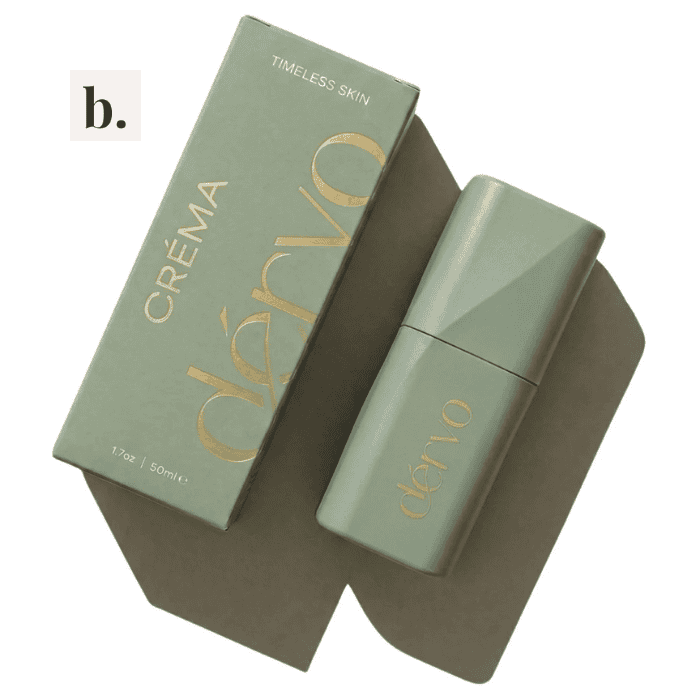
Dérvo
Dérvo Créma Face Moisturizer
If you want a rich facial moisturizer, Dérvo Créma combines humectants, plant-derived emollients and several hyaluronic-acid forms for hydration. Its peptide and botanical ingredients make a treatment-oriented formula, but published marketing claims…
Read the BeautyBrief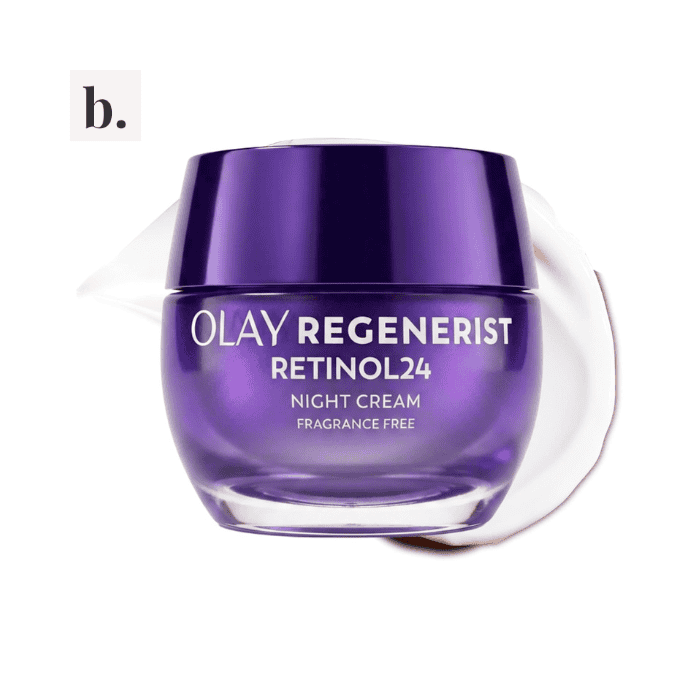
Olay
Olay Regenerist Retinol24 Night Moisturizer
If your skin tolerates retinoids, Olay Retinol24 offers a convenient fragrance-free night moisturizer with two vitamin A derivatives. Its Mid-Range value depends on routine simplicity rather than known retinol strength.
Read the BeautyBrief