

Do Exosome Serums Work Without Microneedling?
At a glance
Exosome serums promise advanced skin rejuvenation, but some of the most impressive research involves microneedling. What happens when you simply apply one to your skin at home? Human studies are beginning to answer that question, although separating the effects of extracellular vesicles from the rest of the formula remains difficult. Here’s what the evidence reveals before you pay extra for the claim.
When you shop for an exosome serum, you’ll see two different uses: an everyday product for intact skin and a topical add-on after microneedling, lasers, or another aesthetic procedure.
You shouldn’t treat those uses as interchangeable.
If you’re judging a daily serum, don’t let dramatic post-procedure results answer the wrong question. A procedure changes your skin, so the evidence you need is whether the finished serum applied to intact skin outperforms a conventional hydrating or treatment formula enough to justify its price.
You can find some human evidence for topical use alone. What you can’t yet assume is that the vesicle material consistently adds a meaningful advantage over the rest of the serum.
In this Briefing
- What “exosome” actually means
- What studies of topical use alone show
- Why improvement does not prove the exosomes caused it
- What changes when microneedling is involved
- Why post-procedure use needs more caution
- What FDA approval does and does not mean here
- How to evaluate an exosome serum before buying
- Is an exosome serum worth it?
What does “exosome” mean on a skincare label?
Not nearly as much as the label might lead you to believe.
When you read “exosome,” first understand what the research term means. Scientists use extracellular vesicles (EVs) for lipid-bilayer particles released from cells. The International Society for Extracellular Vesicles discourages calling a preparation “exosomes” unless its endosomal origin has been demonstrated.[1]
That matters when you’re shopping because exosome does not describe one standardized cosmetic ingredient.
You may find products claiming vesicle preparations associated with:
- human platelets;
- mesenchymal or adipose-derived cells;
- plant-derived extracellular vesicles or exosome-like nanovesicles;
- bacteria or fermented sources;
- engineered or biomimetic vesicles.
You can’t assume those materials behave the same way just because their labels use the same trend word.
If you’re looking at plant-derived exosome-like nanovesicles, you need to distinguish them from mammalian extracellular vesicles. They come from different biological sources, may carry different molecular cargo, and are isolated and characterized differently. Evidence involving human platelet-, adipose-, or other mammalian EVs doesn’t automatically apply to your plant-derived serum.
You may see a September 2026 peer-reviewed review cited in support of plant-derived exosome-like nanovesicles. It describes promising preclinical activity involving inflammation, oxidative stress, angiogenesis, wound healing, and tissue regeneration. That makes the science worth following; it doesn’t prove a finished plant-derived cosmetic works on your intact skin.[2]
Before you compare two bottles, consider what the brand can tell you about the source, isolation process, purity, particle characterization, concentration, storage, stability, formula, and delivery. Each affects what you’re actually getting.
A 2026 commercial-market review illustrates why you should ask those questions: products marketed with exosome language came from varied sources and often disclosed little about isolation, processing, or shelf life.[3]
So when you see exosome on a label, don’t read it as a standardized active in the way you would niacinamide or retinoids.
If you want a closer look at what qualifies as an exosome and how research differs across source materials, see BB’s What Are Exosomes in Skincare?
Do exosome serums work when you simply apply them to intact skin?
If you’re asking whether an ordinary exosome serum is a proven wrinkle, pigmentation, or firming treatment, the evidence isn’t strong enough to make that claim for the category.
Here’s the scale of the human evidence you should know: a 2026 scoping review screened 2,394 records and identified 18 human studies of topical exosome or extracellular-vesicle products for skin rejuvenation. Eight assessed topical application alone, while 10 paired the product with another delivery method or procedure.[3]
You may see improvements in wrinkles, hydration, elasticity, pigmentation, collagen-related measures, and skin appearance reported across these studies.
Those improvements can sound more definitive than the study designs support.
When you look at the review’s conclusions, the limits matter: human research remains scarce, sources and treatment methods vary widely, and much of the broader exosome story still relies on preclinical findings. The authors called for stronger trials directly comparing sources and delivery methods.[3]
So if you’re considering a serum without microneedling, the right takeaway is not “unstudied.” It’s “studied, but still insufficiently proven.”
A useful example: topical platelet-derived serum
If a brand cites topical platelet-derived EV evidence, you may be seeing a six-week study involving 56 participants. They used a platelet-derived exosome/EV serum as part of a standardized skincare regimen. Investigators reported improvements from baseline in wrinkles, redness, pigmentation, luminosity, and color evenness.[4]
Before you accept those improvements as proof of an exosome-specific effect, note the design: the study was prospective but single-arm, non-randomized, and had no placebo or vehicle control.[4]
For your buying decision, that means the regimen improved over six weeks, but you cannot tell how much came from the vesicle material, other serum ingredients, the rest of the skincare routine, normal variation, or other study effects.
The study was also financed in part by Rion Aesthetics, the company associated with the tested product, and two authors were affiliated with Rion Aesthetics.[4]
You don’t need to dismiss those findings because of industry involvement. But when you weigh a company-associated study without a control group, keep its conclusions narrow.
Why is it so hard to prove that the “exosomes” caused the result?
Remember that the serum you’re buying is still a complete cosmetic formula.
It may contain glycerin, hyaluronic acid, peptides, soothing ingredients, emollients, film-formers, or antioxidants. Any of those can help explain why your skin looks smoother or feels more hydrated.
If you see improvement from baseline in a study of the finished serum, that’s evidence for the whole product. You still need a better-controlled comparison before crediting the vesicles.
For you to know whether the exosome/EV material adds something, researchers would ideally compare:
- the finished serum containing the vesicle preparation;
- an otherwise identical serum without that preparation;
- the same application schedule and skincare routine.
That design would help you see whether the featured material contributes a measurable benefit beyond the base serum.
You don’t often get that quality of comparison in the current literature. Reviews published in 2026 still describe small studies, uneven product characterization, short follow-up, and moderate-to-high risk of bias across much of the human research.[5]
When you’re paying a premium, give more weight to controlled testing on the exact finished serum than to diagrams of signaling pathways or a list of growth factors detected in a preparation.
Does microneedling make an exosome serum work better?
If you’re comparing results with microneedling, remember that the procedure changes the treatment context. It doesn’t prove the add-on is more effective for everyday use.
One study you may encounter is a 2023 randomized split-face trial in 28 participants. Researchers performed microneedling on both sides; one side received a human adipose-tissue stem-cell-derived exosome-containing solution and the other received saline. The treated side showed greater improvements in measures of wrinkles, elasticity, hydration, and pigmentation.[6]
That comparison gives you more useful evidence than a before-and-after series because it attempts to isolate the add-on’s contribution.
You still can’t generalize it beyond that preparation, microneedling protocol, treatment schedule, and participant group. It doesn’t mean every retail exosome serum works better because needles were used.
If you’re buying a daily serum for intact skin, don’t treat a microneedling-plus-exosome study as proof that the same result will occur without the procedure.
Why does post-microneedling use need more caution?
Because microneedling deliberately punctures your skin, post-procedure products raise different safety questions.
If a clinic points to FDA-authorized microneedling devices, understand the limit of that authorization. FDA has legally authorized some devices for particular aesthetic uses, including certain facial wrinkles and scars. FDA also says these devices are not approved to deliver cosmetics, topical medications, vitamin solutions, drugs, or blood products into the skin.[7]
The agency says the risks associated with combining microneedling devices with other products are not known.[7]
That doesn’t mean an appropriately trained professional can never use an adjunctive product. It means you shouldn’t view a clinic’s exosome add-on as evidence that FDA reviewed the safety and effectiveness of that combination.
Your skin may also tolerate products differently after microneedling. FDA lists infection as a potential risk and notes that skincare products can sting or itch following the procedure.[7]
If you’re considering a post-procedure product, evidence about its identity, sterility or contamination control where relevant, formulation, storage, and exact protocol becomes even more important than it is for an ordinary moisturizer used on intact skin.
Don’t apply a retail cosmetic to your freshly microneedled skin just because its label says “exosome” or “regenerative.” Follow the post-procedure directions for the treatment you received.
Are exosome products FDA approved?
You need to separate a cosmetic appearance serum from a product promoted as regenerative medical treatment; the regulatory rules are different.
FDA states that exosome products intended to treat diseases or conditions in humans generally require FDA approval and that there are currently no FDA-approved exosome products.[8]
Don’t mistake FDA’s warning about unapproved regenerative-medicine products for a statement that every cosmetic using “exosome” language is automatically an illegal drug.
For your purchase, intended use is what matters.
If a serum is sold only to improve appearance, that’s a cosmetic claim. But if its marketing promises tissue regeneration, disease healing, wound repair, or another drug- or biologic-type effect, you’re looking at different regulatory questions.
For your buying decision, the useful takeaway is simpler: the word “exosome” is not evidence of FDA approval, and a clinical-looking package does not establish that FDA reviewed the product’s rejuvenation or post-procedure claims.
How should you evaluate an exosome serum before buying?
Start by mentally removing the word exosome from the bottle you’re considering.
Would the remaining product still make sense for your skin?
Before you buy, look for:
- A clear source. What exactly is the brand calling an exosome or extracellular vesicle?
- Source-matched evidence. A human platelet or adipose-derived EV study does not validate a plant-derived exosome-like nanovesicle product, and promising plant-vesicle preclinical research does not prove a finished cosmetic works in people.
- Useful characterization. Does the company explain how the material is identified rather than relying only on a proprietary trade name?
- Stability information. How is the material stored, protected, and expected to remain stable through normal product use?
- Finished-product testing. Was the serum you can actually buy tested in people?
- A meaningful control. Does the study compare the serum with its base formula, placebo, or another relevant treatment?
- Realistic claims. Hydration and smoother-looking skin require a lower evidence bar than claims about regeneration, collagen rebuilding, scar repair, or accelerated healing.
- A complete formula. Are familiar ingredients doing enough useful work to justify the product even if the exosome-specific benefit remains uncertain?
- A price that reflects the uncertainty. A large premium needs stronger evidence than an interesting mechanism.
You should give less weight to supplier cell studies, cell-culture diagrams, uncontrolled before-and-after photos, provider testimonials, and research on unrelated vesicle sources.
If you’re comparing products, a study of human platelet-derived EVs doesn’t prove a plant-derived serum works. Research on bacterial vesicles doesn’t validate a stem-cell-derived serum, and microneedling-assisted results don’t automatically establish effectiveness on your intact skin.
If your goal is straightforward hydration, barrier support, pigmentation care, or wrinkle treatment, conventional products using better-established ingredients may give you a clearer reason to buy for less money.
For a practical way to check whether the exact material, formula, application method, and outcome match the research, read BB’s How to Evaluate Exosome Skincare Claims.
So, is an exosome serum worth buying without microneedling?
Could an exosome-labeled product still feel good on your skin? Yes. But current evidence doesn’t show that exosome serums as a category are necessary or consistently better than well-formulated conventional skincare.
You can find human studies of topical use alone, which is more than some emerging skincare categories offer. Still, much of this evidence involves small, short, uncontrolled or heterogeneous studies and specific preparations.
Instead of asking only whether exosomes can work on intact skin, ask whether your exact finished serum has shown that its exosome/EV component adds enough to justify the extra cost.
For many products you’re considering, that answer is still unclear.
If you’re weighing products marketed as regenerative treatments rather than everyday cosmetics, see BB’s What Does Regenerative Skincare Actually Mean?
The BB Perspective
You don’t need microneedling for a serum to function as skincare. Some human studies report improvements from topical exosome/EV formulations used alone.
But when you read procedure-based studies, don’t let them settle the question about your daily serum. Microneedling results can make the category seem better proven than intact-skin use, while uncontrolled topical studies can’t isolate the vesicle material from the rest of the formula.
If your serum features plant-derived exosome-like nanovesicles, don’t borrow evidence from mammalian EVs. Their emerging preclinical biology may be interesting, but the two sources are not interchangeable.
Don’t pay a large premium for “exosome technology” unless the maker identifies and characterizes the material, explains how it stays stable, and tests the finished serum against a meaningful control. Until then, judge your options first as moisturizers or treatment serums, with the exosome story treated as an unproven extra.
Last reviewed: October 2026
Sources
Welsh JA, Goberdhan DCI, O’Driscoll L, et al. Minimal Information for Studies of Extracellular Vesicles (MISEV2023): From Basic to Advanced Approaches. Journal of Extracellular Vesicles. 2024;13(2):e12404. PMID: 38326288.
This international reporting framework explains how extracellular-vesicle preparations should be described and characterized. It is not a clinical test of a consumer skincare product. Return to citation.
Ma X, Shi J, Li R, Hu W, Li K, Zhao L, Wang M. Mechanistic Insights and Therapeutic Potential of Plant-Derived Exosome-Like Nanovesicles in Skin Tissue Regeneration. International Journal of Nanomedicine. 2026;21:635952. Published September 15, 2026. doi:10.2147/IJN.S635952.
This review summarizes mechanistic and largely preclinical evidence for plant-derived exosome-like nanovesicles in skin regeneration. It does not establish that a finished cosmetic works in people. One author is affiliated with BTBU-YHZK Bioengineering Raw Material Development Laboratory / YHZK BIOPHARM CO., LTD. BB uses it to keep plant-derived vesicle evidence separate from mammalian EV evidence and to avoid turning promising preclinical findings into proof of retail efficacy. Return to citation.
Knauer G, Chang A, Gupta A, et al. Clinical Evidence and Commercial Landscape of Topical Exosomes for Skin Rejuvenation: A Scoping Review. Aesthetic Surgery Journal. Published online July 7, 2026; corrected July 29, 2026. PMID: 42411735.
This 2026 scoping review summarizes heterogeneous human studies and commercial products. Variation in material source, formulation, and use makes it unsuitable for ranking retail serums or claiming the vesicles alone caused the results. Return to citation.
Proffer SL, Paradise CR, DeGrazia E, et al. Efficacy and Tolerability of Topical Platelet Exosomes for Skin Rejuvenation: Six-Week Results. Aesthetic Surgery Journal. 2022;42(10):1185-1193. PMID: 35689936.
This short human study examines one topical platelet-derived preparation. Its results cannot be transferred to plant vesicles, other extracellular-vesicle sources, or unrelated finished serums. Return to citation.
Flores Rodríguez JC, Toledo Avelar LE, Yi K, et al. Efficacy of Exosome-Based Therapies for Skin Rejuvenation: A Systematic Review of Human Studies. Cureus. 2026;18(2):e104182. PMID: 41756341.
This systematic review examines human skin-rejuvenation studies that used differing extracellular-vesicle materials and delivery methods. Their combined findings do not establish a category-wide benefit for daily serums on intact skin. Return to citation.
Park GH, Kwon HH, Seok J, et al. Efficacy of Combined Treatment With Human Adipose Tissue Stem Cell-Derived Exosome-Containing Solution and Microneedling for Facial Skin Aging. Journal of Cosmetic Dermatology. 2023;22(12):3418-3426.
The human treatment combined an exosome-containing solution with microneedling. It cannot show what the vesicle preparation would achieve in an ordinary at-home serum applied without the procedure. Return to citation.
U.S. Food and Drug Administration. Microneedling Devices. Updated October 15, 2025. Accessed September 2026.
FDA describes device uses, restrictions, and risks. Device clearance does not establish that adding an extracellular-vesicle solution to microneedling is safe or effective. Return to citation.
U.S. Food and Drug Administration. Consumer Alert on Regenerative Medicine Products Including Stem Cells and Exosomes. July 22, 2020. Accessed September 2026.
FDA warns about unapproved regenerative-medicine treatments, including exosome products marketed for medical uses. This is not an FDA efficacy review of routine topical cosmetic serums. Return to citation.
Related product BeautyBriefs
These BeautyBriefs cover products relevant to the needs discussed in this Beauty Briefing. Inclusion here reflects topic relevance, not a rating or endorsement.

Allies of Skin
Allies of Skin The Lab Drop 10/10/10 Multi GF Exo Advanced Recovery Ampoules
If you are considering Allies of Skin Lab Drop 10/10/10 Ampoules for visible aging, its growth-factor and exosome-themed complexes make an ambitious treatment story. The brand's reported improvements do not establish biological…
Read the BeautyBrief
Schaf
Schaf Moisturizer 3.0
If you prefer a fragrance-free cream, Schaf Moisturizer 3.0 offers rich emollience alongside niacinamide and bakuchiol. Its Premium value rests on how the texture and ingredient blend suit you, not established retinoid-level…
Read the BeautyBrief
Oak Essentials
Oak Essentials Antioxidant Hand Serum
If your hands look dry, Oak Essentials Hand Serum offers humectants and emollients for softness. Its Premium value depends on the scented finish, not unproven cellular regeneration.
Read the BeautyBrief
Neutrogena
Neutrogena Rapid Wrinkle Repair Retinol Regenerating Cream
If your skin tolerates retinol and fragrance, Rapid Wrinkle Repair offers a moisturizing format for gradual fine-line care. Its Mid-Range value rests on texture and convenience rather than a disclosed retinol concentration.
Read the BeautyBrief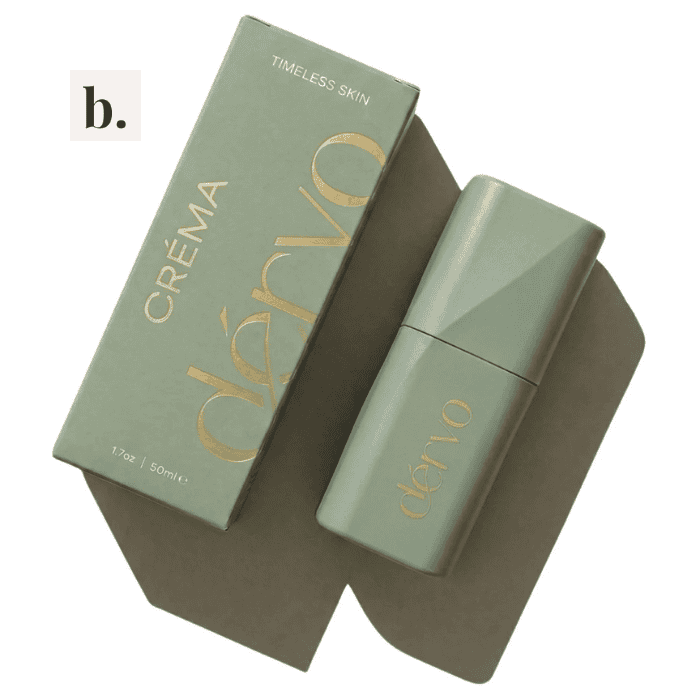
Dérvo
Dérvo Créma Face Moisturizer
If you want a rich facial moisturizer, Dérvo Créma combines humectants, plant-derived emollients and several hyaluronic-acid forms for hydration. Its peptide and botanical ingredients make a treatment-oriented formula, but published marketing claims…
Read the BeautyBrief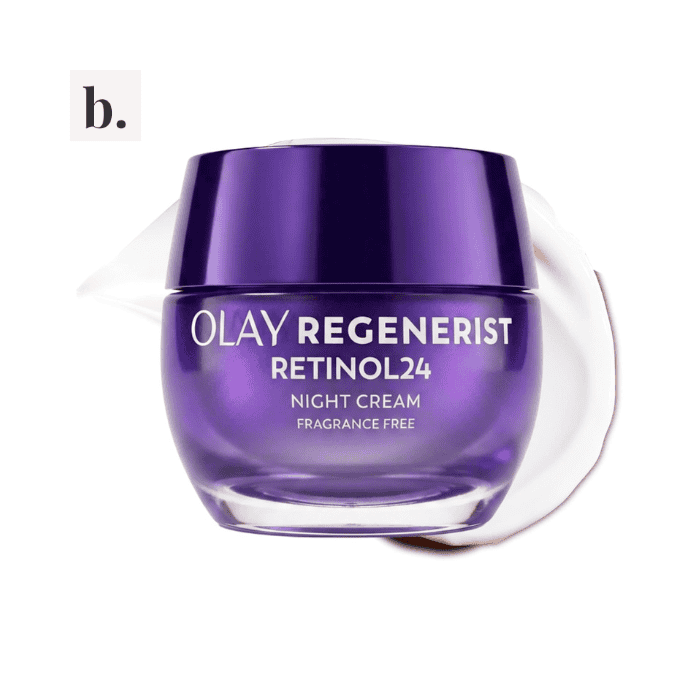
Olay
Olay Regenerist Retinol24 Night Moisturizer
If your skin tolerates retinoids, Olay Retinol24 offers a convenient fragrance-free night moisturizer with two vitamin A derivatives. Its Mid-Range value depends on routine simplicity rather than known retinol strength.
Read the BeautyBrief