Obagi SUZANOBAGIMD® Foaming Cleanser Review
BeautyBrief™
Brand
Obagi
Product
SUZANOBAGIMD® Foaming Cleanser
Claims check
You get sulfate-free foaming and conditioning support, but grapefruit oil and isothiazolinone preservatives complicate the sensitive-skin positioning.
Shopper fit
- Dry
- Normal
- Combination
- Oily
- Sensitive
Formula flags
- Essential oils
- Isothiazolinone preservatives
Shopper preferences
- Dermatologist-Tested
- Hypoallergenic
Key ingredients
| Cocamidopropyl Betaine | Supports foam and cleansing within the sulfate-free surfactant blend. |
|---|---|
| Panthenol | Adds humectant and skin-conditioning support around the cleansing system. |
| Glycerin | Provides additional water-binding support to help reduce a stripped after-feel. |
| Sodium PCA | Adds another humectant pathway within the rinse-off formula. |
| Citrus Paradisi (Grapefruit) Peel Oil | Adds a citrus-derived aromatic component that may be relevant to fragrance-sensitive skin. |
Price tier
$$$ Premium
Value check
At the Premium tier, you get rich foam without sulfates, while simpler fragrance-free cleansers may fit sensitive skin for less.
Where to buy
We may earn a commission through these links at no additional cost to you. This does not affect our BeautyBrief.
Bottom line
If you prefer substantial sulfate-free foam, this cleanser offers a capable cleansing blend with added humectants. Grapefruit oil and isothiazolinone preservatives remain relevant if your skin is reactive, so the Premium price is best justified by its texture rather than its hypoallergenic label.
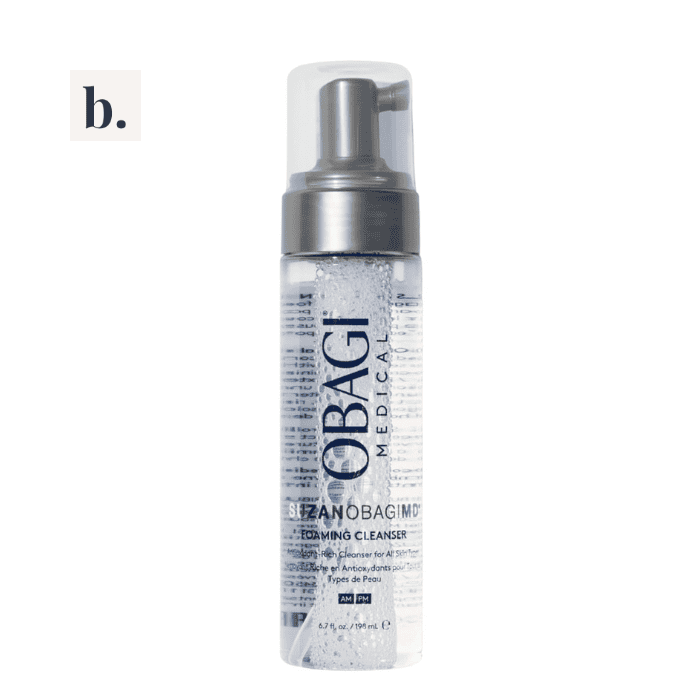
If you want rich foam without a conventional sulfate surfactant base, Obagi SUZANOBAGIMD® Foaming Cleanser is built around sodium lauroyl methyl isethionate, cocamidopropyl betaine, sodium methyl oleoyl taurate, and sodium cocoyl isethionate, with panthenol, glycerin, sodium PCA, and aloe adding conditioning support. Its strongest case is substantial foam and makeup/oil removal without relying on a traditional sulfate base; the main fit limitation is that grapefruit peel oil, limonene, and isothiazolinone preservatives remain relevant for highly reactive or previously sensitized skin.[1]
Obagi labels this exact cleanser dermatologist-tested and hypoallergenic, but neither statement means your sensitive skin will necessarily tolerate the grapefruit oil or isothiazolinone preservatives.
What it claims
Obagi describes SUZANOBAGIMD Foaming Cleanser as a thick microfoam that gently and deeply removes oil buildup, makeup, and environmental impurities. The current page also states that the exact product is dermatologist-tested, hypoallergenic, made without synthetic fragrance or parabens, and intended for sensitive skin across normal-to-dry, normal-to-oily, and combination skin types.[1]
Claims vs. formula
The cleansing claim is well aligned with the surfactant system. Sodium lauroyl methyl isethionate, cocamidopropyl betaine, sodium methyl oleoyl taurate, and sodium cocoyl isethionate provide multiple cleansing and foaming pathways without sodium lauryl sulfate or sodium laureth sulfate.
Cleanser research supports the general idea that surfactant selection and supportive humectants can meaningfully affect after-wash dryness and irritation. Milder surfactant systems interact less aggressively with skin proteins and lipids than harsher cleansing systems, while humectants and conditioning agents can help reduce cleanser-related damage.[2] That evidence supports the formula architecture here, but it does not prove that this finished cleanser is non-irritating for every shopper.
Panthenol, glycerin, sodium PCA, propanediol, and aloe add humectant and conditioning support around the cleanser base. The formula also contains grapefruit peel oil, limonene, methylchloroisothiazolinone, methylisothiazolinone, and benzisothiazolinone. Because this is a rinse-off product, exposure is shorter than with a leave-on formula, but isothiazolinones are established contact allergens and remain relevant if you already know you react to them.[3]
Ingredients that matter
The primary cleansing system blends sodium lauroyl methyl isethionate, cocamidopropyl betaine, sodium methyl oleoyl taurate and sodium cocoyl isethionate. Panthenol, glycerin and sodium PCA add moisture-binding and conditioning support, though rinse-off exposure does not establish lasting moisturization.
The grapefruit peel oil and limonene contribute aromatic components; methylchloroisothiazolinone, methylisothiazolinone and benzisothiazolinone are preservative-related tolerance considerations. If you have a known contact allergy to these ingredients, the sulfate-free formula and hypoallergenic label do not remove that risk.

Cocamidopropyl Betaine
Cocamidopropyl Betaine is an established cleansing surfactant and foam booster. Irritation and contact allergy depend on the formula and may involve manufacturing impurities such as amidoamine or DMAPA.
Read the IngredientBrief
Panthenol
Panthenol is a well-supported humectant and conditioning ingredient that improves hydration and helps reduce water loss. The complete moisturizer matters more than a high percentage or broad barrier-repair marketing.
Read the IngredientBrief
Glycerin
If your skin feels dry or tight, glycerin helps your skin hold moisture. You don't need a high percentage or a separate serum when your moisturizer already works well.
Read the IngredientBrief
Sodium PCA
Sodium PCA is a well-established humectant and component of skin's natural moisturizing system. It supports hydration inside a balanced formula but is highly replaceable and usually does not need a…
Read the IngredientBriefSafety and regulatory context
Obagi calls the exact product hypoallergenic, which may help you compare products but does not mean no one can react to the formula. FDA, however, does not define or set a federal standard for the term “hypoallergenic,” so the label should not be read as a guarantee that the cleanser cannot trigger irritation or an allergic reaction.[4]
Isothiazolinone sensitivity is a separate issue. Reviews of contact allergy identify methylchloroisothiazolinone and methylisothiazolinone as important sensitizers, and reactions can occur in already sensitized people even from rinse-off exposure.[3] If you know you react to these preservatives, this is not the cleanser to test simply because the front-of-page positioning says sensitive skin.
What to expect in the short term
You can expect dense foam and removal of everyday oil, makeup and environmental residue. Compared with a stronger sulfate-based wash, the surfactant architecture and added humectants are better aligned with a less-stripped after-feel, but highly reactive skin can still sting or develop irritation depending on individual sensitivity.
What to expect over time
This remains your cleansing step rather than a targeted treatment. The useful long-term question is whether twice-daily use keeps your skin clean without persistent tightness, stinging, dryness, or rash. The antioxidant extracts highlighted by the brand are secondary in a rinse-off format.
Who it fits
If your skin is dry, normal, combination, oily or sensitive and you prefer foaming cleansers, this may suit you provided you tolerate citrus-derived aromatic components and isothiazolinone preservatives. Obagi’s current exact-product page spans normal-to-dry, normal-to-oily, combination, and sensitive skin, so the BeautyBrief reflects that broader fit.[1]
The exact product is dermatologist-tested and labeled hypoallergenic.[1] Those are verified product-label attributes, not a guarantee of universal tolerance.
Compare before you buy
At the Premium tier, you are paying for a sulfate-free foaming system with a thick texture and Obagi’s sensitive-skin positioning, not an irreplaceable cleansing mechanism. Simpler fragrance-free cleansers without citrus oil or isothiazolinone preservatives can provide effective cleansing for less and are easier to justify when minimizing sensitizer exposure is the main priority.
Final Assessment
If you want substantial foam and oil removal in a sulfate-free cleanser, Obagi SUZANOBAGIMD® Foaming Cleanser offers a well-developed surfactant system with additional conditioning ingredients. The surfactant system is well constructed and the exact product is labeled Dermatologist-Tested and Hypoallergenic, but grapefruit peel oil, limonene, and multiple isothiazolinone preservatives make the sensitive-skin positioning less universal than the label suggests. At the Premium tier, the value is strongest if you specifically prefer this foaming format and already know you tolerate those components.
Compare Prices
Choose a retailer to view current pricing and availability.
We may earn a commission through these links at no additional cost to you.
Last reviewed: October 2026
Sources
Obagi Medical. SUZANOBAGIMD® Foaming Cleanser. Current official U.S. product page. Accessed October 15, 2026.
Ananthapadmanabhan KP, Moore DJ, Subramanyan K, Misra M, Meyer F. Cleansing without compromise: the impact of cleansers on the skin barrier and the technology of mild cleansing. Dermatologic Therapy. 2004;17 Suppl 1:16-25. PMID: 14728695.
This review supports the importance of surfactant mildness and conditioning ingredients in reducing cleanser-related dryness and barrier disruption. It does not test this Obagi finished product.
Herman A, Aerts O, Baeck M, et al. Isothiazolinone derivatives and allergic contact dermatitis: a review and update. Journal of the European Academy of Dermatology and Venereology. 2019;33(2):267-276. PMID: 30284765.
This review supports the relevance of methylchloroisothiazolinone, methylisothiazolinone, and related isothiazolinones as contact allergens, including their regulatory restriction to rinse-off use in some markets. It does not establish that this cleanser will irritate every user.
U.S. Food and Drug Administration. Cosmetics Safety Q&A: “Hypoallergenic”. Current consumer guidance. Accessed October 15, 2026.