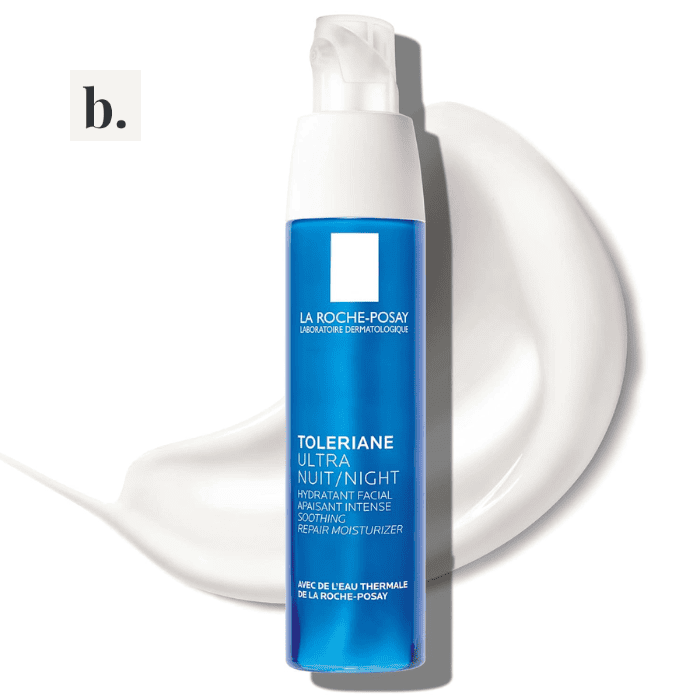
La Roche-Posay Toleriane Double Repair Face Moisturizer Review
BeautyBrief™
Brand
La Roche-Posay
Product
Toleriane Double Repair Face Moisturizer
Claims check
You get a credible moisture-and-barrier system with glycerin, squalane, niacinamide, Ceramide NP and dimethicone, while the brand's one-hour repair, 48-hour hydration and microbiome claims are not independently substantiated by public product-level methods.
Shopper fit
- Dry
- Normal
- Combination
- Oily
- Sensitive
- Acne-Prone
Formula flags
- Silicones
Shopper preferences
- Non-Comedogenic
- Dermatologist-Tested
Key ingredients
| Glycerin | Provides core humectant support for daily hydration. |
|---|---|
| Squalane | Adds lightweight emollient support and helps soften dry or tight-feeling skin. |
| Niacinamide | Supports barrier function, hydration balance, and skin comfort. |
| Ceramide NP | Adds barrier-lipid support within the lightweight moisturizer. |
| Dimethicone | Supports slip, surface smoothing, and moisture retention without requiring a heavy ointment texture. |
Price tier
$$ Mid-Range
Value check
At the Mid-Range tier, you pay for a fragrance-free moisturizer with a balanced humectant, emollient and barrier-supporting formula rather than proven superiority from the microbiome claims.
Where to buy
We may earn a commission through these links at no additional cost to you. This does not affect our BeautyBrief.
Bottom line
If you want lightweight fragrance-free moisture and barrier support, this offers a useful Mid-Range combination of niacinamide, Ceramide NP, glycerin and squalane. If your skin is very dry or needs heavier protection, a richer cream may provide better value.
If your skin needs a daily moisturizer that feels lighter than a rich cream, La Roche-Posay Toleriane Double Repair Face Moisturizer combines glycerin, squalane, niacinamide, Ceramide NP and dimethicone. That gives you both water-binding and moisture-retaining ingredients in a fragrance-free Mid-Range formula.
The reason to consider this product is its balanced moisturizing system, not a promise that every person’s barrier repairs within one hour. If your skin is extremely dry, its relatively light finish may provide less protection from moisture loss than a thicker cream.

What it claims
La Roche-Posay says Toleriane Double Repair helps repair the skin’s protective barrier after one hour, provides up to 48 hours of hydration, immediately comforts sensitive skin and creates a prebiotic action on the skin microbiome. The official U.S. page lists the finished product as dermatologist tested, non-comedogenic, fragrance-free, oil-free and suitable for sensitive skin.[1]
The precise one-hour and 48-hour claims are brand-reported endpoints. The public product page does not provide enough study design and measurement details to independently judge those timelines or determine whether the microbiome claim translates into better outcomes than other moisturizers.
Claims vs. formula
Glycerin is high in the ingredient list and acts as a humectant to help bind water in the skin’s outer layers. Squalane, myristyl myristate and other emollient ingredients soften the surface, while dimethicone adds slip and helps reduce moisture loss. These complementary functions support why the formula is moisturizing without relying on a heavy ointment feel.
Niacinamide contributes more than a label-friendly vitamin name. A study of nicotinamide in cultured cells and topical use found increased synthesis of barrier lipids and reduced transepidermal water loss in dry skin. That supports the ingredient’s relevance but does not establish how much repair Toleriane Double Repair achieves or prove La Roche-Posay’s one-hour endpoint.[2]
Ceramide NP is a skin-identical barrier lipid. A scientific review explains that ceramides play a key role in the outer skin barrier and that their performance depends on how they are incorporated into a finished formula. The presence of a ceramide supports the product’s barrier focus, but ingredient identification alone cannot quantify the finished moisturizer’s clinical effect.[3]
La Roche-Posay also highlights its prebiotic thermal water and a microbiome-supporting action. Water is the first listed ingredient, and the brand’s thermal-water story is part of its product positioning. The ingredient list and public evidence do not isolate a microbiome change caused by this exact formula or demonstrate an advantage over comparable moisturizers.
Ingredients that matter
Glycerin delivers much of the immediate water-binding support. Squalane and dimethicone help soften the feel of skin and reduce moisture loss, while niacinamide and Ceramide NP add relevant barrier-supporting functions. Those roles work together; one highlighted ingredient does not tell you how the complete moisturizer performs.
The formula also contains fatty acids and ester-based emollients that contribute to texture and skin comfort. Its silicone content is relevant if you avoid that ingredient category, but dimethicone’s presence does not make the moisturizer unsuitable for acne-prone skin; the brand specifically identifies this finished product as non-comedogenic.
Because there is no listed added fragrance or exfoliating acid treatment, the formula is easier to consider alongside routines that already include stronger actives. It is still a cosmetic moisturizer, not a medical treatment for a damaged skin barrier.

Glycerin
If your skin feels dry or tight, glycerin helps your skin hold moisture. You don't need a high percentage or a separate serum when your moisturizer already works well.
Read the IngredientBrief
Squalane
If your skin feels dry or rough, squalane can make it feel softer and smoother. You don't need a separate oil when your moisturizer already keeps your skin comfortable.
Read the IngredientBrief
Niacinamide
If your skin feels dry or uncomfortable, niacinamide can support hydration and reduce water loss in a well-formulated product. It also has evidence for uneven tone and visible oiliness, but…
Read the IngredientBrief
Dimethicone
Dimethicone is a well-supported silicone emollient and skin-protecting ingredient that improves slip, smoothness, and surface comfort. Its real moisture benefit depends on the complete moisturizer or skin-protectant formula.
Read the IngredientBriefWhat to expect in the short term
You get a lightweight cream that spreads readily and supplies humectants plus emollients for a smoother, less tight after-feel. La Roche-Posay says its protective-barrier benefits start within one hour, but that specific timing has not been independently established in the public materials.
What to expect over time
Consistent use supplies ingredients relevant to daily hydration and maintenance of the outer skin barrier. The brand’s 48-hour hydration claim gives you a product-specific performance target, not assurance that your own skin remains adequately moisturized for two days without reapplication.
If your skin still feels tight or flakes despite regular use, a richer moisturizer can offer a more protective texture. Persistent irritation deserves more than adding more layers of lotion.
Who it fits
This is a practical option if your skin is dry, normal, combination or sensitive and you want fragrance-free barrier-focused moisturizing without a dense finish. The brand also calls the lotion non-comedogenic, making it a reasonable option to consider when your skin is oily or acne-prone and you want hydration without another treatment active.
Non-comedogenic and dermatologist-tested are manufacturer-disclosed attributes, not a guarantee of zero breakouts or irritation for you. If your skin needs strong occlusion, a richer cream is likely the more useful comparison than another lightweight lotion.
Compare before you buy
Choose Toleriane Double Repair when you want a Mid-Range fragrance-free moisturizer that combines niacinamide, a ceramide, glycerin, squalane and dimethicone. Its strongest reason to buy is this blend of everyday moisturizing and barrier-supporting functions, not the broader microbiome story.
Choose a simple Budget moisturizer if hydration alone is your goal. Choose a richer cream if the amount of moisture protection matters more than a lightweight finish. This non-SPF lotion also does not replace sunscreen for daytime UV protection.
Final Assessment
La Roche-Posay Toleriane Double Repair Face Moisturizer offers credible Mid-Range value for fragrance-free hydration and barrier-focused ingredients in a light cream texture. The exact-product dermatologist-tested and non-comedogenic claims help you assess compatibility, but the one-hour repair, 48-hour hydration and microbiome claims remain brand-reported; your best reason to buy is how well the full moisturizing system fits your skin.
Where to buy
Choose a retailer to view current pricing and availability.
We may earn a commission through these links at no additional cost to you.
Last reviewed: October 2026
Sources
- La Roche-Posay. Toleriane Double Repair Face Moisturizer. Official U.S. product page, ingredient list, directions, safety claims and brand performance statements. Accessed October 14, 2026.
- Tanno O, Ota Y, Kitamura N, Katsube T, Inoue S. Nicotinamide increases biosynthesis of ceramides as well as other stratum corneum lipids to improve the epidermal permeability barrier. British Journal of Dermatology. 2000;143(3):524–531. Ingredient-level evidence, not a study of this moisturizer.
- Schild J, Kalvodová A, Zbytovská J, Farwick M, Pyko C. The role of ceramides in skin barrier function and the importance of their correct formulation for skincare applications. International Journal of Cosmetic Science. 2024;46(4):526–543. Scientific review of ceramide function and formulation; not a finished-product trial.