
La Roche-Posay Toleriane Dermallergo Night Moisturizer Review
BeautyBrief™
Brand
La Roche-Posay
Product
Toleriane Dermallergo Night Moisturizer
Claims check
You get credible fragrance-free moisturization and reported skin-comfort benefits, but consumer perceptions do not establish treatment of allergies or comparative superiority.
Shopper fit
- Dry
- Normal
- Combination
- Sensitive
Formula flags
- None identified
Shopper preferences
- Non-Comedogenic
- Dermatologist-Tested
Key ingredients
| Glycerin | Helps your skin attract and retain water to support hydration. |
|---|---|
| BUTYROSPERMUM PARKII BUTTER / SHEA BUTTER | Adds emollient softness alongside humectants in the night gel-cream. |
| Squalane | Supplies skin-softening lipids within the gel-cream formula. |
| Niacinamide | Contributes skin-conditioning and moisture-barrier support. |
| Allantoin | Adds soothing, skin-conditioning support for dry-feeling skin. |
Price tier
$$ Mid-Range
Value check
At the Mid-Range tier, you get a comfort-focused fragrance-free gel-cream and airtight packaging, though basic hydration is also available for less.
Where to buy
We may earn a commission through these links at no additional cost to you. This does not affect our BeautyBrief.
Bottom line
If your skin is easily unsettled by fragranced products, Dermallergo Night offers a useful Mid-Range moisturizing option with gentle-feeling texture and protective packaging. Its four-week consumer test supports reported comfort, not treatment of an allergic condition or guaranteed tolerance.
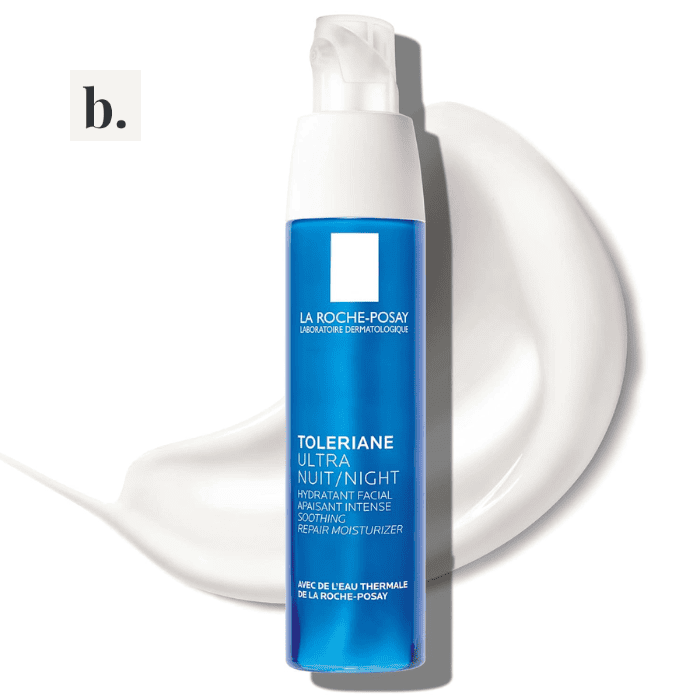
If your skin is easily unsettled by fragranced or active-heavy moisturizers, La Roche-Posay Toleriane Dermallergo Night Moisturizer offers a more focused nighttime option. Its verified U.S. formula pairs glycerin with shea butter, squalane, niacinamide, and allantoin in a fragrance-free gel-cream. The brand also highlights airtight packaging designed to help keep outside contaminants from re-entering.[1] You are paying for a sensitive-skin-focused formula and packaging approach, not a treatment for an underlying allergy or skin disease.
What it claims
La Roche-Posay markets this moisturizer for allergy-prone, ultra-sensitive skin, promising immediate and lasting comfort with a soothing gel-cream feel. Its official U.S. page describes a formula without added fragrance or drying alcohol and an airtight package with anti-contamination valves. The brand instructs you to apply it to your face and neck after cleansing each evening.[1]
In a brand-reported four-week consumer test, 95% of participants said their skin felt soothed and 96% said skin comfort improved. Those percentages describe how participants perceived their skin after use. The public page does not disclose the participant count, comparator, or detailed testing methods, so you cannot treat the figures as proof that this moisturizer outperforms another fragrance-free cream or treats allergic skin conditions.[1]
Claims vs. formula
The complete ingredient list supports the central moisturization story. Glycerin, butylene glycol, propanediol, and pentylene glycol contribute water-binding support; shea butter and squalane add emollience. Niacinamide and allantoin strengthen the formula’s skin-conditioning rationale, while acetyl dipeptide-1 cetyl ester is another comfort-oriented ingredient. Together, these ingredients make sense if you want a moisturizer that addresses dryness and an uncomfortable after-cleansing feel.[1]
The fragrance-free profile removes one common product preference concern, but it cannot guarantee that your individual skin will tolerate every ingredient. Likewise, the airtight packaging is a useful design distinction, not independent proof of superior skin outcomes. The brand’s consumer-test results lend context to its comfort claims, but the disclosed evidence is not sufficient to establish treatment of allergic reactions, persistent redness, or other inflammatory disease.
Ingredients that matter
The practical strength is the combination of water-binding humectants and moisture-sealing emollients. Glycerin and related glycols attract water, while shea butter and squalane soften the skin. Niacinamide and allantoin add complementary conditioning support within a fragrance-free gel-cream.
Acetyl dipeptide-1 cetyl ester and a ferment extract add to the comfort-focused positioning. These ingredients make a plausible moisturizer for sensitive-feeling skin but do not demonstrate that the finished product treats an allergy, eczema or persistent inflammation. You are choosing a texture and routine-compatible formula rather than a medical therapy.

Glycerin
If your skin feels dry or tight, glycerin helps your skin hold moisture. You don't need a high percentage or a separate serum when your moisturizer already works well.
Read the IngredientBrief
Shea Butter
Shea butter is a well-established emollient and occlusive used to soften dry-feeling skin and add richness to moisturizers. Its value depends on the complete formula, not the ingredient name alone.
Read the IngredientBrief
Squalane
If your skin feels dry or rough, squalane can make it feel softer and smoother. You don't need a separate oil when your moisturizer already keeps your skin comfortable.
Read the IngredientBrief
Niacinamide
If your skin feels dry or uncomfortable, niacinamide can support hydration and reduce water loss in a well-formulated product. It also has evidence for uneven tone and visible oiliness, but…
Read the IngredientBriefSafety and regulatory context
La Roche-Posay positions Dermallergo Night for sensitive and allergy-prone skin and identifies it as fragrance-free, dermatologist-tested and non-comedogenic.[1] Those product claims support the corresponding controlled preferences but do not guarantee that your skin will tolerate it or that it treats eczema or an allergic condition.
What to expect in the short term
You can expect a gel-cream format intended to feel more comfortable and less heavy than a dense night cream. The formula provides a credible basis for moisturized, softer-feeling skin after application; the brand’s claims about immediate comfort are not a substitute for independent wear testing. You apply it in the evening after cleansing, as La Roche-Posay directs.[1]
What to expect over time
With regular use, your main expected benefit is maintaining moisture and skin comfort rather than a cumulative anti-aging or disease-treatment effect. La Roche-Posay’s four-week consumer test supports reporting that many participants felt more comfortable, but without a disclosed comparator or full protocol, it does not establish an advantage over another suitable moisturizer.[1] If you continue to experience burning, swelling, or a persistent rash, you need evaluation of the underlying problem rather than relying on a cosmetic moisturizer to address it.
Who it fits
If your skin is dry, normal, combination, or sensitive and you want to avoid fragrance in a nighttime moisturizer, this is a plausible fit. La Roche-Posay explicitly lists the product as Non-Comedogenic and Dermatologist-Tested on the exact official product page, so both qualify as BB Shopper Preferences; neither guarantees universal tolerance.[1] If you prefer a nearly weightless gel, you may find even this emollient gel-cream more substantial than necessary.
Compare before you buy
At the Mid-Range tier, you get a fragrance-free blend of humectants and emollients in a package designed to limit outside contamination. If you already do well with an ordinary fragrance-free moisturizer, you can find less expensive options that also provide everyday hydration. Your reason to pay more here is the specific texture, packaging, and ingredient profile—not a proven treatment benefit beyond moisturizing.
Final Assessment
If your skin is uncomfortable with fragranced leave-on products, La Roche-Posay Toleriane Dermallergo Night Moisturizer offers a fragrance-free option with credible moisturizing support. Its ingredient blend and packaging suit a comfort-first nighttime routine, but the brand’s four-week perception figures do not prove superiority or treatment of allergic and inflammatory skin conditions. At the Mid-Range tier, the value depends on how much you need its specific sensitive-skin positioning and packaging compared with a simpler moisturizer.
Compare Prices
Choose a retailer to view current pricing and availability.
We may earn a commission through these links at no additional cost to you.
Last reviewed: October 2026
Sources
La Roche-Posay. Toleriane Dermallergo Night Moisturizer. Current official U.S. product page. Accessed October 15, 2026.


