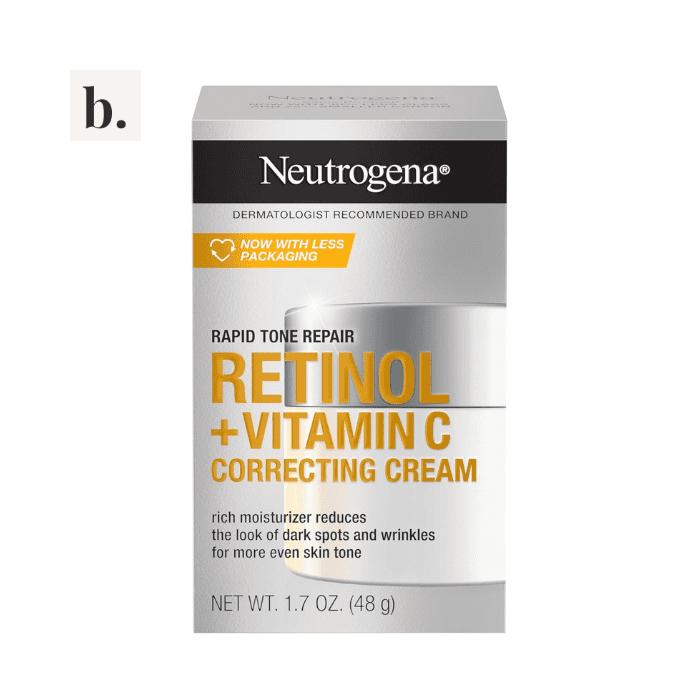
Neutrogena Rapid Tone Repair Retinol + Vitamin C Correcting Cream Review
BeautyBrief™
Brand
Neutrogena
Product
Rapid Tone Repair Retinol + Vitamin C Correcting Cream
Claims check
You get a credible retinol-and-vitamin C-derivative moisturizer, but undisclosed retinol strength limits outcome and timing predictions.
Shopper fit
- Normal
- Combination
Formula flags
- Fragrance
- Retinoids
- Silicones
Shopper preferences
- None Found
Key ingredients
| Retinol | Provides the formula's strongest basis for gradual improvement in fine lines, texture, and uneven-looking skin, with strength limited by the undisclosed concentration. |
|---|---|
| Ascorbyl Glucoside | Adds a vitamin C derivative for antioxidant, radiance, and tone-support positioning without being equivalent to L-ascorbic acid. |
| Glycerin | Provides humectant hydration within the moisturizer base. |
| Sodium Hyaluronate | Adds another water-binding pathway for plumping hydration. |
| Pentaerythrityl Tetraethylhexanoate | Adds emollient softness and helps the treatment cream function as a moisturizer rather than a bare active serum. |
Price tier
$$ Mid-Range
Value check
At the Mid-Range tier, you get moisturizing retinol care in one step, with fragrance and potency uncertainty as the main tradeoffs.
Where to buy
We may earn a commission through these links at no additional cost to you. This does not affect our BeautyBrief.
Bottom line
If you want a retinol moisturizer for uneven tone and texture, Rapid Tone Repair brings treatment ingredients into one cream. The Mid-Range value depends on your tolerance of fragrance and retinol rather than the brand's one-week promise.
If you want a retinol cream that also targets uneven tone, Neutrogena Rapid Tone Repair Retinol + Vitamin C Correcting Cream combines retinol, ascorbyl glucoside, glycerin and sodium hyaluronate. It is a leave-on moisturizer with credible pathways for gradual texture improvement, but the brand does not disclose its retinol concentration or enough clinical detail to guarantee one-week changes.[1]
What it claims
Neutrogena says the cream helps brighten and even skin tone, reduce the look of dark spots and fine lines, smooth texture, and provide long-lasting hydration. The brand also says the finished formula can visibly even tone and reduce the look of fine lines in one week.[1] The public page does not disclose enough study detail to make that one-week result a reliable timeline for every shopper.
Claims vs. formula
The formula has a reasonable ingredient-level basis for gradual treatment benefits. Some controlled retinol studies report visible improvement, but a systematic review found the over-the-counter retinol evidence inconsistent and often methodologically weak.[2] Neutrogena does not disclose the retinol percentage here, so the ingredient supports the direction of the claim without letting you predict the exact strength or timeline for this finished product.
Ascorbyl glucoside is a vitamin C derivative, not the same ingredient as L-ascorbic acid. Vitamin C derivatives can offer useful formulation advantages, but their clinical evidence is less uniform than the evidence for specific tested L-ascorbic acid formulas.[3] That makes the tone-support story reasonable while keeping the one-week dark-spot and fine-line messaging in perspective.
Ingredients that matter
Retinol is the most established treatment-oriented ingredient for fine lines and uneven texture in this formula. Ascorbyl Glucoside, a vitamin C derivative, contributes a pigmentation-focused rationale, while glycerin, sodium hyaluronate and emollients provide moisture. Added fragrance and retinol increase the practical importance of your tolerance and daytime sun protection.

Retinol
Retinol is a well-supported over-the-counter retinoid for fine lines and rough texture, with some benefit for uneven tone. Stability, vehicle, strength, and tolerability matter more than chasing the highest percentage.
Read the IngredientBrief
Glycerin
If your skin feels dry or tight, glycerin helps your skin hold moisture. You don't need a high percentage or a separate serum when your moisturizer already works well.
Read the IngredientBrief
Hyaluronic Acid
If your skin feels dry or tight, hyaluronic acid helps your skin hold moisture. You don't need several HA forms or a separate serum when your moisturizer already hydrates well.
Read the IngredientBrief
Vitamin C
If dullness or uneven tone is your concern, some topical vitamin C formulas can help. Look for stability and tolerability, not just a high percentage.
Read the IngredientBriefSafety and regulatory context
Retinol can be irritating while your skin adjusts. Neutrogena warns that mild redness, warmth, tingling, flaking, or dryness can occur, directs beginners to phase the product in gradually, advises reducing frequency if discomfort persists, and says to discontinue use if irritation continues. The brand also directs daytime use of broad-spectrum SPF 30 or higher while using this product.[1]
The exact formula also contains added fragrance. Fragrance is not an automatic negative, but it adds another tolerance variable in a leave-on retinol product.
What to expect in the short term
You get a moisturizer-style treatment step rather than a lightweight retinol serum. Hydration and surface smoothness can show up before longer-term treatment changes, while redness, tingling, flaking, or dryness can occur as your skin adjusts to retinol. Neutrogena directs beginners to introduce the product gradually and to use broad-spectrum SPF 30 or higher during the day.[1]
What to expect over time
Judge this formula over weeks to months, not a few applications. Retinol benefits depend on consistent use and tolerability, and the undisclosed retinol concentration means there is no defensible way to promise a specific pace of improvement from the ingredient list alone.[2] If the formula keeps leaving your skin irritated, reducing frequency or choosing a simpler retinoid formula makes more sense than pushing through discomfort.
Who it fits
If your skin is normal or combination and you want retinol and moisturizer in one step, this cream fits that aim. If your skin is fragrance-sensitive or easily irritated, the combination of retinol and perfume calls for a more cautious introduction. The brand does not document an applicable controlled shopper preference for this exact product.
Compare before you buy
At the Mid-Range tier, the value is strongest if this replaces both a basic moisturizer and a separate retinol step in your routine. If you already use another retinoid, you are mostly adding overlap rather than a new treatment category. If fragrance is a dealbreaker for you, a fragrance-free retinoid moisturizer gives you a cleaner fit without changing the core treatment goal.
Final Assessment
If you want a one-step retinol moisturizer for uneven tone and fine lines, Rapid Tone Repair offers a credible combination with a vitamin C derivative. Its exact retinol strength and one-week results cannot be independently predicted from the public brand information. Mid-Range value depends on your tolerance and whether combining moisturizer with a retinoid simplifies your routine.
Compare Prices
Choose a retailer to view current pricing and availability.
We may earn a commission through these links at no additional cost to you.
Last reviewed: October 2026
Sources
Neutrogena. Rapid Tone Repair Retinol + Vitamin C Correcting Cream. Current official U.S. product page. Accessed October 15, 2026.
Spierings NMK. Evidence for the Efficacy of Over-the-counter Vitamin A Cosmetic Products in the Improvement of Facial Skin Aging: A Systematic Review. Journal of Clinical and Aesthetic Dermatology. 2021.
Used to frame the evidence boundary for cosmetic retinol: some controlled studies report improvement, but results are not transferable to every finished retinol product or concentration.
Vasques LI, Vendruscolo CW, Leonardi GR. Topical Application of Ascorbic Acid and its Derivatives: A Review Considering Clinical Trials. Current Medicinal Chemistry. 2023.
Used to distinguish vitamin C derivatives from L-ascorbic acid and to support a more measured interpretation of derivative-level efficacy claims.