
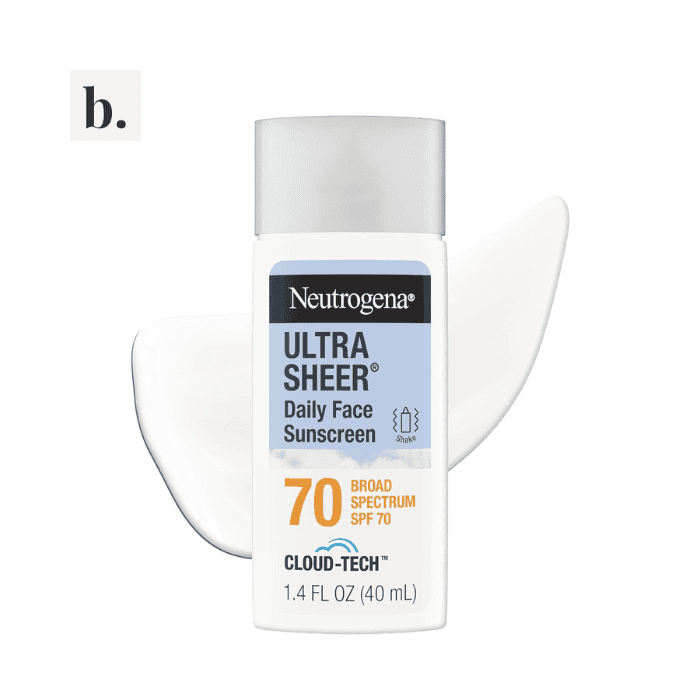
Neutrogena Ultra Sheer Daily Face Sunscreen SPF 70 with BEMT Review
BeautyBrief™
Brand
Neutrogena
Product
Ultra Sheer Daily Face Sunscreen SPF 70 with BEMT
Claims check
If you want high broad-spectrum SPF, this sunscreen provides a labeled SPF 70 with bemotrizinol and other filters, while added peptides do not prove collagen repair.
Shopper fit
- Normal
- Combination
- Oily
Formula flags
- None identified
Shopper preferences
- None Found
Key ingredients
| Bemotrizinol | At 6%, a broad-spectrum organic sunscreen active in the product's tested four-filter SPF 70 system. |
|---|---|
| Avobenzone | At 3%, supplies UVA filtration within the complete sunscreen active combination. |
| Homosalate | At 15%, contributes UVB absorption to the labeled broad-spectrum sunscreen system. |
| Octisalate | At 5%, provides additional UVB filtering as part of the SPF 70 formula. |
| Silica | Absorbent texture modifier that supports a lower-shine, lighter finish without independently proving wear-test outcomes. |
Price tier
$ Budget
Value check
At the Budget tier, you get broad-spectrum SPF 70 and a lighter-feeling facial formula, not proven collagen benefits or water resistance.
Where to buy
We may earn a commission through these links at no additional cost to you. This does not affect our BeautyBrief.
Bottom line
If you want a lightweight face sunscreen with high labeled SPF, Neutrogena Ultra Sheer SPF 70 with BEMT combines several UV filters, including bemotrizinol. SPF 70 is a protection rating, not a promise of all-day coverage; apply enough and reapply as directed.
If you want a high-SPF face sunscreen with a lighter finish, Neutrogena Ultra Sheer Daily Face Sunscreen SPF 70 with BEMT pairs a high broad-spectrum SPF label with a lightweight facial-lotion format. Neutrogena’s official U.S. product page lists 6% bemotrizinol alongside three established sunscreen filters, while a base without listed perfume or fragrance ingredients uses silica and starch to support a less greasy finish.[1]
This makes the most sense if you want everyday facial sun protection without a heavy sunscreen feel. The important limits are practical: the label directs swimmers and people who sweat to choose a water-resistant sunscreen, and the added peptide does not establish that this sunscreen rebuilds collagen.
What it claims
Neutrogena describes Ultra Sheer Daily Face as a lightweight, fast-absorbing, invisible sunscreen that blends across skin tones and layers well under makeup. The company highlights Cloud-Tech, its Helioplex360 filter system, antioxidant ingredients, and patented Micro-Peptide Technology to support healthy-looking skin and skin’s natural collagen.[1]
The brand also reports that 93% of respondents agreed it layered well with makeup and 91% agreed it looked invisible on skin. The current product page does not disclose the sample size, survey conditions, or protocol needed to treat those figures as independent performance testing.[1]
Claims vs. formula
The strongest established benefit is sun protection. Neutrogena’s official U.S. product page lists 3% avobenzone, 6% bemotrizinol, 15% homosalate, and 5% octisalate in the broad-spectrum SPF 70 finished product. That SPF designation belongs to the finished product, not to bemotrizinol by itself. The four-filter system provides complementary UV coverage; the SPF 70 number does not quantify the formula’s UVA protection or establish a meaningful wear advantage over SPF 60.[1]
The lightweight positioning is coherent with the base. Silica and aluminum starch octenylsuccinate help manage surface feel, while butyloctyl salicylate, C12-15 alkyl benzoate, and film-forming components help spread the filters. That supports the plausibility of a smooth finish without proving that every user will find it weightless, non-pilling, or comfortable around the eyes.
Acetyl Dipeptide-31 Amide is the peptide named in the official inactive-ingredient list. Neutrogena does not disclose its concentration or provide a publicly accessible controlled study isolating an added collagen or wrinkle benefit from this exact finished sunscreen. The labeled sun-protection benefit has a clearer evidentiary basis than the supplemental peptide story. Tocopheryl acetate and feverfew-derived material are also included, but their presence does not establish additional clinical protection from visible light or free-radical damage.[1]
Ingredients that matter
Bemotrizinol at 6% works with avobenzone, homosalate and octisalate in the finished broad-spectrum SPF 70 formula. The total tested sunscreen matters more than any one filter’s concentration. BB’s organic UV-filter guide explains the broader filter roles.
Silica and starch support the lightweight finish, while tocopheryl acetate adds skin-conditioning context. The listed acetyl dipeptide-31 amide supports the brand’s peptide story, but this sunscreen’s public evidence does not show a separate collagen-building result attributable to that ingredient.

Bemotrizinol
Bemotrizinol is a well-supported, photostable UVA/UVB sunscreen filter permitted under the U.S. OTC sunscreen monograph. The finished sunscreen's tested protection, wearability, and application matter more than one filter's percentage.
Read the IngredientBrief
Organic UV Filters
Organic UV filters absorb ultraviolet radiation in sunscreens. Their benefits depend on the individual filters and the tested protection, stability, wearability, and tolerability of the finished sunscreen.
Read the IngredientBrief
Tocopheryl Acetate
Tocopheryl acetate is a stable vitamin E derivative used for antioxidant and skin-conditioning functions in cosmetics. It is a supporting ingredient; stand-alone scar, wrinkle, and dark-spot benefits are not established.
Read the IngredientBriefSafety and regulatory context
Bemotrizinol was added to the U.S. over-the-counter sunscreen monograph in 2026 at concentrations up to 6%. This permits its use under specified monograph conditions; it does not mean FDA individually endorsed Neutrogena’s texture, peptide claims, or superiority over other finished sunscreens.[2]
Follow the directions on Neutrogena’s official U.S. product page: apply generously and evenly 15 minutes before sun exposure, reapply at least every two hours, and use a different water-resistant sunscreen when swimming or sweating. Avoid broken skin and the eyes, stop use if a rash occurs, protect the package from excessive heat and freezing, and ask a doctor before use on an infant younger than six months. This daily-face formula does not carry a water-resistance claim.[1]
What to expect in the short term
The formula is designed for a fast-drying, low-shine finish without the white cast associated with many high-mineral-filter formulas. Its silica-starch base supports that approach, but final appearance and under-makeup behavior depend on application amount, skin condition, moisturizer, and makeup. The brand’s survey-style impressions give you a sense of reported wear, but they do not guarantee how it will look or feel with your skincare and makeup.
What to expect over time
Correct, repeated broad-spectrum sunscreen use helps limit UV-related sun damage and premature skin aging. That preventive role is the main sustained benefit of this SPF 70 formula. The evidence shown for this exact product does not establish that Acetyl Dipeptide-31 Amide independently increases collagen, reverses existing wrinkles, or outperforms other well-formulated sunscreens in long-term skin-aging outcomes.[1]
Who it fits
If your skin is normal, combination or oily and you want a facial sunscreen with a lower-shine finish, this formula offers a relevant choice. The official ingredient list contains no named fragrance or parfum ingredient, but you still need to judge your own tolerance. Dry skin may need an additional moisturizer, while swimming or sweating calls for a specifically water-resistant sunscreen.[1]
Compare before you buy
Neutrogena’s Clear Face Sunscreen SPF 60 with BEMT contains the same four sunscreen actives at the same percentages, replacing Ultra Sheer’s micro-peptide with niacinamide in the supporting formula. Its exact U.S. product page explicitly calls it non-comedogenic and designed for acne-prone skin; the Ultra Sheer page does not make that same product-specific claim. Choose by skin fit and how the complete formula wears, not by assuming SPF 70 is always the better purchase.[3]
Against other Budget facial sunscreens, this product’s appeal is its high labeled SPF in a formula without listed added fragrance and the prospect of a lightweight, low-shine finish. Its compact 1.4 fl oz bottle makes generous application and reapplication part of the value calculation; the proprietary peptide does not justify a price premium on its own. A reliable sunscreen you already enjoy using is not obsolete because it lacks BEMT.
Final Assessment
If you want high labeled sun protection in a lighter daily facial formula, Neutrogena Ultra Sheer SPF 70 with BEMT combines four sunscreen filters with absorbent texture ingredients. Its Budget-tier value comes from the tested SPF and easy daily positioning, not a proven collagen benefit from the peptide; apply enough, reapply as directed and choose a water-resistant sunscreen for swimming or heavy sweating.
Compare Prices
Choose a retailer to view current pricing and availability.
We may earn a commission through these links at no additional cost to you.
Last reviewed: October 2026
Sources
Neutrogena. Ultra Sheer Daily Face Sunscreen SPF 70 with BEMT. Official U.S. product page, October 2026.
U.S. Food and Drug Administration. FDA Expands Sunscreen Options for the First Time in 20 Years. June 9, 2026.
Neutrogena. Clear Face Sunscreen Acne-Prone Skin Broad Spectrum SPF 60 with BEMT. Official U.S. product page, October 2026.
More from Neutrogena

BeautyBrief
Neutrogena Rapid Wrinkle Repair Retinol Regenerating Cream
Read the BeautyBrief
BeautyBrief
Neutrogena Clear Face Sunscreen Acne-Prone Skin Broad Spectrum SPF 60 with BEMT
Read the BeautyBrief
BeautyBrief