
Retinol in Skincare
Retinol is a well-supported over-the-counter retinoid for fine lines and rough texture, with some benefit for uneven tone. Stability, vehicle, strength, and tolerability matter more than chasing the highest percentage.
- Aliases
- Vitamin A1, all-trans-Retinol, Retinyl Alcohol
- Ingredient category
- Retinoid
- Most relevant for
- Fine Lines and Wrinkles, Hyperpigmentation, Rough and Bumpy Skin
- Evidence strength
- Well Supported for Improving visible fine lines and rough texture with stable topical retinol leave-on formulations
- Formula matters
- Retinol strength, stability, vehicle, packaging, delivery system, moisturizing ingredients, frequency, and tolerability shape results. A percentage does not guarantee an untested retail product performs like a studied stabilized formula.
- Separate product needed?
- Sometimes. A dedicated retinol product can make sense when visible aging or texture is a priority and another retinoid is not already doing the same job.
BB takeaway
Retinol works, but the retail market is not interchangeable. Choose a stable formula and a strength you can use consistently rather than treating the biggest percentage as the best product.
Ingredient evidence does not prove the performance of every finished product containing it.
What is retinol?
Retinol is a vitamin A derivative and part of the larger retinoid family. It is different from prescription tretinoin, retinal, and vitamin A esters such as retinyl palmitate.
In skin, retinol is converted through several steps into retinoic acid, the form that interacts directly with retinoid receptors.[1] That does not mean you can convert a 0.3% retinol label into an equivalent tretinoin or retinal strength. Different retinoids and formulas are not directly interchangeable.
What does retinol do for skin?
A well-formulated retinol product can gradually improve fine lines, rough texture, and uneven-looking pigmentation.
Retinol is also marketed for acne, but cosmetic retinol should not be treated as interchangeable with acne medicines such as adapalene or prescription tretinoin. If acne is the main concern, choose a treatment with stronger acne-specific evidence rather than assuming every retinol serum will do the same job.[2]
Retinol does not replace sunscreen. If sun-related aging or discoloration is the concern, daily broad-spectrum sun protection remains the more important preventive step.
What the evidence says about retinol skincare
Retinol is well supported for improving visible signs of photoaging when it is delivered in a stable, effective leave-on formula.
A systematic review of over-the-counter vitamin A cosmetics found that some controlled facial studies showed improvement while others did not, which is an important reminder that the ingredient name alone does not guarantee results.[1]
Specific stabilized retinol formulas have performed well in controlled studies. A 0.1% stabilized retinol formula improved several signs of sun-related skin aging in longer and shorter studies, while an older 0.4% lotion improved fine wrinkling and roughness in a different population.[3][4][5]
The shopper takeaway is straightforward: retinol has credible human evidence, but a percentage on the label cannot tell you whether an untested product will reproduce the results of a well-studied formula.
How retinol form and formulation affect results
Retinol can degrade with light, heat, and time. A study of commercial retinoid cosmetics found large differences in stability from one product to another.[6]
That means a large percentage on the front of the box is not enough to judge quality. A lower-strength formula with credible stability or finished-product efficacy data can be a better buy than a stronger product built mostly around the number.
Higher strength is not automatically better. A small study comparing 0.3% and 1% retinol found similar changes in some short-term skin markers, while the 0.3% formula was better tolerated in a separate facial-use study.[7] The study does not prove that both strengths work equally well long term, but it supports an important buying rule: more irritation is not evidence of better results.
Encapsulation can be useful, but the word “encapsulated” does not prove that a product is more stable, gentler, or more effective. Give more weight to actual finished-product testing.
The supporting formula matters too. glycerin, ceramides, emollients, and other moisturizing ingredients can make a retinol product easier to use consistently.
Who may benefit from retinol skincare?
Retinol makes the most sense when gradual improvement in fine lines, rough texture, or uneven-looking tone is a real priority and you want an over-the-counter retinoid.
It can be especially useful for shoppers who want a gentler entry point into retinoids or who prefer an over-the-counter formula rather than a prescription treatment.
You do not need retinol simply because it is popular. If your routine already contains retinal, tretinoin, adapalene, or another retinoid, adding a separate retinol serum, eye cream, or night cream usually creates duplication rather than a clear extra benefit.
Very dry, easily irritated, or inflamed skin can struggle with retinoids. If your skin repeatedly becomes uncomfortable, a stronger percentage is not worth chasing.
Retinol side effects and irritation risk
Dryness, redness, flaking, stinging, and burning are the main practical drawbacks of retinol.
Mild irritation can happen when you start, but irritation is not proof that the product is working. More peeling does not mean faster or better results.
Do not automatically label every new breakout as “purging.” Retinoids can irritate, and the complete formula can also contribute to breakouts.
Pregnancy is a separate consideration. The American College of Obstetricians and Gynecologists states that absorption from topical retinoids is low but that these products are generally recommended to be avoided during pregnancy.[8]
If you are pregnant, avoid retinol and ask your clinician about alternatives. If you are trying to become pregnant or breastfeeding, ask how to handle your specific retinoid product.
How to use retinol in your skincare routine
Follow the directions on the exact product. Retinol is usually used at night, and starting less frequently can make it easier to judge tolerability.[2]
Keep the rest of the routine simple while you learn what your skin tolerates. After cleansing, apply the amount directed by the product and use moisturizer as needed.
If irritation builds, reduce frequency rather than adding more active products. Use broad-spectrum sunscreen every morning.
How long does retinol take to work?
Think in months, not days.
Controlled studies have measured retinol benefits over periods ranging from several weeks to a year, depending on the formula and outcome.[3][4][5]
Do not judge a retinol product after a few applications. Early surface changes can appear before fine-line changes, and no single timeline applies to every formula.
If the product keeps irritating your skin, waiting longer is not the answer.
What can you use with retinol?
Retinol can fit into a routine with many common skincare ingredients. The main practical limit is irritation, not a long list of ingredients that are chemically forbidden together.
Hydrating and moisturizing ingredients such as hyaluronic acid, glycerin, ceramides, and niacinamide can help keep the routine comfortable.
Exfoliating acids and benzoyl peroxide can make a retinoid routine harder to tolerate, especially when you are starting. Adding several strong treatments at once also makes it harder to tell what your skin can handle.
If you already use another retinoid, do not add retinol simply because it appears in a different product type.
How to choose a retinol product
Start with the finished product, not the biggest percentage printed on the package.
Look for a leave-on formula that fits your skin, credible stability or efficacy testing when available, packaging that limits unnecessary light and air exposure, and a strength you can use consistently.
Do not assume an undisclosed percentage means a product is weak. In the United States, over-the-counter retinol products do not have a standard requirement to disclose the percentage on the label or packaging.[2]
If you shop European products, you may see lower strengths because the European Union limits retinol-equivalent concentrations to 0.05% RE in body lotion and 0.3% RE in other leave-on and rinse-off cosmetics, with a required vitamin A warning.[9] Products placed on the EU market from November 1, 2025 must comply; older noncompliant stock can remain available until May 1, 2027. Those rules reflect EU exposure policy and should not be treated as universal ideal strengths for every shopper.
Retinol itself does not justify Premium pricing. Pay more only when the finished product gives you something meaningful in return, such as stronger formulation, better stability, better tolerability, or credible product testing.
Do you need a separate retinol product?
Sometimes.
A dedicated retinol product makes sense when fine lines, rough texture, or uneven-looking tone are a real priority and your routine does not already contain another retinoid.
It makes less sense when you already use retinal, tretinoin, adapalene, or another retinoid; when retinoids repeatedly irritate your skin; or when buying another retinol step would mean sacrificing more important basics such as moisturizer or sunscreen.
If retinol is not a good fit, our guide to affordable retinol alternatives compares options by the concern you actually want to treat, including acne, uneven tone, surface roughness, and visible aging.
The BB Perspective
Retinol deserves attention, but not blind faith.
Some well-studied formulas improve fine lines, texture, and uneven-looking tone, while the broader over-the-counter market is far less uniform.
For your routine, stability, finished-product testing, and tolerability matter more than the largest percentage on the package. A lower-strength formula you can use consistently can be a smarter purchase than a stronger product with little evidence behind it.
Last reviewed: September 2026
Sources
Spierings NMK. Evidence for the Efficacy of Over-the-counter Vitamin A Cosmetic Products in the Improvement of Facial Skin Aging: A Systematic Review. Journal of Clinical and Aesthetic Dermatology. 2021;14(9):33-40. PMID:34980969. PMCID:PMC8675340.
This review found mixed results across vehicle-controlled over-the-counter vitamin A cosmetic trials and supports judging retinol as a formula-specific ingredient rather than assuming every retail product performs equally. Return to citation.
American Academy of Dermatology. Retinoid or retinol?
This dermatologist guidance distinguishes over-the-counter retinol from other retinoids and covers practical use, irritation, nighttime application, gradual introduction, and daytime sun protection. Return to citation.
Kafi R, Kwak HSR, Schumacher WE, et al. Improvement of Naturally Aged Skin With Vitamin A (Retinol). Archives of Dermatology. 2007;143(5):606-612. doi:10.1001/archderm.143.5.606. PMID:17515510.
This randomized, double-blind, vehicle-controlled study tested 0.4% retinol lotion on the arms of very elderly adults for 24 weeks and found improvement in fine wrinkling and roughness. The treatment area and population limit how directly the findings apply to ordinary facial skincare. Return to citation.
Randhawa M, Rossetti D, Leyden JJ, et al. One-year Topical Stabilized Retinol Treatment Improves Photodamaged Skin in a Double-blind, Vehicle-controlled Trial. Journal of Drugs in Dermatology. 2015;14(3):271-280. PMID:25738849.
This research tested a stabilized 0.1% retinol formulation and found greater improvement in signs of photodamage than the vehicle. The findings support the tested stabilized system rather than every product labeled 0.1% retinol. Six authors were affiliated with Johnson & Johnson Consumer Companies, which developed the tested retinol formulation. Return to citation.
Farris P, Berson D, Bhatia N, et al. Efficacy and Tolerability of Topical 0.1% Stabilized Bioactive Retinol for Photoaging: A Vehicle-Controlled Integrated Analysis. Journal of Drugs in Dermatology. 2024;23(4):209-215. doi:10.36849/JDD.8124. PMID:38564380.
This pooled analysis combined six vehicle-controlled studies of a stabilized 0.1% retinol formula and found improvement across several investigator-rated signs of photoaging through 12 weeks. The result supports this specific stabilized formula. Return to citation.
Temova Rakusa Z, Skufca P, Kristl A, Roskar R. Retinoid Stability and Degradation Kinetics in Commercial Cosmetic Products. Journal of Cosmetic Dermatology. 2021;20(7):2350-2358. doi:10.1111/jocd.13852. PMID:33206444.
This laboratory study found substantial differences in retinoid stability across commercial cosmetics and pronounced degradation with light exposure. It supports treating stability as a finished-product issue. Return to citation.
Mellody KT, Bradley EJ, Mambwe B, et al. Multifaceted Amelioration of Cutaneous Photoageing by (0.3%) Retinol. International Journal of Cosmetic Science. 2022;44(6):625-635. doi:10.1111/ics.12799. PMID:35778881. PMCID:PMC9780755.
This research compared several retinol strengths in a short experimental study and separately compared facial tolerability of 0.3% and 1% retinol. The 0.3% formula was better tolerated, but the design does not prove equal long-term facial efficacy. The study was funded by No7 Beauty Company, Walgreens Boots Alliance; the authors declared no conflicts of interest. Return to citation.
American College of Obstetricians and Gynecologists. Skin Conditions During Pregnancy.
ACOG states that systemic absorption from topical retinoids is low but that these medications are generally recommended to be avoided during pregnancy. Return to citation.
Commission Regulation (EU) 2024/996 of 3 April 2024. Official Journal of the European Union. Current September 2026.
This regulation limits Retinol, Retinyl Acetate, and Retinyl Palmitate to 0.05% retinol equivalent in body lotion and 0.3% retinol equivalent in other leave-on and rinse-off cosmetics and requires a vitamin A warning. Noncompliant products cannot be newly placed on the Union market from November 1, 2025 and cannot be made available from May 1, 2027. The rule applies to the European Union and should not be presented as a universal ideal strength. Return to citation.
Products featuring Retinol
These evaluated products list Retinol among the Key Ingredients that meaningfully shape the formula. Inclusion here reflects ingredient relevance, not an endorsement or rating.

Neutrogena
Rapid Wrinkle Repair Retinol Regenerating Cream
If your skin tolerates retinol and fragrance, Rapid Wrinkle Repair offers a moisturizing format for gradual fine-line care. Its Mid-Range value rests on texture and convenience rather than a disclosed retinol concentration.
Read the BeautyBrief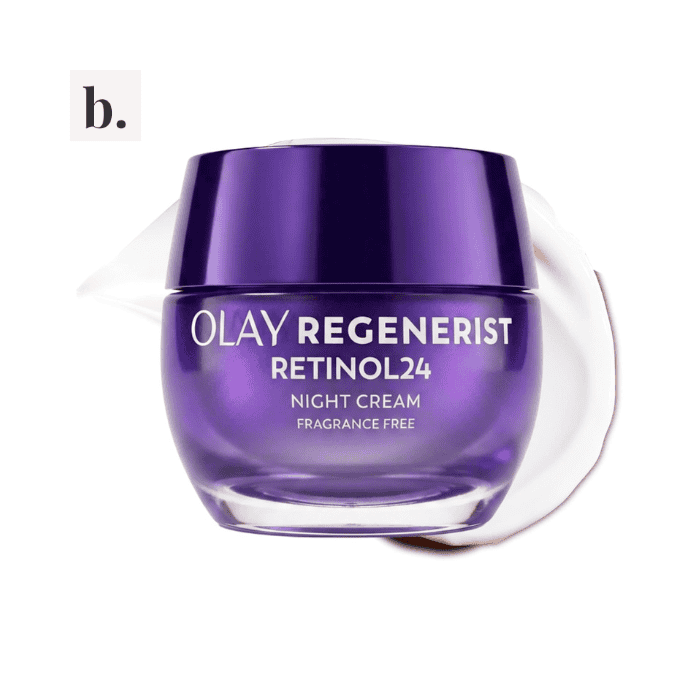
Olay
Regenerist Retinol24 Night Moisturizer
If your skin tolerates retinoids, Olay Retinol24 offers a convenient fragrance-free night moisturizer with two vitamin A derivatives. Its Mid-Range value depends on routine simplicity rather than known retinol strength.
Read the BeautyBrief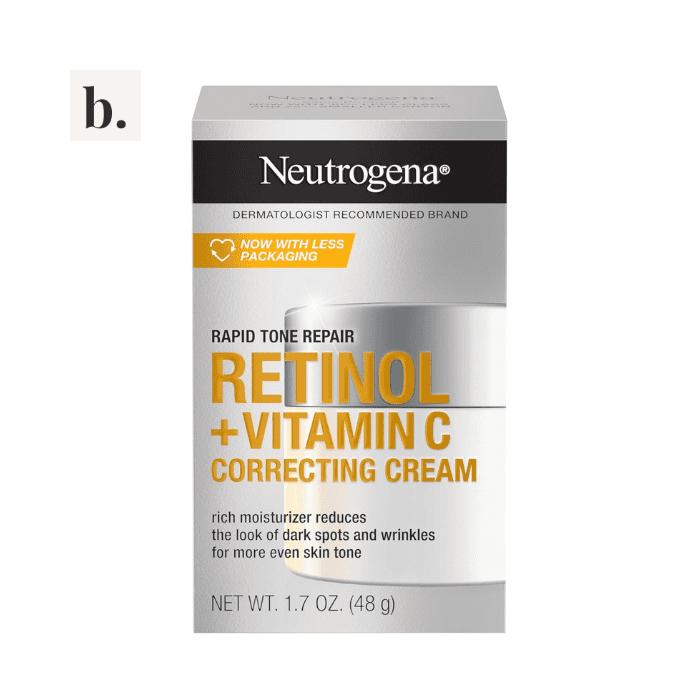
Neutrogena
Rapid Tone Repair Retinol + Vitamin C Correcting Cream
If you want a retinol moisturizer for uneven tone and texture, Rapid Tone Repair brings treatment ingredients into one cream. The Mid-Range value depends on your tolerance of fragrance and retinol rather…
Read the BeautyBrief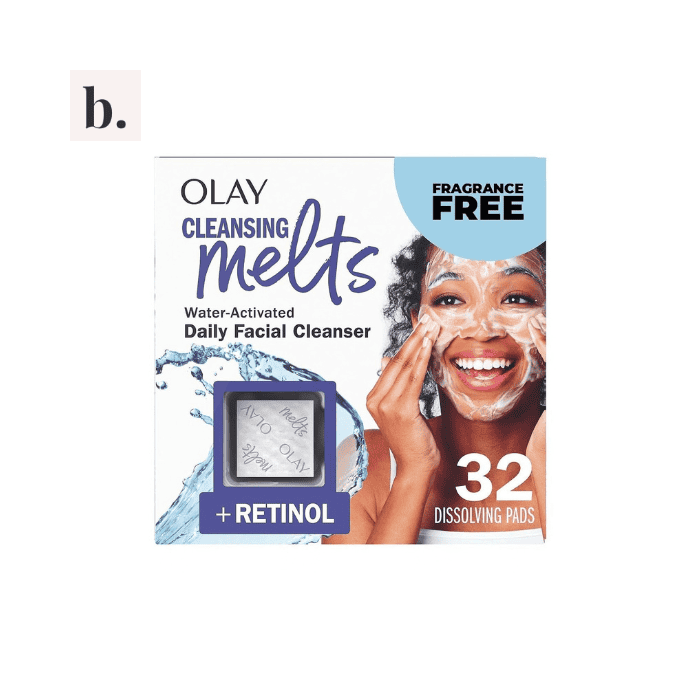
Olay
Cleansing Melts + Retinol
If you need a portable fragrance-free cleanser, Olay Cleansing Melts offers an easy, single-use format. Its Budget value comes from cleansing and convenience, not proven retinol wrinkle treatment.
Read the BeautyBrief
Beverly Hills MD
Resurface + Restore Youth Revealing System
If your skin tolerates acids and retinol, this system provides an intensive route to smoother-looking texture and tone. The Premium value is strongest when you want both steps and accept the cumulative…
Read the BeautyBrief
Olay
Renewing Exfoliating Cleanser with Retinol
If you want affordable surface smoothing built into cleansing, this fragrance-free wash combines scrub particles and salicylic acid. If your main goal is fine-line treatment or you already exfoliate, use a simpler…
Read the BeautyBrief