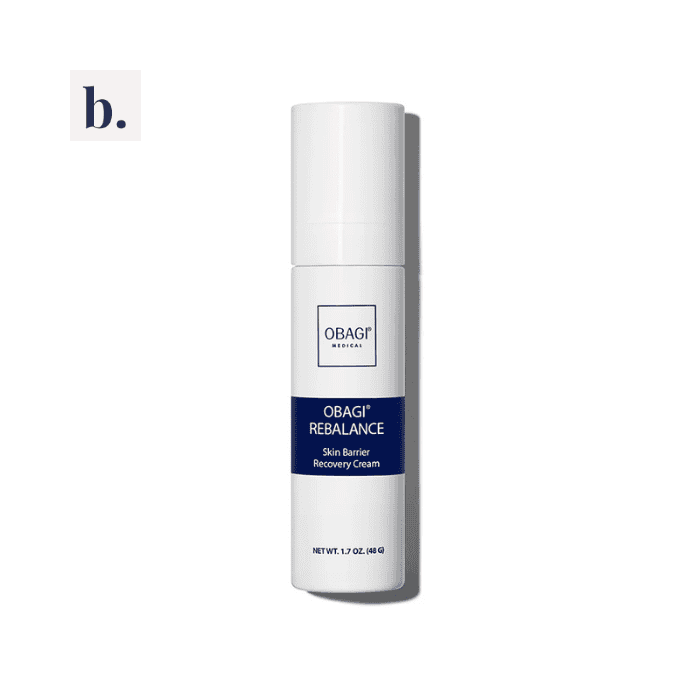
Obagi® Rebalance Skin Barrier Recovery Cream Review
BeautyBrief™
Brand
Obagi
Product
Rebalance Skin Barrier Recovery Cream
Claims check
You get a credible barrier-lipid moisturizer with product-specific hydration data, while its broader microbiome claims lack detailed public measurement methods.
Shopper fit
- Dry
- Normal
- Combination
- Oily
- Sensitive
- Acne-Prone
Formula flags
- None identified
Shopper preferences
- Dermatologist-Tested
Key ingredients
| Ceramide NP | Provides an individual barrier-associated ceramide alongside other ceramides and cholesterol. |
|---|---|
| Cholesterol | Adds another major stratum-corneum lipid alongside the ceramide system and strengthens the barrier-focused formulation rationale. |
| Niacinamide | Adds supporting barrier, conditioning, and tone-evening value within the moisturizer. |
| Squalane | Adds lightweight emollience that helps reduce a dry, tight after-feel. |
| Glycerin | Provides core humectant support and complements the lipid-focused barrier system. |
Price tier
$$$ Premium
Value check
At the Premium tier, you get three ceramides, other lipids and product-specific comfort testing, while simpler creams also support everyday hydration.
Where to buy
We may earn a commission through these links at no additional cost to you. This does not affect our BeautyBrief.
Bottom line
If your skin needs substantial moisture and comfort, Obagi Rebalance offers a thoughtful barrier-lipid system supported by brand-reported testing. Its eczema-focused acceptance adds shopping context, but neither the seal nor the ingredient list proves eczema treatment or a specific microbiome change.
If your skin is dry, uncomfortable or recovering from an irritating routine, Obagi® Rebalance Skin Barrier Recovery Cream uses glycerin, squalane, niacinamide, three ceramides and cholesterol for a moisture-focused formula. Obagi also reports product-specific hydration and post-procedure comfort testing.[1]
The stronger evidence supports moisture and comfort. The brand’s microbiome-rebalancing language goes further than the publicly disclosed measurements, so you should not treat the cream as a demonstrated microbiome therapy.
What it claims
Obagi says BarrierPlex™ Technology helps restore hydration, soothe compromised skin, and rebalance and maintain a healthy skin microbiome with continued use.[1] The brand reports that all participants in a 2022 bio-instrumentation study improved skin hydration after first use, while a separate four-week subject-blind post-procedure study found high levels of perceived gentleness and moisturization at day 14.[1]
Claims vs. formula
The barrier-support architecture is stronger than a simple ceramide marketing story. Ceramides NP, AP, and EOP appear alongside cholesterol, phytosphingosine, rapeseed sterols, hydrogenated lecithin, squalane, niacinamide, glycerin, and other emollient and humectant components.[1] Ceramides and cholesterol are major components of the stratum-corneum lipid matrix, and appropriately formulated ceramide systems are used to support water retention and impaired barrier function.[2]
The finished-product evidence strengthens the hydration case because Obagi reports bio-instrumentation rather than relying only on ingredient theory. The public page does not disclose the full study protocol, sample size, comparator, or microbiome-measurement methods, so BB treats the hydration and comfort claims as better established than the broader microbiome-rebalancing claim.
Ingredients that matter
The most useful combination is glycerin for water binding, squalane for softening and Ceramide NP with Ceramide AP, Ceramide EOP and cholesterol as barrier-associated lipids. Niacinamide and bisabolol add conditioning support within the same cream.
Lactobacillus ferment and microalgae add to the formula’s BarrierPlex story but cannot establish a particular healthy microbiome balance. If you are choosing it for reactive skin, the more meaningful evidence is hydration and post-procedure comfort rather than a guaranteed microbiome change.

Cholesterol
Cholesterol is a well-established skin-barrier lipid and emollient used mainly in moisturizers. Its value comes from the complete physiological-lipid formula rather than the presence of cholesterol alone.
Read the IngredientBrief
Niacinamide
If your skin feels dry or uncomfortable, niacinamide can support hydration and reduce water loss in a well-formulated product. It also has evidence for uneven tone and visible oiliness, but…
Read the IngredientBrief
Squalane
If your skin feels dry or rough, squalane can make it feel softer and smoother. You don't need a separate oil when your moisturizer already keeps your skin comfortable.
Read the IngredientBrief
Glycerin
If your skin feels dry or tight, glycerin helps your skin hold moisture. You don't need a high percentage or a separate serum when your moisturizer already works well.
Read the IngredientBriefWhat to expect in the short term
You can expect substantial moisture and a comfort-focused cream finish rather than a dense balm. Obagi directs two to four pumps morning and evening or as needed, with sunscreen afterward in the morning.[1] The exact product is also labeled Dermatologist Tested on the current U.S. product page.[1]
What to expect over time
With continued use, you can look for consistent hydration and comfort, especially when your skin feels dry after retinoids or other treatments. Obagi also holds a current National Eczema Association Seal of Acceptance for this exact product, which supports its use-case positioning for eczema-prone and sensitive skin without turning the seal into proof of every marketing claim.[3]
Who it fits
Dry, normal, combination, oily, sensitive, and acne-prone skin can reasonably use this moisturizer when barrier support is the priority. The current Obagi page specifically positions it for dehydrated, sensitive, and acne/blemish-prone skin and lists normal-to-oily, normal-to-dry, and combination skin types.[1] After ablative procedures, the brand directs users to follow their doctor’s instructions.
Compare before you buy
At the Premium tier, Rebalance makes a stronger value case than a basic moisturizer because it combines a broad barrier-lipid system, product-specific hydration data, post-procedure perception testing, dermatologist-tested labeling, and current National Eczema Association acceptance. Shoppers who only need uncomplicated daily moisturization can still meet that need with simpler lower-tier formulas.

RoC Barrier Renew® PM Moisturizer For a more accessible option focused on daily moisture and barrier maintenance, compare RoC Barrier Renew PM Moisturizer at the Budget tier. Its ceramide-and-emollient system is a different proposition from Obagi’s ceramide-cholesterol formula and product-specific testing. The BB moisturizer-formula guide explains how to weigh that evidence against texture, routine fit, and value.
Read the BeautyBriefFinal Assessment
Obagi Rebalance Skin Barrier Recovery Cream is a well-built barrier moisturizer with a comprehensive lipid system and product-specific evidence supporting hydration and comfort. The microbiome claim is less fully documented than the barrier story, but the core formula, testing, and eczema-focused acceptance give the Premium positioning a clearer rationale than prestige alone.
Compare Prices
Choose a retailer to view current pricing and availability.
We may earn a commission through these links at no additional cost to you.
Last reviewed: October 2026
Sources
Obagi Medical. Obagi® Rebalance Skin Barrier Recovery Cream. Current official U.S. product page. Accessed October 15, 2026.
Schild J, Kalvodová A, Zbytovská J, Farwick M, Pyko C. The role of ceramides in skin barrier function and the importance of their correct formulation for skincare applications. International Journal of Cosmetic Science. 2024.
The review describes ceramides, cholesterol, and free fatty acids as central components of the stratum-corneum lipid matrix and emphasizes that formulation quality matters for barrier-support performance. It does not test this Obagi finished product.
National Eczema Association. OBAGI® REBALANCE Skin Barrier Recovery Cream. Seal of Acceptance product directory. Accessed September 26, 2026.