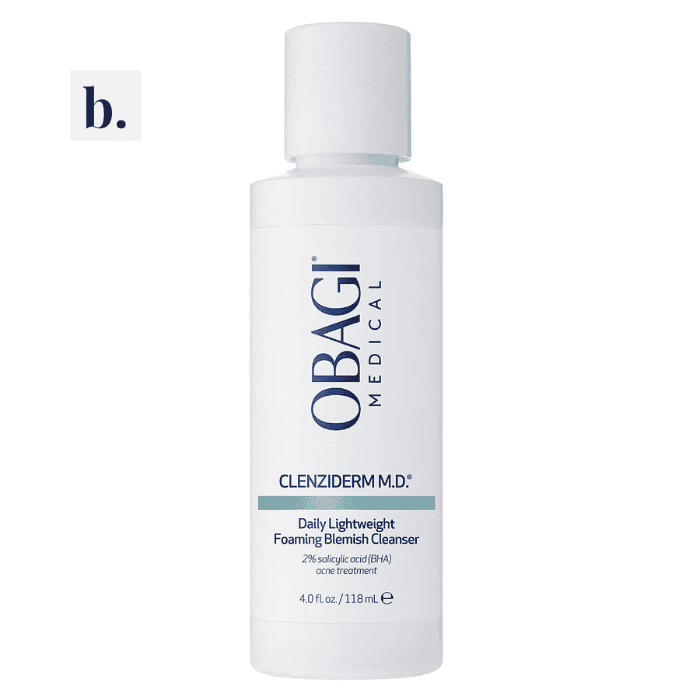
Obagi CLENZIderm M.D.® Daily Lightweight Foaming Blemish Cleanser Review
BeautyBrief™
Brand
Obagi
Product
CLENZIderm M.D.® Daily Lightweight Foaming Blemish Cleanser
Claims check
You get a recognized 2% salicylic-acid acne treatment in a strong foaming wash, but its menthol, fragrance and sulfates raise tolerability concerns.
Shopper fit
- Normal
- Combination
- Oily
- Acne-Prone
Formula flags
- Fragrance
- Exfoliating acids
- Sulfates
- Added color
- Menthol
Shopper preferences
- Dermatologist-Tested
Key ingredients
| Salicylic Acid | At 2%, serves as the OTC acne-treatment active and supports comedone and clogged-pore reduction. |
|---|---|
| Glycerin | Adds humectant support within an otherwise strongly cleansing formula. |
| Cocamidopropyl Betaine | Supports the foaming surfactant system and moderates the cleansing base. |
| Menthol | Creates the cooling sensory effect but does not add acne-treatment efficacy. |
| Chamomilla Recutita (Matricaria) Flower Extract | Adds botanical conditioning support in a rinse-off acne wash without removing its dryness risks. |
Price tier
$$$ Premium
Value check
At the Premium tier, you get a medicated foaming cleanser, while other 2% salicylic-acid washes provide the same active strength for less.
Where to buy
We may earn a commission through these links at no additional cost to you. This does not affect our BeautyBrief.
Bottom line
If your oily or acne-prone skin tolerates high-foam cleansing, this wash offers a legitimate 2% salicylic-acid acne-treatment step. Menthol, fragrance, sulfates and a dryness warning limit its fit for reactive skin, and the Premium price does not buy a higher active strength.
If your oily or acne-prone skin needs a medicated rinse-off step, Obagi CLENZIderm M.D.® Daily Lightweight Foaming Blemish Cleanser uses 2% salicylic acid in a strongly foaming surfactant base. Glycerin and chamomile add limited conditioning support, while fragrance, menthol, sodium laureth sulfate, sodium lauryl sulfate, and added color make tolerability the main tradeoff.[1]
The 2% salicylic acid is a recognized U.S. OTC acne-drug active, so this wash has a real treatment role. Because you rinse it off and its base is strongly cleansing, choose it for acne-prone skin that tolerates an active foaming wash rather than expecting leave-on treatment strength.
What it claims
Obagi says the cleanser helps unclog pores, wash away dead skin and impurities, reduce surface sebum, and support clearer-looking skin. The current U.S. page identifies salicylic acid 2% as the active ingredient, describes the product for normal-to-oily and combination skin, and labels the exact product Dermatologist Tested.[1]
Claims vs. formula
The acne and clogged-pore positioning has a direct regulatory and formula basis. FDA’s OTC acne monograph recognizes salicylic acid at 0.5% to 2% as an acne active, so the 2% level here sits at the top of the permitted range.[2]
Clinical evidence supports 2% salicylic acid in rinse-off acne care. In a 30-person four-week crossover study, a salicylic acid cleanser reduced comedones; that study tested another formula, not this Obagi wash.[3] Those studies support the cleanser format and concentration but do not prove this Obagi formula’s exact effect size.
The complete formula is not mild. Sodium laureth sulfate and sodium lauryl sulfate create strong cleansing and degreasing, cocamidopropyl betaine supports the foam system, and menthol plus menthyl lactate create the cooling after-feel. Obagi itself instructs shoppers to reduce frequency if dryness or peeling becomes excessive.[1]
Ingredients that matter
The clinically relevant ingredient is salicylic acid at the declared 2% drug-active strength. Its acne-treatment role is distinct from the foam created by sodium laureth sulfate, sodium lauryl sulfate and cocamidopropyl betaine. The active has a legitimate role in treating blackheads, whiteheads and pimples; the surfactants primarily wash away oil and debris.
Glycerin and chamomile provide limited conditioning support, while menthol and menthyl lactate create a cooling effect. Those ingredients cannot remove the possibility of dryness from the acid and cleansing base, so you should monitor tightness, peeling and irritation rather than assuming cooling means gentleness.

Salicylic Acid
If blackheads or mild breakouts are your concern, salicylic acid can help unclog pores. Choose one cleanser or leave-on treatment your skin tolerates; 2% isn't automatically better.
Read the IngredientBrief
Glycerin
If your skin feels dry or tight, glycerin helps your skin hold moisture. You don't need a high percentage or a separate serum when your moisturizer already works well.
Read the IngredientBrief
Cocamidopropyl Betaine
Cocamidopropyl Betaine is an established cleansing surfactant and foam booster. Irritation and contact allergy depend on the formula and may involve manufacturing impurities such as amidoamine or DMAPA.
Read the IngredientBriefSafety and regulatory context
Because this is an OTC acne drug, the 2% salicylic-acid active matters more than marketing language. FDA’s current monograph recognizes salicylic acid from 0.5% to 2% for topical acne products.[2]
Obagi directs users to begin once daily, increase gradually to two or three times daily if needed and tolerated, and reduce use to once daily or every other day if dryness or peeling becomes excessive. The brand also advises sunscreen and notes that peeling, dryness, or redness can occur if the treatment is used too aggressively.[1]
What to expect in the short term
You can expect substantial foam, oil removal and a pronounced cooling sensation. Compared with a bland non-medicated cleanser, tightness, dryness, or peeling is more plausible, especially if the rest of the routine already includes benzoyl peroxide, retinoids, exfoliating acids, or other drying acne treatments.
What to expect over time
With consistent use and good tolerance, this 2% salicylic-acid wash can support your acne routine by targeting comedones and clogged pores. It should not be treated as equivalent to a leave-on acne treatment when breakouts require stronger or more persistent therapy.
A 10-week randomized study in 139 participants tested a three-step regimen with a 2% salicylic-acid cleanser, 2% salicylic-acid toner and 5% benzoyl-peroxide gel, compared with a clindamycin/benzoyl-peroxide regimen.[4] Because the cleanser was one part of a multi-step regimen, that trial cannot isolate the cleanser’s independent contribution.
Who it fits
If your skin is normal-to-oily, combination or acne-prone and you tolerate active foaming cleansers, this is a practical format for a 2% salicylic-acid step. Dry, sensitive, or already treatment-irritated skin has more reason to choose a gentler cleanser or use a medicated wash less frequently.
Obagi labels the exact product dermatologist-tested, which is useful shopping information but does not guarantee skin tolerance.[1]
Compare before you buy
At the Premium tier, you are paying more for a 2% salicylic-acid cleanser even though other washes use the same permitted drug-active strength. The strongest case is for shoppers already committed to the CLENZIderm regimen or who specifically prefer this high-foam, cooling format; the active strength itself is not unusual enough to justify the tier on its own.
Final Assessment
If your oily or acne-prone skin responds well to active foaming washes, Obagi CLENZIderm M.D.® Daily Lightweight Foaming Blemish Cleanser offers a legitimate 2% salicylic-acid acne-treatment step. The acne, clogged-pore, and oil-control role is legitimate, while sulfates, fragrance, added color, menthol, and the brand’s own dryness warning make tolerability the main limitation. At the Premium tier, your strongest reason to choose it is compatibility with your routine and tolerance of its cooling, high-foam formula rather than an unusually potent acne active.
Compare Prices
Choose a retailer to view current pricing and availability.
We may earn a commission through these links at no additional cost to you.
Last reviewed: October 2026
Sources
Obagi Medical. CLENZIderm M.D.® Daily Lightweight Foaming Blemish Cleanser. Current official U.S. product page. Accessed October 15, 2026.
U.S. Food and Drug Administration. OTC Monograph M006: Topical Acne Drug Products for OTC Human Use. Current monograph.
Shalita AR. Comparison of a salicylic acid cleanser and a benzoyl peroxide wash in the treatment of acne vulgaris. Clinical Therapeutics. 1989;11(2):264-267. PMID: 2525420.
This 30-person crossover study supports the general acne and comedone-reduction potential of a 2% salicylic-acid cleanser. It did not test this exact Obagi finished product.
Thiboutot D, Eichenfield L, Shalita A, et al. A 3-step acne system containing solubilized benzoyl peroxide versus clindamycin-benzoyl peroxide. Cutis. 2009;84(1):48–55. PMID: 19743725.
This randomized study tested a three-step acne regimen rather than this cleanser on its own; its results do not isolate what the cleanser contributed.