

Does Microbiome Skincare Actually Help Acne?
At a glance
Microbiome-focused acne products use several different technologies, from prebiotics and postbiotics to live probiotics, bacteriophages, and selective antimicrobials. They do not work the same way, and the label alone does not tell you whether the finished product improves acne.
“Microbiome balancing” is becoming a bigger acne claim, but it can describe very different things.
One product may contain a prebiotic such as inulin. Another may contain inactivated microbial material. A true probiotic has to deliver live microorganisms. Bacteriophages are viruses that infect selected bacteria. Precision antimicrobials can use targeted enzymes to attack specific microbes.
Those technologies do not share one evidence base.
That distinction matters because acne is not simply a problem of having too much Cutibacterium acnes. C. acnes also lives on healthy skin, and research increasingly points to differences in strain balance, microbial interactions, sebum, follicular plugging, and inflammation rather than a simple “good bacteria versus bad bacteria” model.[1]
For you, the useful question is not whether a product says it supports the microbiome. It is what the technology actually does, whether it still works in the finished formula, and whether human testing shows a meaningful acne benefit.
In this Briefing
Why does the acne microbiome matter?
C. acnes is a normal member of the skin microbiome. The important change in acne appears to involve the composition of the microbial community and the balance of C. acnes strains, not simply whether the species is present.
A 2026 human study used droplet digital PCR to compare C. acnes phylotypes in 14 people with acne and 14 people with healthy skin. Healthy skin contained nearly equal amounts of phylotype IA and phylotypes IB/II, while acne samples showed a 111-fold predominance of IA over IB/II, driven largely by depletion of IB/II rather than a simple increase in IA.[2]
That does not mean every shopper needs to “increase diversity” or eliminate one bacterial group. It does show why blanket claims such as “kills acne bacteria” and “balances the microbiome” can oversimplify what is happening.
The acne process also involves excess sebum, abnormal follicular keratinization, and inflammation. A microbiome-targeted technology may address one part of that process without replacing ingredients that work through other mechanisms.
What are the five main microbiome approaches?
| Approach | What is delivered? | What has to remain functional? | Human acne evidence | What to look for |
|---|---|---|---|---|
| Prebiotic | A substrate intended to be selectively used by host microorganisms. | The substrate and its intended microbiome effect. | Limited and heterogeneous. | Evidence that the exact substrate changes the microbiome in a beneficial way and improves an acne outcome. |
| Postbiotic | Inactivated microorganisms and/or their components with a demonstrated health benefit. | The relevant inactivated material and its biological activity. | Limited but growing. | Characterization of the material plus human evidence for the claimed benefit. |
| Live probiotic | Live microorganisms delivered in an adequate amount with a demonstrated benefit. | Strain identity and viability through the point of use. | The largest evidence base of the three “biotic” categories, but still mixed. | Strain-specific stability, dose, and human testing of the same strain or strain combination. |
| Bacteriophage | Viruses selected to infect particular bacteria. | Phage infectivity and activity against the intended bacterial target. | Early topical human evidence for target engagement; acne-lesion evidence remains limited. | Controlled trials showing meaningful acne improvement, not only lower bacterial counts. |
| Selective antimicrobial | A targeted molecule such as an enzyme designed to kill or inhibit selected microbes. | The molecule’s activity and target specificity in the finished formula. | Early product and company-led evidence for some technologies. | Independent or well-controlled human testing showing what the technology adds beyond established acne actives. |
Do prebiotics help acne?
Possibly, but the term is used more loosely in skincare marketing than it is in microbiome science.
The International Scientific Association for Probiotics and Prebiotics defines a prebiotic as a substrate that is selectively utilized by host microorganisms and confers a health benefit.[3]
That is a higher bar than simply adding inulin, a sugar, or another fermentable material to a formula and calling it microbiome-friendly.
PCA SKIN’s Acne Control Prebiotic Gel Cleanser illustrates the interpretation problem. The product contains inulin as part of its Triple Biotic Technology, but it also contains 2% salicylic acid, 1% azelaic acid, 1% niacinamide, and butyloctanol.[4]
If a formula like that improves acne, the improvement cannot automatically be assigned to the prebiotic component. The finished product contains several ingredients with separate acne-relevant or supportive roles.
What this means for you: A prebiotic can be a reasonable supporting feature, but the word alone does not establish better acne control. Look for evidence showing what that specific prebiotic system adds to the complete formula.
Do postbiotics help acne?
Postbiotics are easier to formulate than live probiotics because they are intentionally non-living. That does not make their performance easier to prove.
The scientific consensus definition describes a postbiotic as a preparation of inanimate microorganisms and/or their components that confers a health benefit. Purified microbial metabolites alone do not automatically meet that definition.[5]
This distinction matters because skincare labels may use words such as ferment, lysate, metabolite, and postbiotic as though they are interchangeable.
A 2026 systematic review examined 33 clinical studies involving 2,112 people with acne. Lesion counts declined within treatment groups, but pooled results did not show statistically significant differences between microbiome interventions and controls. The studies also varied substantially in intervention type, route, formula, and design. This supports further study of these approaches as possible adjuncts, not proven replacements for standard acne care.[6]
What this means for you: “Postbiotic” is not a performance guarantee. The useful evidence is tied to the exact material and finished product, not the category name.
Do live probiotics help acne?
Live probiotics are the most studied of the three “biotic” categories in this guide, but the results are not consistent enough to treat them as an established replacement for standard acne treatment.
A true probiotic must contain live microorganisms that confer a health benefit when administered in adequate amounts. That means strain identity and viability matter.[7]
This is an important label check. A ferment or lysate does not become a probiotic simply because it began with bacteria.
Eucerin’s PROBIOM8 platform is a useful example because the brand explicitly says its TopiC.A technology delivers two live skin-native bacterial strains, CA-31 and CA-81, and up to 50 million live bacteria per drop.[8]
That makes it a more specific probiotic claim than a formula that simply uses probiotic-adjacent language. It still does not prove that all topical probiotic products work, or that the complete PROBIOM8 routine outperforms established acne therapies.
The broader evidence is mixed. A 2026 systematic review and meta-analysis of 13 probiotic clinical studies involving 1,453 participants found no significant reduction versus controls in total, inflammatory, or non-inflammatory lesion counts. Oral probiotic subgroups did improve one acne-severity score, but the studies were heterogeneous.[9]
What this means for you: “Contains probiotics” is not enough. Ask which strains are present, whether they are still viable when you use the product, and whether the same strains and finished formula were tested in people with acne.
Do bacteriophages help acne?
Bacteriophages are viruses that infect bacteria. Their appeal in acne is precision: a phage can be selected to attack particular C. acnes strains rather than broadly suppressing multiple bacterial species.
A randomized, double-blind, vehicle-controlled cosmetic study evaluated a three-phage cocktail called BX001 in 75 people with mild-to-moderate acne. The high-dose gel reduced facial Cutibacterium burden compared with vehicle and was well tolerated.[10]
That is meaningful evidence that the technology reached and affected its microbial target.
It is not the same as proving that a phage gel clears acne better than an established acne treatment. The study primarily evaluated safety, tolerability, and bacterial targeting rather than a head-to-head comparison of lesion clearance.
What this means for you: Target engagement is an important step, but look for fewer inflammatory and non-inflammatory lesions, better tolerability, or another meaningful clinical outcome before treating phage technology as a better acne purchase.
What about selective antimicrobials and precision enzymes?
Another emerging approach uses targeted antimicrobial molecules rather than live microbes or phages.
Hypothesis uses CUT-02, a patented lysin enzyme designed to target C. acnes. The brand reports that CUT-02 eliminated 99.9% of C. acnes within one hour in laboratory testing without a measurable effect on selected non-target bacteria. Its Acne Precision Serum combines CUT-02 with 0.5% salicylic acid, and the brand reports an eight-week clinical study in 19 adults.[11]
Those findings make CUT-02 an interesting technology. They do not establish that it is more effective, less irritating, or better for the microbiome than benzoyl peroxide, topical retinoids, or other established acne treatments.
Each of those is a separate claim requiring its own evidence.
The same formula also contains salicylic acid, so finished-product improvement cannot automatically be attributed to CUT-02 alone.
What this means for you: “Precision” describes the intended targeting strategy. It does not by itself prove a better clinical result.
What does the overall acne evidence show?
Microbiome-directed acne care has enough human evidence to be taken seriously as an emerging category. It does not yet have enough consistent evidence to replace the better-established acne options as a group.
The American Academy of Dermatology’s current acne guideline strongly recommends benzoyl peroxide and topical retinoids. It conditionally recommends salicylic acid and azelaic acid and recommends combining topical therapies with different mechanisms when appropriate.[12]
That gives you a useful benchmark.
A microbiome product does not need to outperform every established acne treatment to be useful. It can earn a place if it improves tolerability, adds a different mechanism, helps a specific type of acne, or produces a meaningful benefit that the rest of the routine is not providing.
But the more a brand implies that microbiome technology is a replacement for proven acne therapy, the stronger the finished-product evidence needs to be.
How should you evaluate a microbiome acne product?
- Identify the actual technology. Is it a prebiotic substrate, a postbiotic preparation, live bacteria, a bacteriophage, or a selective antimicrobial? “Microbiome” is not an ingredient.
- Check whether the technology can still function in the finished formula. Live probiotics need viability. Phages need infectivity. Enzymes need retained activity.
- Look for testing on the product you can actually buy. Laboratory or supplier evidence is useful for mechanism, but it cannot automatically establish finished-product performance.
- Check the outcome that was measured. Lower bacterial counts or changes in microbiome composition are not the same as fewer pimples.
- Separate the microbiome component from established acne actives. If the formula also contains salicylic acid, azelaic acid, benzoyl peroxide, or a retinoid, ask whether the study isolates what the microbiome technology adds.
- Compare tolerability as well as efficacy. A product that controls acne with less irritation can have real value even if its mechanism is not revolutionary.
- Do not assume more microbiome claims mean a better formula. A “prebiotic + postbiotic + probiotic” story is not stronger evidence unless the components are characterized and the complete product is tested.
Does “microbiome balancing” mean anything by itself?
Not enough to guide a purchase.
There is no single microbiome composition your skin needs to reach. Healthy skin contains C. acnes, and acne involves more than bacteria alone.
A claim that a product “balances,” “resets,” “restores,” or “protects” the microbiome needs two things before it becomes useful to you: a defined way of measuring that change and a meaningful human outcome connected to it.
More microbial diversity is not automatically better. Less C. acnes is not automatically better. A shift in one bacterial measurement is not automatically acne treatment.
The outcome that matters is whether the intervention improves the skin problem you are trying to solve.
When should acne be treated as more than a skincare-shopping problem?
If acne is painful, cystic, scarring, widespread, or not improving with a reasonable over-the-counter routine, a dermatologist can offer prescription options and help prevent long-term scarring.
That matters especially when a microbiome product is being marketed as a gentler alternative to medical acne care. Gentler can be useful. It should not delay more effective treatment when acne is leaving scars or causing significant symptoms.
The BB Perspective
Microbiome acne skincare is becoming scientifically more interesting at the same time its marketing language is becoming less precise.
Prebiotics, postbiotics, live probiotics, bacteriophages, and selective antimicrobials are different technologies. They should not share one evidence halo.
If you’re considering a microbiome acne product, don’t pay for “microbiome balance” as an idea. Look for the exact technology, proof that it remains functional in the finished formula, and human evidence showing what it adds beyond established acne ingredients and treatments.
Last reviewed: September 2026
Sources
Dréno B, Dagnelie MA, Khammari A, Corvec S. The Skin Microbiome: A New Actor in Inflammatory Acne. American Journal of Clinical Dermatology. 2020;21(Suppl 1):18-24. doi:10.1007/s40257-020-00531-1.
This review describes the shift from viewing acne as simple C. acnes overgrowth toward strain-level imbalance, microbial interactions, and inflammation. It provides biological context rather than evidence for a specific consumer product. Return to citation.
Feidenhansl C, Rruci E, Knödlseder N, Lomholt HB, Brüggemann H. Differential Quantification of Cutibacterium acnes Phylotypes IA and IB/II on Healthy and Acne-Prone Human Skin. Experimental Dermatology. 2026;35(8):e70347. doi:10.1111/exd.70347. PMID: 42603144.
This human study compared skin swabs from 14 healthy participants and 14 people with acne and found a major difference in C. acnes phylotype balance. It supports a dysbiosis model but does not establish a treatment or prove that deliberately changing the measured ratio improves acne. Return to citation.
Gibson GR, Hutkins R, Sanders ME, et al. The International Scientific Association for Probiotics and Prebiotics consensus statement on the definition and scope of prebiotics. Nature Reviews Gastroenterology & Hepatology. 2017;14(8):491-502. doi:10.1038/nrgastro.2017.75.
This expert consensus defines a prebiotic as a substrate selectively utilized by host microorganisms that confers a health benefit. It supports terminology and evidence standards rather than acne efficacy. Return to citation.
PCA SKIN. Acne Control Prebiotic Gel Cleanser. Accessed September 2026.
The official U.S. product page documents 2% salicylic acid, 1% azelaic acid, 1% niacinamide, inulin, butyloctanol, and the brand’s Triple Biotic Technology claims. It is used here as a representative finished-product example, not independent efficacy evidence. Return to citation.
Salminen S, Collado MC, Endo A, et al. The International Scientific Association of Probiotics and Prebiotics consensus statement on the definition and scope of postbiotics. Nature Reviews Gastroenterology & Hepatology. 2021;18(9):649-667. doi:10.1038/s41575-021-00440-6.
This expert consensus defines postbiotics and distinguishes them from live probiotics and purified microbial metabolites. It addresses terminology and evidence requirements rather than acne efficacy. Return to citation.
Warp PV, Bilik SM, Ferrari LM, Keri JE. Prebiotics, Probiotics, and Postbiotics for Acne Vulgaris: A Systematic Review. Dermatology and Therapy. 2026;16(3):1531-1550. doi:10.1007/s13555-026-01659-4. PMID: 41703218.
This systematic review included 33 clinical studies and 2,112 patients. It found encouraging results across prebiotic, probiotic, and postbiotic interventions but substantial heterogeneity and a need for larger standardized trials. The authors reported no conflicts of interest. Return to citation.
Hill C, Guarner F, Reid G, et al. The International Scientific Association for Probiotics and Prebiotics consensus statement on the scope and appropriate use of the term probiotic. Nature Reviews Gastroenterology & Hepatology. 2014;11(8):506-514. doi:10.1038/nrgastro.2014.66.
This expert consensus establishes that probiotics are live microorganisms and that evidence should be tied to the specific strain and intended benefit. It is used here for terminology rather than acne efficacy. Return to citation.
Eucerin. The Science Behind PROBIOM8. Accessed September 2026.
The brand’s technical page describes CA-31 and CA-81 as live skin-native bacterial strains and states that its TopiC.A technology delivers up to 50 million live bacteria per drop. These are manufacturer-provided claims and should not be generalized to topical probiotics as a class. Return to citation.
Julanon N, Unhapipatpong C, Wongjirattikarn R, et al. Role of Probiotics in Managing Acne Vulgaris: A Systematic Review and Meta-Analysis of Clinical Trials. Journal of Cutaneous Medicine and Surgery. 2026. doi:10.1177/12034754261445880. PMID: 42153538.
This meta-analysis included 13 studies with 1,453 participants. Probiotics did not significantly reduce total, inflammatory, or non-inflammatory lesion counts versus controls, although oral probiotic subgroups improved one acne-severity score. Heterogeneity limits broad conclusions. Return to citation.
Golembo M, Puttagunta S, Rappo U, et al. Development of a topical bacteriophage gel targeting Cutibacterium acnes for acne prone skin and results of a phase 1 cosmetic randomized clinical trial. Skin Health and Disease. 2022;2(2):e93. doi:10.1002/ski2.93. PMID: 35677920.
This randomized, vehicle-controlled cosmetic study evaluated a three-phage cocktail in 75 participants and demonstrated tolerability and reduced facial C. acnes burden at the high dose. The study was sponsored by BiomX; most authors were current or former company employees and may have owned stock. It primarily establishes bacterial target engagement rather than comparative acne-treatment efficacy. Return to citation.
Hypothesis. CUT-02 Precision Enzyme FAQ and Acne Precision Serum. Accessed September 2026.
The brand describes CUT-02 as a patented lysin targeting C. acnes, reports 99.9% reduction in laboratory testing, and reports an eight-week finished-product study in 19 adults. These are company-provided data. The serum also contains 0.5% salicylic acid, so product-level improvement does not isolate the effect of CUT-02. Return to citation.
Reynolds RV, Yeung H, Cheng CE, et al. Guidelines of care for the management of acne vulgaris. Journal of the American Academy of Dermatology. 2024;90(5):1006.e1-1006.e30. doi:10.1016/j.jaad.2023.12.017. PMID: 38300170.
The American Academy of Dermatology guideline strongly recommends benzoyl peroxide and topical retinoids and conditionally recommends salicylic acid and azelaic acid. It provides the evidence-based benchmark for claims that newer microbiome technologies replace or outperform established acne treatments. Return to citation.
Related product BeautyBriefs
These BeautyBriefs cover products relevant to the needs discussed in this Beauty Briefing. Inclusion here reflects topic relevance, not a rating or endorsement.
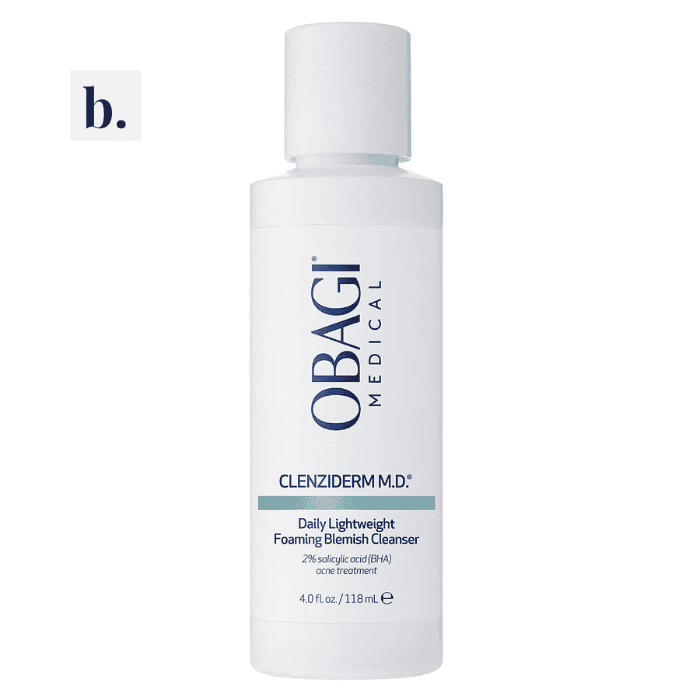
Obagi
Obagi CLENZIderm M.D.® Daily Lightweight Foaming Blemish Cleanser
If your oily or acne-prone skin tolerates high-foam cleansing, this wash offers a legitimate 2% salicylic-acid acne-treatment step. Menthol, fragrance, sulfates and a dryness warning limit its fit for reactive skin, and…
Read the BeautyBrief
PCA SKIN
PCA SKIN Facial Wash Oily/Problem
If your skin is oily, combination or breakout-prone, this cleanser combines daily oil removal with some rinse-off exfoliation. Its short contact time and undisclosed acid percentages limit acne-treatment expectations, so choose it…
Read the BeautyBrief
Peach Slices
Peach Slices Acne Oil-Free Moisturizer
If you want a gentle-leaning acne active with daily moisture, this offers useful Budget convenience. If you already use acids or need a higher-strength dedicated treatment, compare your full routine first.
Read the BeautyBrief
Murad
Murad Acne Control Clarifying Cleanser
If your oily or acne-prone skin needs a medicated wash, Murad offers 1.5% salicylic acid with strong foaming cleansing. Fragrance, menthol and overlap with other acne treatments complicate your fit, while the…
Read the BeautyBrief
Amazon Basics
Amazon Basics Acne Treatment Face Wash
If your oily or acne-prone skin already tolerates 10% benzoyl peroxide, Amazon Basics gives you a Budget medicated wash. Fragrance, menthol and the label's irritation warnings make a gentler formula a better…
Read the BeautyBrief
Proactiv
Proactiv Solution Renewing Cleanser
If you want a medicated scrub, this cleanser combines acne treatment with physical exfoliation. Fragrance and the added polishing step matter if your skin is easily irritated. At the Premium tier, you…
Read the BeautyBrief