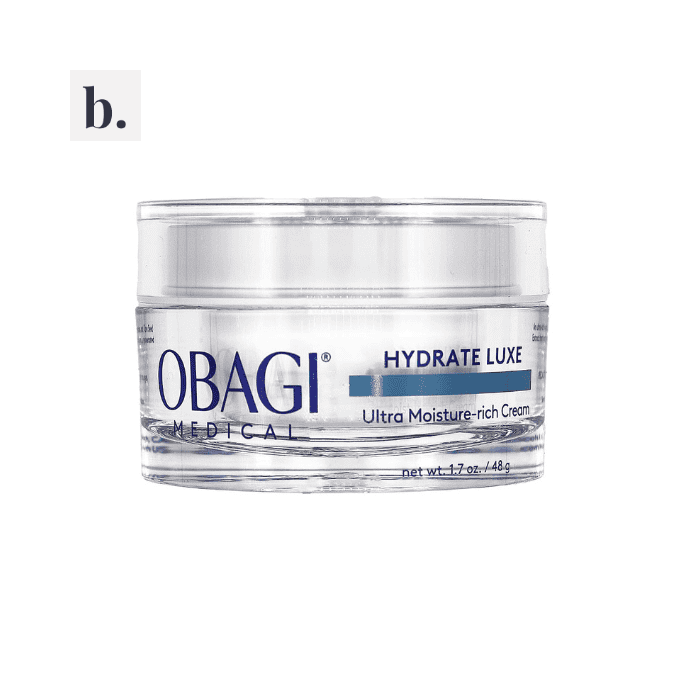
Obagi-C® Fx C-Therapy Night Cream Review
BeautyBrief™
Brand
Obagi
Product
Obagi-C® Fx C-Therapy Night Cream
Claims check
Prominent arbutin gives the formula a credible brightening rationale, while the current public evidence does not establish a distinct finished-product advantage and the leave-on sodium lauryl sulfate narrows fit for sensitive or barrier-impaired skin.
Shopper fit
- Dry
- Normal
- Combination
Formula flags
- Sulfates
- Silicones
Shopper preferences
- Dermatologist-Tested
Key ingredients
| Arbutin | The main targeted brightening ingredient and strongest part of the product's uneven-tone rationale. |
|---|---|
| Vitamin C | Adds antioxidant and brightening support, though the finished formula does not disclose concentration or stability data for a distinct treatment effect. |
| Glycerin | Provides core humectant support within the night-cream base. |
| Vitamin E | Adds supporting antioxidant and conditioning value as tocopheryl acetate. |
| Lactic Acid | Is present in the formula, but concentration and pH are not disclosed, so an exfoliating treatment effect should not be assumed. |
Price tier
$$$ Premium
Value check
At the Premium tier, the product offers a legitimate arbutin-led brightening strategy and rich moisturizer format, but current public evidence does not establish a finished-product advantage that clearly separates it from other discoloration-focused moisturizers.
Where to buy
We may earn a commission through these links at no additional cost to you. This does not affect our BeautyBrief.
Bottom line
This night cream has a credible brightening rationale led by arbutin, with vitamin C, vitamin E, and moisturization support around it. The leave-on sodium lauryl sulfate narrows sensitive-skin fit, and the current public evidence does not establish a distinctive finished-product advantage.
Obagi-C® Fx C-Therapy Night Cream is a rich brightening moisturizer built around glycerin, arbutin, tocopheryl acetate, ascorbic acid, lactic acid, and a silicone-containing cream base.[1]
The formula has a credible pigmentation-focused rationale, led most clearly by arbutin. The current public evidence does not establish how much this finished cream improves discoloration or how quickly, and the leave-on sodium lauryl sulfate makes the formula less appealing for sensitive or barrier-impaired skin.

What it claims
Obagi positions the night cream to moisturize while arbutin, vitamin C, and vitamin E help brighten and even skin tone overnight.[1]
Claims vs. formula
Arbutin appears prominently in the formula and has a credible depigmenting rationale through effects on melanin production. Reviews of topical arbutin describe clinical evidence for skin-lightening use while also emphasizing that formulation, delivery, concentration, and finished-product testing matter.[2]
Vitamin C and vitamin E add antioxidant context, while glycerin supports moisturization.[1] Lactic acid is present, but the official page does not disclose a concentration or pH that would establish it as a meaningful exfoliating treatment in this finished cream.
Sodium lauryl sulfate is also present in this leave-on formula. SLS is widely used in experimental models of irritant contact dermatitis because it can disrupt the skin barrier and increase irritation under relevant exposure conditions.[3] Its presence does not make the product universally unsuitable, but it is a meaningful fit consideration for sensitive or already-irritated skin.
Ingredients that matter
Arbutin: The main targeted brightening ingredient and the strongest part of the product’s uneven-tone rationale.[2]
Vitamin C: Adds antioxidant and brightening support, though the finished formula does not disclose the concentration or stability data needed to predict a distinct vitamin C treatment effect.
Glycerin: Provides core humectant support within the night-cream base.
Vitamin E: Adds supporting antioxidant and conditioning value as tocopheryl acetate.
Lactic Acid: Is present in the formula, but its concentration and pH are not disclosed, so an exfoliating treatment effect should not be assumed.

Alpha Arbutin
If dark marks are your concern, alpha arbutin has some evidence for uneven tone, mostly in combination formulas. You don't need a separate serum when your routine already addresses pigmentation.
Read the IngredientBrief
Vitamin C
If dullness or uneven tone is your concern, some topical vitamin C formulas can help. Look for stability and tolerability, not just a high percentage.
Read the IngredientBrief
Glycerin
If your skin feels dry or tight, glycerin helps your skin hold moisture. You don't need a high percentage or a separate serum when your moisturizer already works well.
Read the IngredientBrief
Vitamin E
Vitamin E is a family of antioxidant and conditioning ingredients used in moisturizers, oils, balms, and broader antioxidant systems. The exact form and finished formula matter more than the vitamin…
Read the IngredientBriefWhat to expect in the short term
Expect a rich moisturizing finish rather than an immediate visible correction of discoloration. Shoppers with sensitive, compromised, or already irritated skin should pay attention to stinging, dryness, or increased discomfort because this is a leave-on formula containing sodium lauryl sulfate.
What to expect over time
The arbutin-led formula gives the product a reasonable brightening strategy for uneven tone. The current official page does not provide finished-product clinical data establishing a specific fading timeline or a clear performance advantage over other modern brightening moisturizers.
Who it fits
Dry, normal, and combination skin focused on discoloration are the clearest fits when a richer night cream is wanted. Sensitive or barrier-impaired skin has less predictable fit because of the leave-on sodium lauryl sulfate, even though the exact product is dermatologist-tested.[1]
Compare before you buy
The formula combines a legitimate arbutin-led brightening strategy with moisturizing and antioxidant support, but it does not provide finished-product efficacy data that clearly separates it from other discoloration-focused moisturizers. At the Premium tier, the value depends on whether the shopper specifically wants this Obagi-C Fx formula and tolerates its older leave-on surfactant architecture.
Final Assessment
Obagi-C Fx C-Therapy Night Cream has a credible brightening rationale led by arbutin, with vitamin C, vitamin E, and moisturization support around it. Its main tradeoff is a leave-on sulfate formula without current public finished-product efficacy data, so the strongest case is for shoppers who want an arbutin-based night moisturizer and already know their skin tolerates the formula.
Where to buy
Choose a retailer to view current pricing and availability.
We may earn a commission through these links at no additional cost to you. This does not affect our BeautyBrief.
Last reviewed: October 2026
Sources
Obagi Medical. Obagi-C® Fx C-Therapy Night Cream. Current official U.S. product page. Accessed October 8, 2026.
Used to verify product identity, current formula, once-nightly directions, current claims, dermatologist-tested status, skin-type positioning, product status, and brand-direct Price Tier context.
Zhu W, Gao J. Arbutin as a Skin Depigmenting Agent with Antimelanogenic and Antioxidant Properties. Antioxidants. 2021;10(7):1129. doi:10.3390/antiox10071129.
The review summarizes mechanistic and clinical evidence for arbutin as a depigmenting ingredient while emphasizing formulation, delivery, efficacy, and safety considerations. It does not test this Obagi finished cream.
Lee CH, Maibach HI. The sodium lauryl sulfate model: an overview. Contact Dermatitis. 1995;33(1):1-7. doi:10.1111/j.1600-0536.1995.tb00438.x.
This review describes SLS as a standard experimental model for acute and cumulative skin irritation and barrier disruption. It supports irritation context for leave-on exposure but does not establish that every SLS-containing cosmetic will irritate every user.