
Bemotrizinol in Skincare
Bemotrizinol is a well-supported, photostable UVA/UVB sunscreen filter permitted under the U.S. OTC sunscreen monograph. The finished sunscreen's tested protection, wearability, and application matter more than one filter's percentage.
- Aliases
- Bis-Ethylhexyloxyphenol Methoxyphenyl Triazine, BEMT, Anisotriazine
- Ingredient category
- Sunscreen Filter
- Most relevant for
- Sun Protection
- Evidence strength
- Well Supported for Providing UVA and UVB filtration in properly formulated and tested sunscreen products
- Formula matters
- Concentration, the other UV filters, film formation, water resistance, base formula, and finished-product SPF and broad-spectrum testing determine real protection; the filter percentage alone does not rank sunscreens.
- Separate product needed?
- Usually No. You need a well-formulated sunscreen for sun protection, not a separate product simply because it contains bemotrizinol.
BB takeaway
Bemotrizinol is a credible broad-spectrum sunscreen filter, but shoppers should still buy the finished sunscreen rather than the ingredient story. Prioritize tested protection, wearability, and consistent use over filter percentage.
Ingredient evidence does not prove the performance of every finished product containing it.
What is bemotrizinol?
Bemotrizinol is an organic UV filter used in sunscreen. On an ingredient list, you may see Bis-Ethylhexyloxyphenol Methoxyphenyl Triazine, or the abbreviation BEMT.
It absorbs across both UVA and UVB wavelengths and is highly photostable, meaning it holds up well when exposed to sunlight.[1]
FDA added bemotrizinol to U.S. OTC sunscreen Monograph M020 in 2026 at concentrations up to 6%. The change took effect August 9, 2026.[2]
There is one current U.S. market wrinkle: federal law gives DSM Nutritional Products LLC and its licensees, assignees, or successors an 18-month exclusivity period tied to the 2026 order. So bemotrizinol is now part of the U.S. monograph, but not every sunscreen company can immediately market a bemotrizinol sunscreen under that change.[2]
What does bemotrizinol do for skin?
Bemotrizinol’s job is sun protection.
It helps a finished sunscreen absorb UVA and UVB radiation before that radiation can damage skin. In a properly formulated and tested product, it can contribute to protection against sunburn and broader UV-related skin damage.
Bemotrizinol can also help stabilize certain other sunscreen filters. Laboratory formulation work found that it reduced light-related breakdown of avobenzone and octinoxate in tested combinations.[1]
It does not repair existing sun damage, fade pigmentation by itself, or replace shade, protective clothing, and other sun-protection habits.
What the evidence says about bemotrizinol skincare
Bemotrizinol is well supported for its intended role as a UVA/UVB sunscreen active.
FDA reviewed efficacy, clinical pharmacology, safety, and nonclinical evidence before concluding that bemotrizinol up to 6% is generally recognized as safe and effective under the conditions described in Monograph M020 for adults and children 6 months and older.[2]
FDA’s review also found low overall skin absorption in the submitted clinical pharmacology data and no irritation, phototoxicity, or photoallergenicity in the dermal studies reviewed.[2]
That is meaningful evidence for the filter. It still does not tell you whether a particular sunscreen will pill, sting your eyes, look shiny, leave a cast, or feel pleasant enough to apply generously.
For your routine, the filter is credible. Choose the finished sunscreen for its tested protection and how comfortably you can wear it.
How bemotrizinol form and formulation affect results
Bemotrizinol is only one part of a sunscreen system.
Its concentration, the other UV filters, the base formula, film-forming ingredients, water resistance, and how evenly the product spreads all affect the final protection and wear experience.
A higher bemotrizinol percentage is not an SPF score. It does not automatically mean stronger UVA protection or a better sunscreen.
Regulatory limits also differ by market. The European Union permits Bis-Ethylhexyloxyphenol Methoxyphenyl Triazine at up to 10%, while the current U.S. OTC monograph permits bemotrizinol up to 6% under the applicable conditions.[3][2] That difference is a regulatory limit, not a simple quality ranking.
The base formula often matters more to daily use. Alcohol, oils, silicones, powders, fragrance, tint, and film formers can affect shine, dryness, pilling, white cast, eye comfort, and water resistance.
A sunscreen with an impressive filter list is still a poor purchase if you dislike it enough to apply too little.
Who may benefit from bemotrizinol skincare?
Bemotrizinol can suit anyone who finds a sunscreen containing it comfortable, dependable, and easy to apply generously.
It may be especially appealing if you prefer modern multi-filter sunscreens with broad UVA and UVB coverage and strong photostability.
But you do not need bemotrizinol specifically. If your current broad-spectrum sunscreen wears well, does not irritate you, and is easy to reapply, there is no reason to replace it solely to obtain this filter.
Bemotrizinol side effects and irritation risk
FDA found adequate safety evidence for bemotrizinol at concentrations up to 6% under the conditions in its 2026 final sunscreen order.[2]
That does not make every sunscreen containing it irritation-free. A finished formula can still sting the eyes, feel drying, trigger breakouts, or cause a rash because of fragrance, alcohol, preservatives, another UV filter, or the product base.
If your skin is reactive, patch-testing the finished sunscreen on a small area can help you assess tolerance before using it across your face.
Stop using a sunscreen that causes persistent burning, swelling, blistering, or an itchy spreading rash.
How to use bemotrizinol in your skincare routine
You do not use bemotrizinol by itself. Use a finished sunscreen containing it according to the product’s directions.
In a morning routine, sunscreen generally goes after moisturizer and before makeup.
Apply enough to cover exposed skin evenly and reapply while outdoors, especially after swimming, sweating, or towel drying. The American Academy of Dermatology recommends reapplying about every two hours when outdoors.[4]
Do not mix sunscreen with moisturizer or foundation in your hand. The sunscreen was tested as a finished formula, and mixing changes the layer you are relying on for protection.
How long does bemotrizinol take to work?
Bemotrizinol does not need weeks to build up in the skin.
It contributes to UV protection when the finished sunscreen is applied as directed and forms an even film. Follow the label for how long before sun exposure the product should be applied.
Protection drops when sunscreen is applied too thinly, rubbed away, or removed by water and sweat. Application and reapplication matter more than simply owning a sunscreen with a strong filter list.
What can you use with bemotrizinol?
A bemotrizinol sunscreen can generally be layered over common morning skincare such as moisturizer, niacinamide, vitamin C, and prescribed topical treatments.
There is no shopper-level rule requiring bemotrizinol to be separated from a particular skincare active.
If your sunscreen pills or slides, simplify the layers underneath rather than assuming the UV filter itself is incompatible with your skincare.
How to choose a bemotrizinol product
Start with the finished sunscreen, not the filter name.
Look for broad-spectrum protection and an SPF appropriate for how you will use the product. The American Academy of Dermatology recommends broad-spectrum, water-resistant SPF 30 or higher for outdoor use.[5]
Then judge the things that determine whether you will actually wear enough: texture, eye comfort, finish, white cast, makeup compatibility, and ease of reapplication.
Do not assume a sunscreen is automatically invisible, gentle, or superior in UVA protection simply because it contains bemotrizinol.
Do not chase the highest bemotrizinol percentage either. Protection is established on the finished sunscreen, not by comparing one filter percentage in isolation.
During the current U.S. exclusivity period, do not assume every imported or newly marketed bemotrizinol product is automatically compliant with U.S. OTC sunscreen requirements. Judge U.S.-market products by their Drug Facts labeling and lawful marketing status, not just by the ingredient list.[2]
Bemotrizinol alone does not justify Premium pricing. Pay more only if the complete sunscreen gives you a meaningful advantage in wear, comfort, tint, water resistance, packaging, or ease of reapplication.
Do you need a separate bemotrizinol product?
Usually, no.
You need a well-formulated sunscreen for sun protection, not a product simply because it contains bemotrizinol.
Bemotrizinol belongs inside a professionally formulated and tested sunscreen. Raw UV filters and DIY sunscreen mixtures are not substitutes for a finished product.
You also do not need to replace a sunscreen that already works well just to obtain this filter.
The BB Perspective
Bemotrizinol is a meaningful addition to the U.S. sunscreen toolkit.
Its broad UVA/UVB absorption, photostability, and FDA’s 2026 GRASE determination make it a credible formulation option. But the shopper decision has not changed: buy the sunscreen, not the ingredient story.
Choose a product whose tested protection, texture, eye comfort, finish, and price work for you. Bemotrizinol is a strong filter—not a guarantee that one sunscreen is better than another.
Last reviewed: September 2026
Sources
Chatelain E, Gabard B. Photostabilization of butyl methoxydibenzoylmethane (avobenzone) and ethylhexyl methoxycinnamate by bis-ethylhexyloxyphenol methoxyphenyl triazine (Tinosorb S), a new UV broadband filter. Photochemistry and Photobiology. 2001;74(3):401-406. doi:10.1562/0031-8655(2001)074<0401:POBMAA>2.0.CO;2. PMID:11594052.
This laboratory formulation study supports bemotrizinol’s broad UV absorption and its ability to improve the photostability of tested avobenzone and octinoxate combinations. It did not test everyday sunscreen wear or compare retail products. Both authors were affiliated with the Department of Biopharmacy at Spirig Pharma Ltd. The study evaluated Tinosorb S-containing laboratory sunscreen formulations rather than finished retail products. Return to citation.
FDA’s final order, issued following a request by DSM Nutritional Products LLC and a review of submitted and published evidence, adds bemotrizinol to the U.S. OTC sunscreen monograph at concentrations up to 6% and took effect August 9, 2026. FDA concluded that the filter is generally recognized as safe and effective under the order’s conditions for adults and children 6 months and older. The order also describes an 18-month statutory exclusivity period for DSM Nutritional Products LLC and its licensees, assignees, or successors. FDA’s supporting review reported low overall skin absorption and no irritation, phototoxicity, or photoallergenicity in the dermal studies reviewed. These findings apply under the monograph conditions and do not constitute individual approval of every finished sunscreen. Return to citation.
European Union. Regulation (EC) No 1223/2009 on Cosmetic Products, Annex VI. Current September 2026.
EU Annex VI lists Bis-Ethylhexyloxyphenol Methoxyphenyl Triazine as a permitted UV filter at up to 10%. This is a regulatory concentration limit and does not establish the SPF, UVA protection, or cosmetic quality of a finished sunscreen. Return to citation.
American Academy of Dermatology. How to Apply Sunscreen.
AAD recommends applying sunscreen generously and reapplying about every two hours when outdoors, as well as after swimming or sweating according to product directions. This guidance applies to finished sunscreens generally rather than bemotrizinol specifically. Return to citation.
American Academy of Dermatology. How to Select a Sunscreen.
AAD recommends choosing a broad-spectrum, water-resistant sunscreen with SPF 30 or higher for outdoor sun protection. This supports prioritizing the tested finished product and wearability rather than ranking sunscreens by one UV filter. Return to citation.
Products featuring Bemotrizinol
These evaluated products list Bemotrizinol among the Key Ingredients that meaningfully shape the formula. Inclusion here reflects ingredient relevance, not an endorsement or rating.
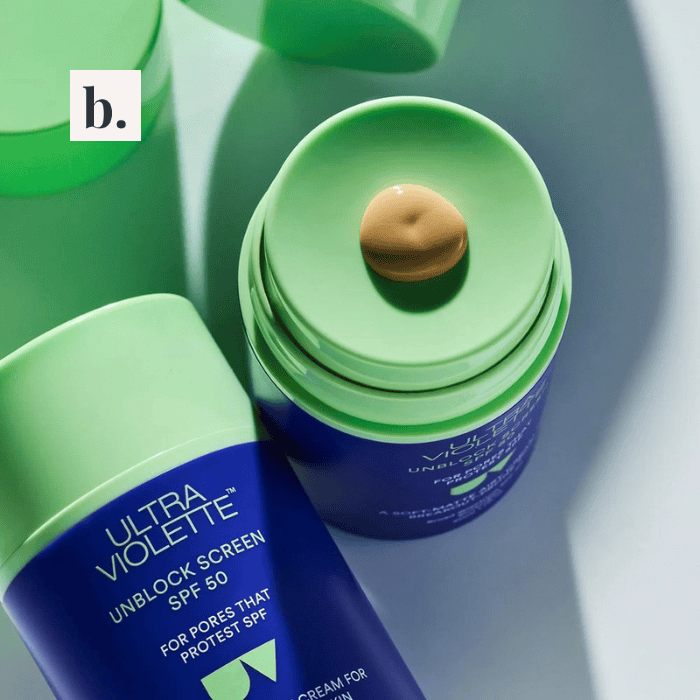
Ultra Violette
Unblock Screen SPF50 Breakout-Friendly SKINSCREEN
If your skin is oily or breakout-prone and you want a soft-matte SPF 50 sunscreen, Ultra Violette Unblock Screen combines UV filters with a low-shine finish. Its breakout-friendly positioning is not proof…
Read the BeautyBrief
Neutrogena
Clear Face Sunscreen Acne-Prone Skin Broad Spectrum SPF 60 with BEMT
If you have acne-prone skin and want broad-spectrum protection without a heavy finish, Neutrogena Clear Face SPF 60 with BEMT offers a brand-labeled non-comedogenic sunscreen. That claim does not guarantee you will…
Read the BeautyBrief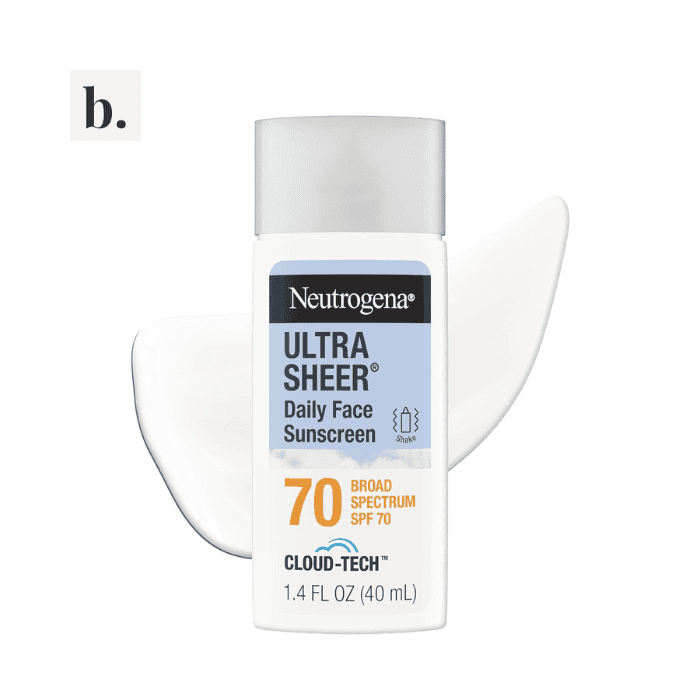
Neutrogena
Ultra Sheer Daily Face Sunscreen SPF 70 with BEMT
If you want a lightweight face sunscreen with high labeled SPF, Neutrogena Ultra Sheer SPF 70 with BEMT combines several UV filters, including bemotrizinol. SPF 70 is a protection rating, not a…
Read the BeautyBrief