
Ultra Violette Unblock Screen SPF 50 Breakout-Friendly SKINSCREEN Review
BeautyBrief™
Brand
Ultra Violette
Product
Unblock Screen SPF 50 Breakout-Friendly SKINSCREEN
Claims check
If your skin is breakout-prone, the SPF 50 formula supports sun protection and a matte finish, but a small study does not establish acne treatment.
Shopper fit
- Combination
- Oily
- Acne-Prone
Formula flags
- Added color
Shopper preferences
- Vegan
Key ingredients
| Bemotrizinol | At 3%, provides organic broad-spectrum UV filtration within the finished hybrid SPF 50 sunscreen system. |
|---|---|
| Zinc Oxide | At 10%, provides mineral UV filtration alongside bemotrizinol and octocrylene. |
| Octocrylene | At 6%, adds organic UV absorption as the third labeled sunscreen active. |
| Bixa Orellana Seed Extract | Supports the brand's Bix'Activ oil-control story; its separate effect on blemishes in this finished sunscreen is unestablished. |
| Saccharide Isomerate | Adds water-binding support through the Pentavitin ingredient system, without establishing a quantified 72-hour hydration result for every user. |
Price tier
$$ Mid-Range
Value check
At the Mid-Range tier, you pay for hybrid SPF 50 and a soft-matte format, not proven acne treatment or water-resistant performance.
Bottom line
If your skin is oily or breakout-prone and you want a soft-matte SPF 50 sunscreen, Ultra Violette Unblock Screen combines UV filters with a low-shine finish. Its breakout-friendly positioning is not proof that it treats acne, and you should choose it for protection, skin feel and tolerance rather than blemish treatment.
If your skin is oily or breakout-prone and you prefer a soft-matte sunscreen, Ultra Violette Unblock Screen SPF 50 combines 3% bemotrizinol, 10% zinc oxide and 6% octocrylene in a hybrid broad-spectrum formula. Silica, waxes and supporting ingredients explain its low-shine design, but the brand’s small blemish evaluation does not make it an acne treatment.[1]
Its primary benefit is sunscreen protection when used as directed. The value decision is whether you want this particular finish and formula, not a guarantee that it will prevent future breakouts.
What it claims
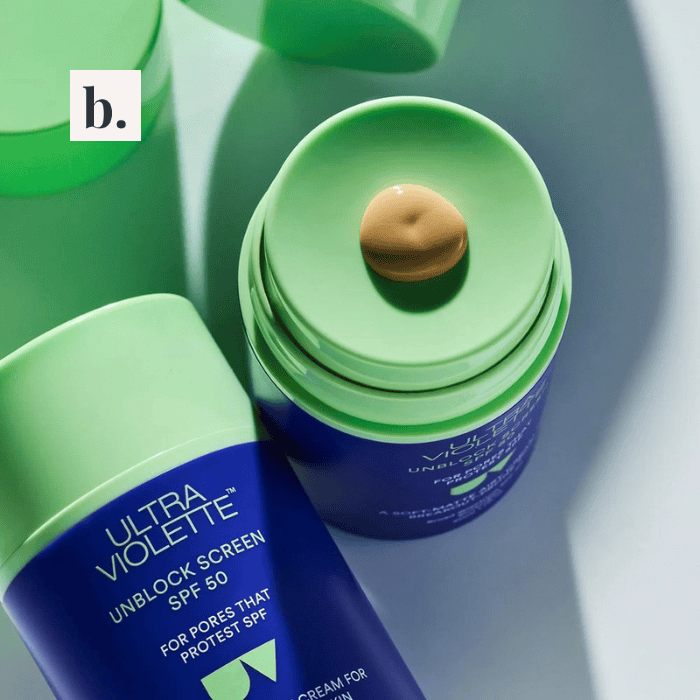
Ultra Violette describes Unblock Screen as a breakout-friendly, zinc-bemotrizinol SPF 50 for oily, acne-prone, and reactive skin. It emphasizes a soft-matte finish, blurred-looking pores, reduced visible shine, skin hydration, and fewer non-inflammatory blemishes after ongoing use. The highlighted supporting ingredients are Bix’Activ, a branded Bixa orellana seed extract, and Pentavitin, a branded saccharide isomerate moisturizing ingredient.[1]
The brand reports a dermatologist-supervised, 28-day evaluation involving 21 participants, including people with oily, sensitive, and acne-prone skin. It states that 95% experienced fewer non-inflammatory blemishes, 86% perceived a blurring or evening effect, and 90% said skin did not look oilier or shinier after use. The brand also describes group-average reductions in blemishes and blackheads. These results are directly relevant to the finished sunscreen, but the public summary does not establish a controlled comparison against a standard sunscreen, identify the independent effect of each ingredient, or prove that the formula treats acne.[1]
Claims vs. formula
The primary sun-protection claim is supported by the finished product’s U.S. broad-spectrum SPF 50 labeling. The active combination has three separate filters: bemotrizinol at 3%, zinc oxide at 10%, and octocrylene at 6%. The hybrid system is materially different from an all-mineral sunscreen or an organic-filter-only formula. Seeing zinc oxide and BEMT together does not, on its own, tell shoppers how much UVA protection the product delivers compared with a competing sunscreen; the finished SPF and broad-spectrum testing matter.[1]
The matte-finish positioning has a coherent formula basis. Silica and waxes contribute to a smoother, less shiny surface feel, and iron-oxide colorants influence the product’s appearance on skin. The formula also contains fatty alcohols and emollients that support spreadability. None of these ingredients guarantees no visible cast, no pilling, or universal comfort around the eyes; the brand’s no-stinging and breakout-friendly language is a product claim rather than a characteristic of bemotrizinol itself.[1]
Saccharide isomerate contributes water-binding support, but the brand’s 72-hour hydration language is not accompanied on the public product page by enough exact-product methodology to verify continuous 72-hour performance for ordinary use. Bixa orellana seed extract is consistent with the brand’s oil-control positioning, yet a botanical extract’s presence does not establish that it independently reduces blackheads or replaces acne treatment. The 21-person study offers preliminary finished-product context, not a generalizable acne-treatment result.
Ingredients that matter
Bemotrizinol, zinc oxide and octocrylene form the UV-filter system at their labeled 3%, 10% and 6% concentrations. The finished broad-spectrum SPF 50 matters more than ranking those actives by concentration or calling the formula mineral or organic. BB’s organic UV-filter guide explains the difference between filter classes.
Silica and waxes contribute to the advertised soft-matte texture, while Bixa orellana seed extract and saccharide isomerate underpin the brand’s oil-control and hydration stories. The brand’s 21-person, 28-day evaluation reports outcomes for the finished sunscreen, not the isolated effect of any one highlighted ingredient. It does not establish treatment of acne or guaranteed 72-hour hydration for you.

Bemotrizinol
Bemotrizinol is a well-supported, photostable UVA/UVB sunscreen filter permitted under the U.S. OTC sunscreen monograph. The finished sunscreen's tested protection, wearability, and application matter more than one filter's percentage.
Read the IngredientBrief
Zinc Oxide
Zinc oxide is a well-supported mineral UV filter and a separate skin-protectant active. In sunscreen, tested protection, film formation, tint, texture, and wear matter more than the zinc oxide percentage…
Read the IngredientBrief
Organic UV Filters
Organic UV filters absorb ultraviolet radiation in sunscreens. Their benefits depend on the individual filters and the tested protection, stability, wearability, and tolerability of the finished sunscreen.
Read the IngredientBriefSafety and regulatory context
In June 2026, FDA added bemotrizinol to the U.S. over-the-counter sunscreen monograph for use under specified conditions up to 6%. Unblock Screen uses 3%. That regulatory change expands formulation options; it is not an individual FDA endorsement of Ultra Violette’s shine, pore, blemish, or skincare claims.[2]
Ultra Violette’s official U.S. product page does not reproduce product-specific application directions or carry a stated 40- or 80-minute water-resistance claim. Check your product’s Drug Facts label for its specific directions and warnings. For general sunscreen use, FDA recommends applying generously 15 minutes before sun exposure, reapplying at least every two hours, and choosing water-resistant sunscreen for swimming or sweating. You should follow the label if it provides different or additional instructions.[3]
The inactive list includes benzyl alcohol, phenoxyethanol, colorants, and several plant-derived materials. Those ingredients do not automatically make the product unsuitable for sensitive or acne-prone skin, but individual reactions remain possible. Shoppers with known sensitivity to a specific ingredient should compare the exact U.S. list rather than treating breakout-friendly marketing as a guarantee.
What to expect in the short term
On application, the intended effect is broad-spectrum coverage in a soft-matte, more blurred-looking finish rather than a dewy sunscreen sheen. Silica, waxes, emollients, and iron oxides help explain that design, but the precise appearance depends on skin tone, application quantity, moisturizer, and makeup. The brand’s study reports participant impressions, not a guarantee of how the sunscreen will look with your moisturizer or makeup.
What to expect over time
Consistent use of a labeled broad-spectrum sunscreen helps reduce UV exposure and prevent sunburn and UV-related early skin aging when paired with other sun-protection measures. Ultra Violette’s 28-day data gives some finished-product support to the claim that its users observed less shine and fewer non-inflammatory blemishes, but the small, brand-supervised sample and undisclosed comparison design limit what can be concluded. This remains a sunscreen, not a substitute for evidence-based treatment of persistent acne or comedones.[1]
Who it fits
If your skin is oily, acne-prone or combination and you prefer a less shiny daily sunscreen, Unblock Screen offers a hybrid mineral-organic filter system. Its brand evaluation included sensitive-skin participants, but the presence of multiple sunscreen actives and the complete inactive system still make personal tolerability important. Drier skin may prefer a more emollient sunscreen, and anyone who swims or sweats needs one with a tested water-resistance claim.
Compare before you buy
The Beauty Briefing’s U.S. bemotrizinol sunscreen guide puts this hybrid filter system in context. Neutrogena’s Clear Face SPF 60 and Ultra Sheer Daily Face SPF 70 use 6% bemotrizinol with avobenzone, homosalate, and octisalate. Ultra Violette uses 3% bemotrizinol with zinc oxide and octocrylene. These are different complete filter systems, and a higher BEMT percentage alone does not establish greater UVA protection.[4][5]
At the Mid-Range tier, a 50 mL facial sunscreen must offer meaningful daily usability to earn its position against larger or less expensive alternatives with comparably dependable labeled UV protection. The small brand-reported evaluation adds context for the breakout-friendly and shine claims, but it does not establish a clinically proven acne-treatment advantage.
Final Assessment
If your skin is oily or breakout-prone, Ultra Violette Unblock Screen combines broad-spectrum SPF 50 with a soft-matte finish. Its small blemish study does not establish treatment of acne, and individual tolerance and adequate sunscreen reapplication remain more important than the breakout-friendly label.
Last reviewed: October 2026
Sources
- Ultra Violette. Unblock Screen SPF 50 Breakout-Friendly SKINSCREEN 50ml. Official U.S. product page, October 2026.
- U.S. Food and Drug Administration. FDA Expands Sunscreen Options for the First Time in 20 Years. June 9, 2026.
- U.S. Food and Drug Administration. Sunscreen: How to Help Protect Your Skin from the Sun. FDA consumer guidance on sunscreen use and reapplication.
- Neutrogena. Clear Face Sunscreen Acne-Prone Skin Broad Spectrum SPF 60 with BEMT. Official U.S. product page, October 2026.
- Neutrogena. Ultra Sheer Daily Face Sunscreen SPF 70 with BEMT. Official U.S. product page, October 2026.