
burnd Tinted SPF 34 Review
BeautyBrief™
Brand
burnd
Product
Tinted SPF 34
Claims check
Broad-spectrum SPF 34 supports your sun protection, while the tint improves appearance and photolyase has not demonstrated a repair benefit in this finished product.
Shopper fit
- Dry
- Normal
- Combination
- Sensitive
- Acne-Prone
Formula flags
- Added color
Shopper preferences
- Cruelty-Free
- Non-Comedogenic
Key ingredients
| Zinc Oxide | At 23.2%, serves as the sole sunscreen active in the Broad Spectrum SPF 34 formula. |
|---|---|
| Iron Oxides | Create the sheer tint and help counter the visible white cast associated with high-zinc mineral sunscreens. |
| Glycerin | Adds humectant hydration to support a more moisturizer-like daily finish. |
| Propanediol | Adds supporting humectant and solvent function within the lightweight base. |
| Plankton Extract / Photolyase | Adds a light-activated DNA-repair enzyme with human evidence in other sunscreen systems, without exact-product repair data for this formula. |
Price tier
$$ Mid-Range
Value check
At the Mid-Range tier, the value comes from combining broad-spectrum high-zinc mineral protection, a sheer tint, non-comedogenic positioning, and moisturizer-like wear in one daily sunscreen.
Where to buy
We may earn a commission through these links at no additional cost to you. This does not affect our BeautyBrief.
Bottom line
If you want a tinted mineral sunscreen with a wearable finish, burnd SPF 34 provides zinc oxide protection and pigment-based coverage. Its photolyase ingredient is not proof that the finished sunscreen reverses prior DNA damage, so choose it for UV protection and how the tint looks on your skin.
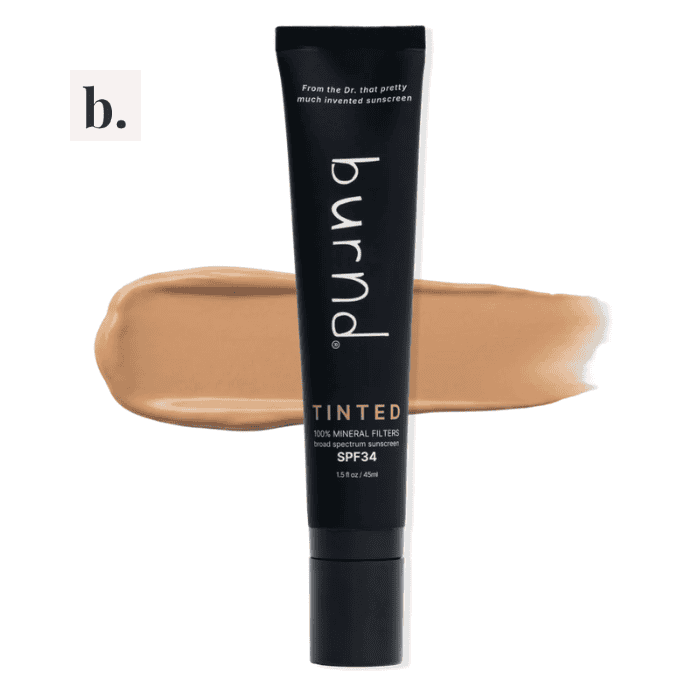
If you want mineral sun protection with light coverage, burnd Tinted SPF 34 is a 100% mineral daily sunscreen built around 23.2% zinc oxide, with iron oxides for tint and glycerin, sorbitol, propanediol, and lightweight emollients supporting a more moisturizer-like finish. Its strongest case is straightforward broad-spectrum protection in a tinted, fragrance-free, non-comedogenic format; the main cosmetic limitation is the single sheer tint.[1]
What it claims
burnd positions the product as a lightweight, moisturizing Broad Spectrum SPF 34 with 23.2% zinc oxide as its only sunscreen active. The brand says the tint helps reduce white cast, wears under makeup, and works best for light through medium-deep skin tones. It also highlights photolyase, a light-activated enzyme derived from plankton.[1]
Claims vs. formula
The sunscreen claim is the clearest part of the formula. The exact product is labeled Broad Spectrum SPF 34 and uses zinc oxide at 23.2% as its sole sunscreen active. Iron oxides create the tint, while glycerin, sorbitol, propanediol, coco-caprylate/caprate, isohexadecane, and lightweight hydrocarbons support hydration, spreadability, and wearability.[1]
The tint should be understood primarily as a wearability feature unless the finished product has visible-light testing. Iron oxides can contribute to visible-light attenuation in tinted sunscreens, but pigment names alone do not establish how much visible-light protection a specific formula provides. BB explains that distinction in Do Iron Oxide Levels Matter in Tinted Sunscreen?
The photolyase claim has more scientific basis than a purely decorative ingredient story, but the evidence does not belong to this exact sunscreen. In a small human study, a sunscreen containing photolyase reduced UV-induced cyclobutane pyrimidine dimers and apoptosis more than sunscreen alone after repeated solar-simulated UV exposure.[2] burnd does not publish equivalent finished-product repair data for Tinted SPF 34, so BB treats photolyase as a supporting feature rather than the main reason to buy the product.
Ingredients that matter
Zinc Oxide — 23.2%: Serves as the sole sunscreen active in the Broad Spectrum SPF 34 formula.
Iron Oxides: Create the sheer tint and help counter visible white cast from the high-zinc mineral base.
Glycerin: Adds humectant hydration to support a more moisturizer-like daily finish.
Propanediol: Adds supporting humectant and solvent function within the lightweight base.
Plankton Extract / Photolyase: Adds a light-activated DNA-repair enzyme with human evidence in other sunscreen systems, without exact-product repair data for this formula.

Zinc Oxide
Zinc oxide is a well-supported mineral UV filter and a separate skin-protectant active. In sunscreen, tested protection, film formation, tint, texture, and wear matter more than the zinc oxide percentage…
Read the IngredientBrief
Glycerin
If your skin feels dry or tight, glycerin helps your skin hold moisture. You don't need a high percentage or a separate serum when your moisturizer already works well.
Read the IngredientBrief
Propanediol
Propanediol is a common solvent and moisture-supporting ingredient that helps formulas spread and feel lighter. It is useful but highly replaceable, so the complete formula matters more than the ingredient…
Read the IngredientBriefSafety and regulatory context
Broad Spectrum labeling is a finished-product test claim, not something BB infers from the zinc-oxide percentage alone. FDA guidance also distinguishes broad-spectrum protection from water resistance: water-resistant sunscreens must be specifically tested and labeled for either 40 or 80 minutes.[3]
The current burnd product page does not make a water-resistance claim. The brand directs reapplication at least every two hours and more often after swimming, sweating, or toweling off; if swimming or heavy sweating is the main use case, choose a sunscreen that carries a specific water-resistance time on its label.[1][3]
What to expect in the short term
Expect a tinted mineral sunscreen with more cosmetic blending than an untinted high-zinc formula. The formula is designed to feel lightweight, smooth, hydrating, and non-greasy and can be worn alone or under makeup. The main immediate fit issue is shade match rather than fragrance or heaviness.[1]
What to expect over time
With generous daily application and appropriate reapplication, the dependable long-term benefit is broad-spectrum sun protection. Photolyase may add a secondary DNA-repair mechanism based on studies of other formulas, but burnd has not published finished-product evidence showing a defined repair benefit from this exact sunscreen.[2]
Who it fits
If your skin is dry, normal, combination or acne-prone and you prefer a sheer tint, the mineral-filter formula offers a lightweight option. The exact product page describes it as fragrance-free, non-comedogenic and made for sensitive skin, although these statements do not guarantee comfort for every person.[1]
burnd also states that it does not test its products on animals. This is a brand-declared Cruelty-Free claim rather than an independently certified statement.[1]
The tint works best, according to burnd, for light, medium-light, medium, and medium-deep skin tones. Very fair or deeper complexions have more reason to compare multi-shade tinted sunscreens before buying.
Compare before you buy
At the Mid-Range tier, the value comes from combining a high-zinc mineral sunscreen, tint, fragrance-free formula, non-comedogenic positioning, and moisturizer-like wear in one step. If shade flexibility or water resistance matters more than a one-tint daily formula, a multi-shade or specifically water-resistant sunscreen is the better comparison.
Final Assessment
If you want a tinted mineral sunscreen with a wearable finish, burnd SPF 34 provides zinc oxide protection and pigment-based coverage. Its photolyase ingredient is not proof that the finished sunscreen reverses prior DNA damage, so choose it for UV protection and how the tint looks on your skin.
Where to buy
Choose a retailer to view current pricing and availability.
We may earn a commission through these links at no additional cost to you.
Last reviewed: October 2026
Sources
burnd. burnd daily tinted Broad Spectrum SPF 34. Current official U.S. product page. Accessed October 8, 2026.
Stege H, Roza L, Vink AA, et al. Reduced ultraviolet-induced DNA damage and apoptosis in human skin with topical application of a photolyase-containing DNA repair enzyme cream. Journal of Investigative Dermatology. 2012;132(3 Pt 1):693-701. PMID: 22086236.
This 10-volunteer human study found that a photolyase-containing sunscreen reduced UV-induced DNA damage markers more than sunscreen alone under the study conditions. It did not test burnd Tinted SPF 34.
U.S. Food and Drug Administration. Tips to Stay Safe in the Sun: From Sunscreen to Sunglasses. Current consumer guidance. Accessed October 8, 2026.
