
Vitamin C in Skincare
If dullness or uneven tone is your concern, some topical vitamin C formulas can help. Look for stability and tolerability, not just a high percentage.
- Aliases
- Ascorbic Acid, L-Ascorbic Acid
- Ingredient category
- Antioxidant, Brightening Ingredient
- Most relevant for
- Dullness, Hyperpigmentation
- Evidence strength
- Some Support for Improving uneven pigmentation with topical vitamin C formulas
- Formula matters
- The vitamin C form, concentration, pH, stability, packaging, vehicle, and supporting antioxidants all affect performance; evidence for L-ascorbic acid does not automatically apply to derivatives.
- Separate product needed?
- Usually No. A separate vitamin C serum is usually unnecessary unless dullness or uneven tone remains a routine need not already addressed by another product.
BB takeaway
Vitamin C is a credible antioxidant and brightening ingredient, but results are formula-specific. Choose a stable, tolerable product rather than chasing the highest percentage.
Ingredient evidence does not prove the performance of every finished product containing it.
What is vitamin C?
Vitamin C is the common name for L-ascorbic acid, a water-soluble antioxidant found naturally in skin and many foods. Ascorbic acid and L-ascorbic acid are recognized names for vitamin C.[1]
Skincare brands also use related ingredients such as sodium ascorbyl phosphate, magnesium ascorbyl phosphate, ascorbyl glucoside, 3-O-ethyl ascorbic acid, tetrahexyldecyl ascorbate, and ascorbyl tetraisopalmitate. These are derivatives or related forms, not aliases for L-ascorbic acid.
That distinction matters because vitamin C forms differ in stability, solubility, conversion, delivery, irritation potential, and supporting evidence. A front label that says only “vitamin C” does not tell you enough to judge the product.
What does vitamin C do for skin?
Topical vitamin C is used mainly for antioxidant support and for improving the look of dull or unevenly pigmented skin.
Some tested formulas also improve visible signs of photoaging such as roughness and fine lines. Vitamin C is involved in collagen biology, but that does not mean every vitamin C serum visibly firms skin or “rebuilds collagen.”
Vitamin C can complement daily sunscreen by adding antioxidant support. It does not replace broad-spectrum sunscreen or provide a labeled SPF on its own.
It is also not a guaranteed treatment for melasma, post-inflammatory hyperpigmentation, or every type of discoloration. The exact form, finished formula, stability, consistency of use, and sunscreen habits all affect the result.
What the evidence says about vitamin C skincare
Topical vitamin C has some human evidence for improving uneven pigmentation and photoaging, but the evidence base is still limited and formula-specific.
A 2023 systematic review included seven prospective randomized studies with 139 participants. Across the included trials, topical vitamin C was associated with lighter pigmentation and improvements in some measures of skin texture and wrinkling.[2]
The review also found substantial differences in formulations, concentrations, procedures, treatment periods, and study quality. Some protocols combined vitamin C with laser treatment. The authors concluded that more studies are needed to confirm the findings and determine an ideal concentration.
A 2026 randomized double-blind controlled study in 66 healthy Chinese women evaluated a freshly mixed 10% vitamin C serum for 12 weeks. The treatment group showed changes in antioxidant-related biomarkers and skin-color measurements, including lower redness and yellowness values.[3]
That study tested one stabilized 10% L-ascorbic acid system. Three authors were affiliated with Amway, and the author-contribution statement identified one Amway-affiliated author as the study’s initiator and sponsor. The findings should therefore be treated as evidence for the tested formula rather than proof that every 10% vitamin C serum performs the same way.
Combination-formula evidence reinforces the same point. A human study of a formula containing 15% L-ascorbic acid, 1% vitamin E, and 0.5% ferulic acid reduced several measured signs of damage after controlled ultraviolet exposure.[4] That result belongs to the tested antioxidant system, not L-ascorbic acid alone.
For you, the practical takeaway is that vitamin C has credible but not universal evidence for brighter, more even-looking skin. Claims of dramatic wrinkle reversal, scar removal, major melasma correction, or procedure-like rejuvenation need stronger product-specific evidence.
How vitamin C form and formulation affect results
L-ascorbic acid has the clearest direct topical evidence, but it is also difficult to formulate because it oxidizes readily and generally needs an acidic environment for efficient delivery.
Classic absorption research found that L-ascorbic acid delivery depended heavily on formula pH and concentration. In the tested model, skin levels increased up to 20% and did not improve further at higher concentrations.[5]
That does not make 20% the ideal strength for you or prove that a 20% serum gives better visible results than a 10% or 15% formula.
Derivative-based formulas may offer different stability, texture, oil or water solubility, and tolerability. Their benefits should be judged by evidence for the exact derivative or, preferably, the finished product rather than borrowed from L-ascorbic acid research.
Percentage claims also need context. A “20% vitamin C complex” may refer to a blend or supplier solution rather than 20% of one active vitamin C ingredient.
Packaging and storage matter because oxidation can reduce the usefulness of unstable formulas. Opaque or air-limiting packaging can help, but a dark bottle alone does not prove that a formula will remain stable throughout use.
If a clear or pale L-ascorbic acid product becomes markedly darker, oxidation is a reasonable concern. Follow the manufacturer’s storage and discard guidance rather than treating color as a precise potency test.
Who may benefit from vitamin C skincare?
Vitamin C can be useful when dullness, uneven-looking tone, superficial discoloration, or visible sun-related changes are meaningful concerns.
It can also make sense if you want antioxidant support alongside daily sunscreen and are willing to use the product consistently.
If your skin is reactive or already irritated by retinoids or exfoliating acids, a strongly acidic L-ascorbic acid serum may be harder to tolerate. A lower concentration, derivative-based formula, or simpler routine may fit better.
You do not need vitamin C simply because it is popular. Consistent sunscreen usually deserves higher priority when the goal is preventing additional pigmentation or photoaging.
Vitamin C side effects and irritation risk
The most common problems are stinging, burning, dryness, tightness, redness, itching, or irritation. Acidic L-ascorbic acid formulas can be especially noticeable on already sensitive or overtreated skin.
Vitamin C is not expected to cause a true acne “purge.” New bumps after starting a serum may reflect irritation, the product base, another ingredient, or an unrelated breakout.
In June 2025, the Expert Panel for Cosmetic Ingredient Safety approved a re-review summary for ascorbic acid and specified ascorbates, maintaining the existing safety conclusion rather than identifying a new safety concern.[6]
That safety conclusion applies to the ingredients and cosmetic-use conditions reviewed. It does not guarantee that every finished vitamin C formula will be well tolerated.
Stop using a product that causes persistent burning, swelling, blistering, severe itching, or a worsening rash.
How to use vitamin C in your skincare routine
Use the product according to its directions. Vitamin C can be used in the morning or evening.
Morning use is common because antioxidant formulas fit naturally under sunscreen. A lightweight serum usually goes after cleansing and before moisturizer.
In the morning, finish with broad-spectrum sunscreen. Vitamin C does not replace sunscreen even when a product is marketed as photoprotective.
If the formula repeatedly stings or dries your skin, reduce frequency or choose a better-tolerated product rather than forcing daily use.
How long does vitamin C take to work?
A vitamin C product can make skin look brighter immediately if the formula also hydrates or reflects light, but that is not the same as changing pigmentation.
Clinical studies generally evaluate visible or measured changes over weeks to months. The 2026 10% serum trial ran for 12 weeks, while the studies in the 2023 systematic review used varied treatment periods.[3][2]
There is no universal vitamin C timeline because form, concentration, stability, formula, sunscreen use, pigmentation depth, and tolerance all vary.
What can you use with vitamin C?
Vitamin C fits into routines with glycerin, hyaluronic acid, ceramides, niacinamide, panthenol, squalane, and other moisturizing ingredients.
Vitamin E and ferulic acid are often paired with L-ascorbic acid in antioxidant formulas. Specific combinations have human evidence, but seeing the same ingredient names on another label does not prove equivalent stability or performance.
Vitamin C can also be used in a routine containing retinoids or exfoliating acids. The practical issue is combined irritation, not a blanket incompatibility rule. Separating applications or reducing frequency may make the routine easier to tolerate.
How to choose a vitamin C product
Start by identifying the exact vitamin C ingredient rather than buying from the front-label percentage alone.
For L-ascorbic acid, look for a clearly disclosed concentration, protective packaging, reasonable storage guidance, and a texture you can tolerate under moisturizer or sunscreen.
For a derivative-based product, check the exact derivative and look for evidence relevant to that material or the finished product. Do not assume sodium ascorbyl phosphate, tetrahexyldecyl ascorbate, ascorbyl glucoside, and L-ascorbic acid are interchangeable.
Be cautious with phrases such as “medical grade,” “clinical strength,” “stable vitamin C,” “20% vitamin C complex,” or “advanced antioxidant technology” when the brand does not explain the active, percentage, stability, or finished-product evidence.
Vitamin C alone does not justify Premium or Luxury pricing. Pay more only when the complete product offers a meaningful advantage in stability, packaging, tolerability, texture, or credible product-level testing.
Do you need a separate vitamin C serum?
Usually, no.
A dedicated serum can make sense when dullness or uneven tone is a priority and vitamin C fills a real gap in your routine.
You do not need a separate serum if another product already addresses the concern, the vitamin C formula repeatedly irritates your skin, or daily sunscreen is not yet consistent.
A stable moisturizer or other leave-on treatment containing vitamin C can be just as practical when it delivers the benefit you want.
The BB Perspective
Vitamin C is a credible antioxidant and brightening ingredient, but the category is easy to oversell.
The strongest shopper-relevant evidence supports modest improvement in uneven pigmentation with specific topical formulas. L-ascorbic acid has the clearest direct evidence, while derivatives need to earn their claims on their own.
Choose a vitamin C product only when it solves a real concern, remains stable enough to use, and fits comfortably into your routine. Higher percentages, more derivatives, and prestige packaging do not automatically create better results.
Last reviewed: September 2026
Sources
National Library of Medicine PubChem. L-Ascorbic Acid.
PubChem identifies L-ascorbic acid as vitamin C and lists ascorbic acid and L-ascorbic acid as recognized names. Related salts and cosmetic derivatives are distinct chemical materials rather than aliases for L-ascorbic acid. This source supports ingredient identity rather than topical efficacy. Return to citation.
Correia G, Magina S. Efficacy of topical vitamin C in melasma and photoaging: A systematic review. Journal of Cosmetic Dermatology. 2023;22(7):1938-1945. doi:10.1111/jocd.15748. PMID: 37128827.
This systematic review included seven prospective randomized studies with 139 participants. The included trials generally reported lighter pigmentation and improvements in some photoaging measures, but formulas, concentrations, procedures, treatment periods, and study quality varied. Some studies combined topical vitamin C with laser treatment. The review supports potential benefit while also supporting a Some Support rather than universal-efficacy interpretation. Return to citation.
Zi Y, Liu J, Liu Q, Pan Y, Jiang X. Study on the Multiple Efficacies of Vitamin C Serum in Anti-Glycation, Anti-Carbonylation, Antioxidation, and Anti-Inflammation of Human Skin Based on In Vivo Tests. Journal of Cosmetic Dermatology. 2026;25(5):e70888. doi:10.1111/jocd.70888. PMID: 42087444. PMCID: PMC13145321.
This randomized double-blind controlled study included 66 healthy Chinese women and tested a freshly mixed 10% vitamin C formula for 12 weeks. The treatment group showed changes in antioxidant-related biomarkers and skin-color measurements. Three authors were affiliated with Amway, and the author-contribution statement identified one Amway-affiliated author as the study’s initiator and sponsor, although the paper separately reported no funding and no conflicts of interest. The findings support the tested formula rather than every 10% vitamin C serum. Return to citation.
Murray JC, Burch JA, Streilein RD, Iannacchione MA, Hall RP, Pinnell SR. A topical antioxidant solution containing vitamins C and E stabilized by ferulic acid provides protection for human skin against damage caused by ultraviolet irradiation. Journal of the American Academy of Dermatology. 2008;59(3):418-425. doi:10.1016/j.jaad.2008.05.004. PMID: 18603326.
This human study evaluated a specific antioxidant system containing 15% L-ascorbic acid, 1% vitamin E, and 0.5% ferulic acid during controlled ultraviolet exposure. It supports the tested combination and should not be generalized to vitamin C alone or every formula that lists the same ingredients. The study was supported by a grant from SkinCeuticals-L’Oréal. Coauthor Sheldon Pinnell disclosed a consulting relationship with the company, which held a patent on the tested C E Ferulic formulation. Return to citation.
Pinnell SR, Yang H, Omar M, et al. Topical L-ascorbic acid: percutaneous absorption studies. Dermatologic Surgery. 2001;27(2):137-142. doi:10.1046/j.1524-4725.2001.00264.x. PMID: 11207686.
This formulation study found that L-ascorbic acid delivery depended strongly on pH and concentration and that measured skin levels did not rise further above 20% under the tested conditions. Much of the penetration work used pig skin, so it is useful formulation evidence rather than proof that 20% is an ideal consumer strength or produces superior visible results. Sheldon Pinnell disclosed that he was a consultant for SkinCeuticals, while coauthor Mostafa Omar was president of PhytoCeuticals. Return to citation.
Expert Panel for Cosmetic Ingredient Safety. Ascorbic Acid and Ascorbates — Re-Review Summary. June 2025.
The Panel reviewed updated use data and newer safety literature and reaffirmed its existing conclusion that the assessed ascorbic acid and ascorbate ingredients are safe as used in cosmetics. It did not reopen the safety assessment. The Panel separately found the available data insufficient to assess exposure from cosmetic airbrush delivery systems. This is an independent cosmetic-ingredient safety assessment, not evidence of efficacy or a guarantee that every finished vitamin C product will be tolerated. Return to citation.
Products featuring Vitamin C
These evaluated products list Vitamin C among the Key Ingredients that meaningfully shape the formula. Inclusion here reflects ingredient relevance, not an endorsement or rating.
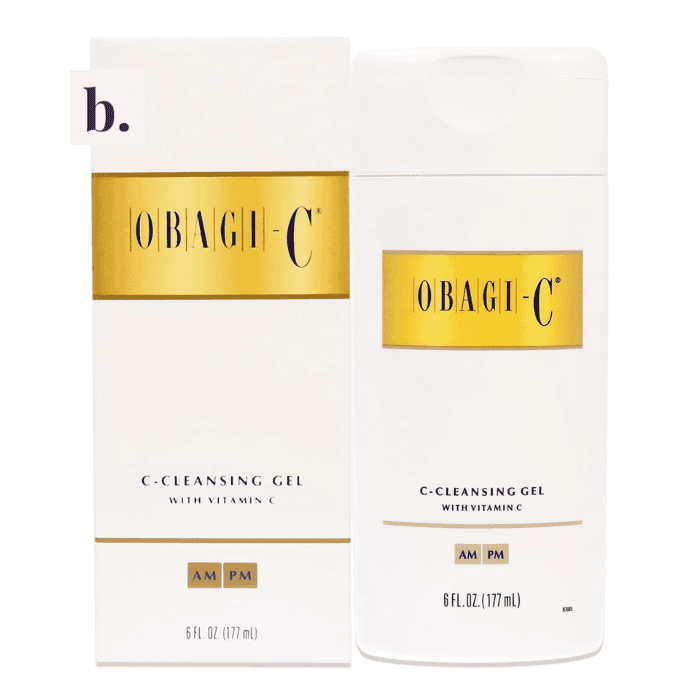
Obagi
C® Fx C-Cleansing Gel
If you want a traditional foaming cleanser, Obagi-C Fx C-Cleansing Gel provides useful everyday washing for oil and residue. Its vitamin C does not establish the results of a leave-on treatment, while…
Read the BeautyBrief
Obagi
C® Fx C-Therapy Night Cream
If your skin tolerates rich creams and you want arbutin for uneven tone, C-Therapy Night Cream offers an ingredient-based brightening rationale. Its leave-on sodium lauryl sulfate and lack of finished-product outcomes make…
Read the BeautyBrief