
Hyaluronic Acid in Skincare
If your skin feels dry or tight, hyaluronic acid helps your skin hold moisture. You don't need several HA forms or a separate serum when your moisturizer already hydrates well.
- Aliases
- Hyaluronan
- Ingredient category
- Humectant
- Most relevant for
- Dryness
- Evidence strength
- Well Supported for Increasing surface hydration with leave-on topical formulas
- Formula matters
- Molecular weight, form, concentration, vehicle, and supporting moisturizers affect hydration and feel; more HA forms or a larger percentage does not automatically mean better performance.
- Separate product needed?
- Usually No. A separate hyaluronic acid serum is usually unnecessary when your moisturizer already provides enough hydration.
BB takeaway
Hyaluronic acid is a credible hydration ingredient, not topical filler. Choose the complete formula for lasting comfort rather than multi-weight or high-percentage marketing.
Ingredient evidence does not prove the performance of every finished product containing it.
What is hyaluronic acid?
Hyaluronic acid is a large water-binding sugar molecule found naturally in skin, connective tissue, joints, and other parts of the body. It is also known as hyaluronan.[1]
In skincare, hyaluronic acid is used mainly as a humectant. Its practical job is to help the outer skin layer hold water.
Ingredient lists may also include sodium hyaluronate, hydrolyzed hyaluronic acid, hydrolyzed sodium hyaluronate, potassium hyaluronate, or sodium acetylated hyaluronate. These are related salts or derivatives, not aliases for hyaluronic acid and not automatic quality rankings.
What does hyaluronic acid do for skin?
Hyaluronic acid supports surface hydration.
A well-formulated leave-on product can make dry or dehydrated skin feel softer, smoother, and less tight. Better hydration can also temporarily soften the look of fine lines that become more noticeable when skin is dry.
That is a moisturizing effect. Topical hyaluronic acid does not restore lost facial volume, behave like injectable filler, treat acne or pigmentation, exfoliate, or provide sun protection.
Very dry skin may also need emollients and occlusives because a humectant alone does not necessarily provide enough lasting moisture retention.
What the evidence says about hyaluronic acid skincare
Hyaluronic acid is well supported as a topical hydration ingredient, but the strongest evidence still belongs to specific formulas rather than the ingredient name alone.
A 2024 double-blind randomized controlled trial in 36 adults aged 60 to 80 with dry skin compared low-molecular-weight hyaluronic acid, high-molecular-weight hyaluronic acid, and vehicle lotions on separate areas of the leg. After four weeks, the low-molecular-weight formula produced significantly higher hydration measurements than both the high-molecular-weight formula and vehicle.[2]
The same trial found no significant differences among groups in transepidermal water loss or clinical dryness scores. That means the study supports a hydration effect and a possible molecular-weight difference, not a claim that low-molecular-weight HA universally repairs the barrier or produces better visible skin.
A 2026 randomized study in 123 volunteers compared a cleanser-only control with a hyaluronic acid serum, a moisturizer, and the serum-plus-moisturizer routine. The serum, moisturizer, and combined routine all increased hydration at 30 minutes; at eight hours, the combined routine maintained the clearest hydration advantage over control.[3]
That study tested complete retail products, not isolated hyaluronic acid, and both authors were affiliated with Good Molecules. It supports a formula-first point: lasting hydration depends on the complete moisturizing system, not on the humectant alone.
For you, the evidence supports hyaluronic acid as a credible hydration ingredient. Claims about major wrinkle correction, deep-tissue plumping, or filler-like effects require evidence beyond ordinary topical HA use.
How hyaluronic acid form and formulation affect results
Molecular weight can affect how hyaluronic acid behaves in a formula and on the skin.
Lower-molecular-weight materials are smaller, while higher-molecular-weight forms are larger and tend to remain closer to the surface. The 2024 clinical trial suggests that molecular weight can change measured hydration, but it does not establish one ideal molecular size for every product or skin type.[2]
Related materials such as sodium hyaluronate and hydrolyzed hyaluronic acid also have different physical properties. Seeing several hyaluronate names on one ingredient list does not prove better or “multi-depth” hydration.
Percentage claims also need context. A front-label number may refer to pure hyaluronic acid, a diluted raw-material solution, or a supplier blend. Unless the brand explains what the percentage measures, comparisons across products are weak.
The rest of the formula matters just as much. A thin HA serum may add water-binding support but still leave dry skin uncomfortable without glycerin, emollients, ceramides, silicones, oils, or petrolatum to support longer-lasting comfort.
Who may benefit from hyaluronic acid skincare?
Hyaluronic acid can be useful when skin feels dry, dehydrated, tight, or temporarily crepey from dryness.
Lightweight HA serums and gel-creams may suit oily or combination skin when richer moisturizers feel uncomfortable. Dry skin often benefits more from a cream that combines hyaluronic acid with emollient and occlusive support.
It can also be a useful supporting ingredient when retinoids, exfoliating acids, frequent cleansing, cold weather, or low humidity make skin feel drier.
You do not need to seek it out specifically if your current moisturizer already keeps your skin comfortable. Glycerin, urea, panthenol, and other humectants can provide excellent hydration without hyaluronic acid.
Hyaluronic acid side effects and irritation risk
Hyaluronic acid and related hyaluronates have a favorable cosmetic safety record.
The Expert Panel for Cosmetic Ingredient Safety concluded that the hyaluronates it assessed are safe under the cosmetic practices of use and concentrations reviewed.[4]
That does not guarantee every HA product will suit you. Fragrance, preservatives, exfoliating ingredients, botanical extracts, or an already irritated skin barrier may be the real reason a serum stings or causes redness.
Stickiness, pilling, tightness, or a film-like feel are usually formulation or layering problems rather than signs that hyaluronic acid is unsafe.
Stop using a product that causes persistent burning, swelling, severe itching, blistering, or a worsening rash.
How to use hyaluronic acid in your skincare routine
Hyaluronic acid does not require a special routine step. Use the finished product according to its format.
A lightweight serum usually goes before moisturizer. A moisturizer containing hyaluronic acid can serve as the only hydration step when it keeps your skin comfortable.
You do not have to follow a universal damp-skin rule. A well-formulated product already contains water and other ingredients that influence how it hydrates. If the brand gives specific application directions, follow those.
If a serum leaves skin feeling tight after it dries, follow it with a suitable moisturizer or replace it with a more complete moisturizing formula.
How long does hyaluronic acid take to work?
Surface hydration and a smoother feel can appear quickly after application.
In the 2026 regimen study, hydration changes were measurable within 30 minutes, while the durability of that effect differed among the serum, cream, and combined routine at eight hours.[3]
The 2024 molecular-weight trial evaluated longer-term hydration after four weeks.[2]
Those timelines belong to the tested formulas. They do not prove that every HA product provides eight-hour hydration or that visible fine lines should improve on a fixed schedule.
What can you use with hyaluronic acid?
Hyaluronic acid fits easily with nearly every common skincare ingredient.
It can appear alongside glycerin, urea, panthenol, ceramides, cholesterol, squalane, dimethicone, and petrolatum.
It also fits into routines containing retinoids, exfoliating acids, benzoyl peroxide, vitamin C, or niacinamide.
A hydrating serum cannot make an overly irritating routine harmless. If skin is persistently burning, peeling, or inflamed, reducing the source of irritation matters more than adding another humectant layer.
How to choose a hyaluronic acid product
Start with the hydration problem you actually need to solve rather than the number of HA forms advertised.
If you want lightweight hydration, a serum, lotion, or gel-cream may make sense. If your skin is persistently dry, a moisturizer that also contains emollient and occlusive support is usually more useful than a stand-alone HA serum.
Judge texture, stickiness, pilling, fragrance, compatibility with sunscreen and makeup, package size, price, and whether hydration lasts long enough for your routine.
Treat “multi-molecular,” “multi-depth,” “deep penetration,” and “filler effect” as product claims rather than automatic consequences of seeing several hyaluronates on an ingredient list.
Topical HA does not reproduce an injectable dermal filler. FDA-approved hyaluronic acid fillers are medical devices injected into tissue to create structural filling effects.[5]
Hyaluronic acid alone does not justify Premium or Luxury pricing. Pay more only when the complete product offers a meaningful advantage in texture, tolerability, packaging, hydration durability, or credible finished-product testing.
Do you need a separate hyaluronic acid serum?
Usually, no.
Many moisturizers, sunscreens, and other leave-on products already contain hyaluronic acid, a related hyaluronate, or another effective humectant.
A separate serum can make sense when you specifically want a lightweight hydration layer and it solves a real routine problem without adding stickiness or unnecessary complexity.
You can leave it out when your moisturizer already keeps your skin comfortable.
The BB Perspective
Hyaluronic acid is a credible and useful hydration ingredient, but it is also highly replaceable.
Molecular weight can affect performance, yet the marketing often turns that detail into a quality ladder the evidence does not support. More forms, more molecular weights, and a larger percentage do not automatically mean better hydration.
Choose the product that gives you lasting comfort with a texture you enjoy using. Treat hyaluronic acid as a useful formula feature—not a reason by itself to add another step or pay a premium.
Last reviewed: September 2026
Sources
National Library of Medicine PubChem. Hyaluronic Acid.
PubChem describes hyaluronic acid as a naturally occurring glycosaminoglycan and lists hyaluronan as a recognized synonym. Related salts such as sodium hyaluronate are chemically related materials rather than aliases for hyaluronic acid itself. This source supports ingredient identity rather than topical efficacy. Return to citation.
Muhammad P, Novianto E, Setyorini M, et al. Effectiveness of topical hyaluronic acid of different molecular weights in xerosis cutis treatment in elderly: a double-blind, randomized controlled trial. Archives of Dermatological Research. 2024;316(6):329. doi:10.1007/s00403-024-03003-2. PMID: 38829483.
This double-blind randomized controlled trial included 36 adults aged 60 to 80 with dry skin. Low-molecular-weight HA lotion produced greater hydration measurements after four weeks than high-molecular-weight HA and vehicle, while transepidermal water loss and clinical dryness scores did not differ significantly among groups. No adverse effects were reported. The findings support molecular weight as one formulation factor without establishing universal superiority for low-molecular-weight HA. Return to citation.
Maldonado López AM, da Silva Souza ID. A serum and cream moisturization regimen outperforms separate use in sustaining hydration, reducing TEWL, and balancing surface lipids over an 8-h study. International Journal of Cosmetic Science. Published online March 30, 2026. doi:10.1111/ics.70100. PMID: 41906718.
This randomized study included 123 volunteers assigned to a cleanser control, hyaluronic acid serum, moisturizing cream, or serum-plus-cream routine. The serum, cream, and routine increased hydration at 30 minutes; at eight hours, only the combined routine remained significantly more hydrated than control. The study tested complete retail products rather than isolated hyaluronic acid. Good Molecules, LLC fully sponsored the study and employed both authors. It supports formula and regimen context rather than a claim that a separate HA serum is necessary. Return to citation.
Expert Panel for Cosmetic Ingredient Safety. Safety Assessment of Hyaluronates as Used in Cosmetics. Final report, June 2023. Accessed September 2026.
The Expert Panel assessed hyaluronic acid and multiple related hyaluronate cosmetic ingredients and concluded that they are safe under the practices of use and concentrations reviewed. This assessment addresses cosmetic ingredient safety rather than the effectiveness of finished HA products. Return to citation.
U.S. Food and Drug Administration. FDA-Approved Dermal Fillers. Accessed September 2026.
FDA explains that dermal fillers are medical devices evaluated for injection into specified tissue areas and that hyaluronic acid filler gels combine with water and swell to create smoothing or filling effects. This is fundamentally different from applying a topical HA cosmetic to the skin surface. Return to citation.
Products featuring Hyaluronic Acid
These evaluated products list Hyaluronic Acid among the Key Ingredients that meaningfully shape the formula. Inclusion here reflects ingredient relevance, not an endorsement or rating.
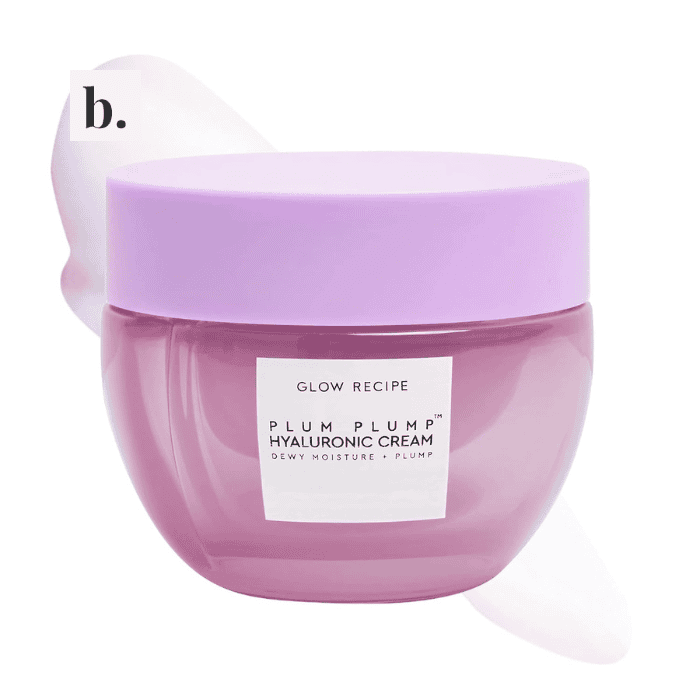
Glow Recipe
Plum Plump Hyaluronic Cream
If you want lightweight hydration, Plum Plump combines hyaluronic acid forms, glycerin and squalane for a temporarily plumper-looking finish. Its refillable format adds value, but the fragrance and limited wrinkle evidence matter…
Read the BeautyBrief
Vanicream
Daily Facial Moisturizer
If you want light daily moisture with a simple barrier-lipid system, Vanicream offers strong Budget value. If your skin needs heavier occlusion, compare a richer cream.
Read the BeautyBrief
Peach Slices
Snail Rescue All-in-One Oil Free Moisturizer
If you like light snail-mucin hydration, this gel offers useful Budget value. If you avoid animal-derived ingredients or need clinical acne treatment, choose another moisturizer.
Read the BeautyBrief
OSEA
Seabiotic® Water Cream
If you want light hydration supported by product-specific testing, Seabiotic offers a distinctive Premium water cream. If ordinary moisture is your only goal, less expensive moisturizers can provide comparable basic ingredient functions.
Read the BeautyBrief
Beauty of Joseon
Dynasty Cream
If you want a richer cream with a dewy finish and product-specific hydration data, Dynasty Cream offers useful Mid-Range value. If you prefer a matte texture or avoid honey-derived ingredients, choose another…
Read the BeautyBrief
innisfree
Green Tea Seed Hyaluronic Acid Cream
If you want a cushioned moisturizer with hydration data and barrier-supporting ingredients, this offers solid Mid-Range value. If you avoid silicones, choose another cream because the official ingredient list contradicts the brand's…
Read the BeautyBrief