
Ethylhexyl Palmitate in Skincare
Ethylhexyl Palmitate is a silky emollient. Concentrated testing on the backs of selected men showed comedogenic potential, but that does not establish that every finished product containing it will clog facial pores.
- Aliases
- Octyl Palmitate, 2-Ethylhexyl Palmitate, Palmitic Acid 2-Ethylhexyl Ester, 2-Ethylhexyl Hexadecanoate
- Ingredient category
- Emollient
- Most relevant for
- Dryness
- Evidence strength
- Well Supported for Softening and smoothing skin as an emollient in cosmetic formulas
- Formula matters
- Concentration, companion emollients, waxes, film formers, surfactants, and rinse-off versus leave-on use matter. Tests of concentrated Octyl Palmitate do not predict whether every finished facial product will clog pores.
- Separate product needed?
- Usually No. Ethylhexyl Palmitate is a formulation ingredient, not a dedicated skincare step shoppers need to add separately.
BB takeaway
Ethylhexyl Palmitate is a useful emollient with real comedogenic potential under concentrated testing. Clog-prone shoppers should notice it without automatically blacklisting every formula that contains it.
Ingredient evidence does not prove the performance of every finished product containing it.
What is ethylhexyl palmitate?
Ethylhexyl Palmitate is an ester made from palmitic acid and 2-ethylhexyl alcohol. It is used mainly as an emollient to soften skin and improve slip and spreadability.[1]
Older research may call it Octyl Palmitate, a former name for Ethylhexyl Palmitate.[2]
It is not the same ingredient as palmitic acid, isopropyl palmitate, cetyl palmitate, or other palmitate esters.
What does ethylhexyl palmitate do for skin?
Its main skincare role is emollience. Ethylhexyl Palmitate helps skin feel softer and smoother and can make a formula glide more easily across the skin.
It is also useful in moisturizers, sunscreens, makeup, cleansing oils, and body products because it can make richer oils, waxes, pigments, and filter systems feel less heavy.
Those are formulation benefits, not treatment claims. Ethylhexyl Palmitate is not an acne treatment, barrier-repair active, anti-aging ingredient, or pigment-correcting ingredient.
What the evidence says about ethylhexyl palmitate skincare
Ethylhexyl Palmitate is well supported as an emollient. The more important shopper question is whether its comedogenic potential matters in the finished product.
The Cosmetic Ingredient Review Expert Panel assessed Ethylhexyl Palmitate within a larger group of alkyl esters and concluded that the group is safe in cosmetics under the uses and concentrations reviewed when formulated to be nonirritating.[2] A body oil containing 77.9% Ethylhexyl Palmitate produced no irritation or sensitization reactions in a 104-person repeat-insult patch test.
Its pore-clogging reputation also has direct human evidence. In a 2021 controlled study, cosmetic-grade Octyl Palmitate served as the positive control on the upper backs of men selected for prominent follicles and the ability to form comedones. After four weeks, all 12 analyzed participants showed more than a 50% increase in microcomedones at the test site.[3]
That is a real comedogenicity signal, but the exposure was deliberately concentrated and designed as a positive control. It does not show that every moisturizer, sunscreen, cleanser, or makeup product containing Ethylhexyl Palmitate will clog facial pores.
Finished-product testing is an important counterweight. A separate human study found that finished cosmetics containing ingredients previously labeled comedogenic were not necessarily comedogenic when the complete products were tested.[4]
How ethylhexyl palmitate form and formulation affect results
Products can use very different amounts of Ethylhexyl Palmitate. A formula in which it makes up a large part of the emollient system is not equivalent to one using a small amount for texture or spread.
The rest of the formula matters too. Film formers, waxes, silicones, surfactants, powders, other emollients, and product format can all change how a product sits on skin.
Ingredient-list position gives only a rough clue. It cannot reveal the exact percentage or predict whether the finished product will clog pores.
Who may benefit from ethylhexyl palmitate skincare?
Ethylhexyl Palmitate can be useful in products for normal or dry skin when the goal is a smoother, softer feel without the heaviness of some richer oils and waxes.
It can also improve the elegance of sunscreens, makeup removers, moisturizers, and complexion products.
If you are very prone to closed comedones or recurring congestion, it is reasonable to pay more attention to Ethylhexyl Palmitate in leave-on facial products, especially when it appears prominently. That is a reason for extra scrutiny, not an automatic reason to reject the product.
Ethylhexyl palmitate side effects and irritation risk
Available human safety testing is reassuring for irritation and sensitization.[2]
For clog-prone skin, comedogenicity is the more relevant concern. The concentrated human test showed clear microcomedone formation, but finished-product behavior can differ substantially from raw-ingredient testing.[3][4]
If several leave-on products containing Ethylhexyl Palmitate repeatedly seem to produce the same closed-comedone pattern for you, trying a simpler formula without it is a reasonable comparison.
How to use ethylhexyl palmitate in your skincare routine
There is no special way to use Ethylhexyl Palmitate. It is already part of the finished formula, so use the product according to its directions.
If you are clog-prone, introduce new leave-on products one at a time. That makes it easier to see whether a moisturizer, sunscreen, or makeup product changes your congestion pattern.
In rinse-off products such as cleansing oils, exposure is much shorter than in all-day leave-on products, so raw-ingredient comedogenicity data are even less direct.
How long does ethylhexyl palmitate take to work?
Its emollient effect is immediate: a formula can feel smoother and more spreadable as soon as it is applied.
There is no multi-week treatment timeline because Ethylhexyl Palmitate is not an acne, pigmentation, wrinkle, or barrier-repair active.
The four-week comedogenicity study is a test condition, not a prediction that a retail product will clog pores after exactly four weeks.
What can you use with ethylhexyl palmitate?
Ethylhexyl Palmitate has no standard incompatibility with common skincare ingredients. It can appear in routines with retinoids, exfoliating acids, niacinamide, vitamin C, ceramides, peptides, and sunscreen.
Its role is mainly texture and emollience, so there is no evidence-based reason to build a routine around pairing it with a particular active.
How to choose an ethylhexyl palmitate product
Do not reject a product automatically because Ethylhexyl Palmitate appears on the ingredient list. Start with your tendency to clog, the product format, and the complete formula.
If you develop closed comedones easily, be more cautious with rich leave-on facial products in which it appears prominently. Finished-product non-comedogenic testing is more informative than a generic ingredient score.
Use your own history too. If a product performs well without increasing congestion, that real-world response matters more than a theoretical rating.
Ethylhexyl Palmitate alone does not justify Premium pricing.
Do you need a separate ethylhexyl palmitate product?
Usually, no.
Ethylhexyl Palmitate is a formulation ingredient, not something you need as a dedicated skincare step.
The BB Perspective
Ethylhexyl Palmitate is exactly why ingredient-level pore-clogging ratings need context.
It is a useful emollient with a reassuring irritation and sensitization record, and concentrated Octyl Palmitate produced a strong microcomedone response in a controlled human test. Both facts can be true at the same time.
For clog-prone skin, notice it without automatically blacklisting it. Judge the finished formula, product format, any finished-product testing, and what your own skin actually does.
Last reviewed: September 2026
Sources
COSMILE Europe. Ethylhexyl Palmitate.
This source identifies Ethylhexyl Palmitate and supports its standard emollient function. Return to citation.
Fiume MM, Heldreth B, Bergfeld WF, et al. Safety Assessment of Alkyl Esters as Used in Cosmetics. International Journal of Toxicology. 2015;34(2 Suppl):5S-69S. doi:10.1177/1091581815594027. PMID:26362120.
This CIR assessment identifies Octyl Palmitate as a former name for Ethylhexyl Palmitate and supports cosmetic safety under the conditions reviewed. Cosmetic Ingredient Review is funded by the Personal Care Products Council, a cosmetics-industry trade association. Return to citation.
Waranuch N, Wisutthathum S, Tuanthai S, et al. Safety assessment on comedogenicity of dermatological products containing d-alpha tocopheryl acetate in Asian subjects: A double-blind randomized controlled trial. Contemporary Clinical Trials Communications. 2021;23:100834. doi:10.1016/j.conctc.2021.100834. PMID:34471722. PMCID:PMC8387765.
Cosmetic-grade Octyl Palmitate served as the positive control and produced a strong microcomedone response under concentrated upper-back test conditions. This demonstrates comedogenic potential, not certainty that a retail facial formula will clog pores. The authors declared no competing financial interests or personal relationships. One coauthor was affiliated with Blackmores Institute, and the tested finished creams were made by Blackmores; the concentrated Octyl Palmitate positive control was a separate test material. Return to citation.
Draelos ZD, DiNardo JC. A re-evaluation of the comedogenicity concept. Journal of the American Academy of Dermatology. 2006;54(3):507-512. doi:10.1016/j.jaad.2005.11.1058. PMID:16488305.
This small human study supports the point that finished cosmetics containing raw materials labeled comedogenic are not necessarily comedogenic as complete products. Return to citation.
Products featuring Ethylhexyl Palmitate
These evaluated products list Ethylhexyl Palmitate among the Key Ingredients that meaningfully shape the formula. Inclusion here reflects ingredient relevance, not an endorsement or rating.

Mary Kay
Special-Edition Mary Kay Melt-In Cleansing Balm
If you want a twist-to-dispense cleansing balm, Mary Kay Melt-In uses emollients and emulsifiers to loosen makeup. Its salmon DNA ingredient rules out vegan fit, and its Mid-Range value rests on convenience…
Read the BeautyBrief
e.l.f. Cosmetics
e.l.f. Spicy Bundt Nice Silky Body Cream – POP Tromsø Collection
If you like a spice-and-orange scented body cream, this formula combines glycerin, emollients, silicones and petrolatum. Its Budget value rests on scent and texture, while perfume and aromatic oils limit its fit…
Read the BeautyBrief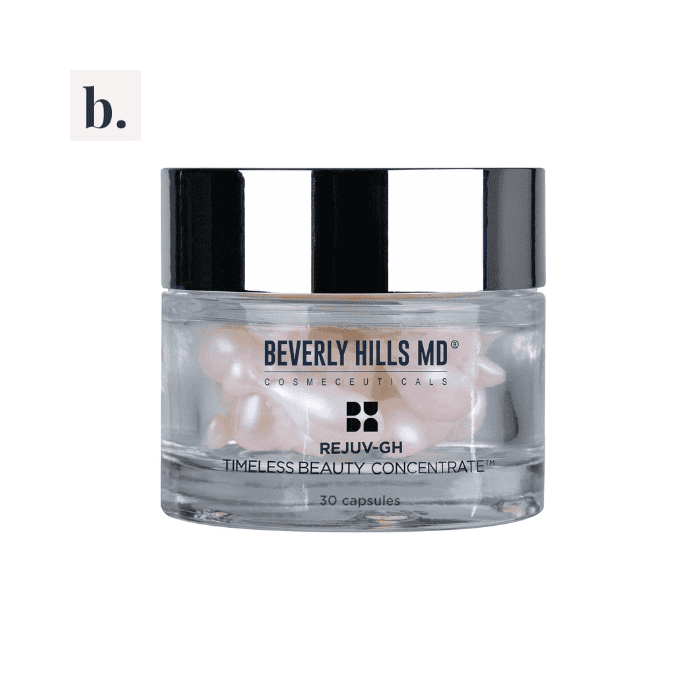
Beverly Hills MD
Rejuv-GH Timeless Beauty Concentrate
If your priority is smoother-looking skin and a luminous finish, Rejuv-GH offers a useful silicone-rich texture. Its peptide positioning does not prove lasting lifting, so the Premium value depends on how much…
Read the BeautyBrief
TULA
24-7 Moisture Hydrating Day & Night Cream
If you tolerate fragrance and prefer a rich day-and-night cream, classic TULA 24-7 offers meaningful Premium hydration backed by a small study. If you avoid scent, dairy-derived ingredients or heavier emollients, select…
Read the BeautyBrief
Peach & Lily
Matcha Pudding Antioxidant Cream
If you enjoy a scented rich cream with niacinamide, Matcha Pudding offers useful Mid-Range hydration value. If you avoid essential oils or rich emollients, choose a simpler fragrance-free moisturizer.
Read the BeautyBrief
YOUFE
Vitamin E Cleansing Balm
If you enjoy scented cleansing balms, YOUFE provides oil-based makeup and sunscreen removal. Its aromatic oils can affect sensitive-eye and skin tolerance, and rinse-off vitamin E is not a leave-on treatment. At…
Read the BeautyBrief