

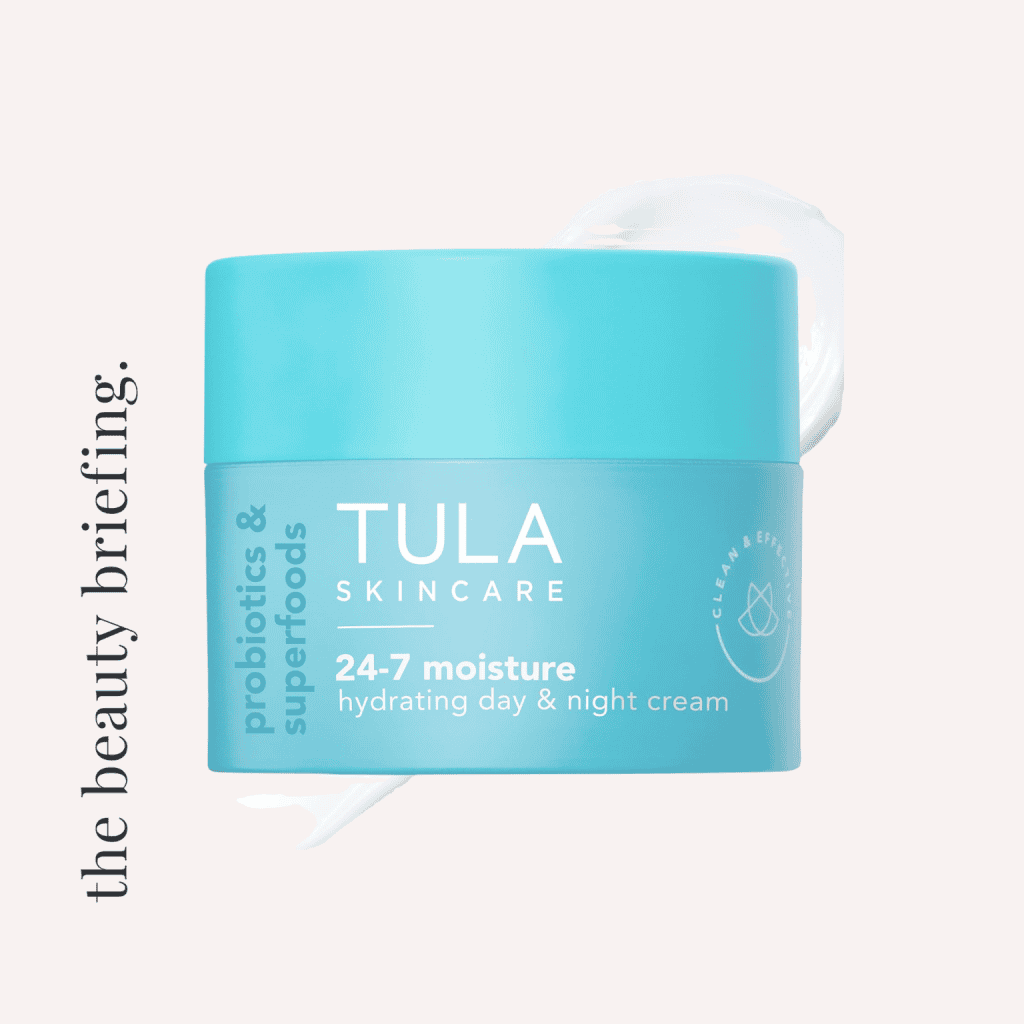
TULA 24-7 Moisture Hydrating Day & Night Cream Review
BeautyBrief™
Brand
TULA
Product
24-7 Moisture Hydrating Day & Night Cream
Claims check
You get clinically supported 24-hour hydration from a rich, fragranced cream, but the 31-person consumer perceptions of firmness and the marketing's microbiome claims do not establish lasting structural changes.
Shopper fit
- Dry
- Normal
- Combination
Formula flags
- Fragrance
- Comedogenic concerns
- Silicones
Shopper preferences
- Cruelty-Free
Key ingredients
| Squalane | Helps soften skin and reduce moisture loss. |
|---|---|
| Glycerin | Helps attract water to the outer layers of skin. |
| Sodium Hyaluronate | Helps bind water in the skin. |
| Sodium PCA | Adds more water-binding support to the moisturizer. |
| Ethylhexyl Palmitate | A prominent emollient that adds slip and richness, which can be a preference concern for very clog-prone routines. |
Price tier
$$$ Premium
Value check
At the Premium tier, you pay for 24-hour hydration testing and a rich day-and-night texture; fragrance and milk-derived ingredients limit its fit compared with simpler alternatives.
Where to buy
We may earn a commission through these links at no additional cost to you. This does not affect our BeautyBrief.
Bottom line
If you tolerate fragrance and prefer a rich day-and-night cream, classic TULA 24-7 offers meaningful Premium hydration backed by a small study. If you avoid scent, dairy-derived ingredients or heavier emollients, select a more compatible formula.
If you want one moisturizer for morning and evening and prefer a creamy finish, the classic TULA 24-7 Moisture Hydrating Day & Night Cream combines squalane, glycerin, sodium hyaluronate and other emollients. The brand publishes product-specific instrumental hydration and consumer-perception results from a 31-person testing program.
Be careful to distinguish the classic version from the separately sold fragrance-free cream. This classic version contains perfume, fragrance allergens and milk proteins, so it is cruelty-free but not vegan according to TULA.
What it claims
TULA says the classic cream hydrates for 24 hours, nourishes the skin microbiome, strengthens the moisture barrier and improves the appearance of firmness and fine lines. The official page reports an instrumental test involving 31 participants and self-assessments involving 31 people at one and four weeks.[1]
After one week, the brand says 96% felt hydrated all day. Its four-week self-assessments also report high levels of perceived firmness and smoother-looking skin. The percentages are brand-published study outcomes; self-assessment does not establish collagen rebuilding, and the page does not publish a separate product-level microbiome measurement.
Claims vs. formula
Ethylhexyl palmitate is the second ingredient and gives the classic cream substantial emollient slip. Squalane, caprylic/capric triglyceride, cetyl alcohol, dimethicone and vegetable oil reinforce the moisture-retaining base, while glycerin, sodium hyaluronate, sodium lactate and sodium PCA provide complementary humectant support.
Independent glycerol research supports water-binding and outer-skin-barrier roles, providing a plausible mechanism for moisturization. The actual 24-hour hydration claim is better evaluated from TULA’s finished-product instrumental testing, not simply the presence of glycerin.[2]
Lactococcus and Bifida ferment lysates, Lactobacillus ingredients, lactose and milk protein contribute to TULA’s prebiotic and probiotic-style story. The brand also explicitly states that this cream does not contain live cultures. The label does not establish improved microbial diversity or a clinical change in the skin microbiome.
Lactic acid is listed but a disclosed concentration and finished-product exfoliation endpoint are lacking; it is not a reason to treat this as a dedicated acid exfoliant. The formula’s current listed perfume and fragrance allergens are more relevant to sensitive-skin selection than the marketing’s broad all-skin-types positioning.
Ingredients that matter
Squalane, ethylhexyl palmitate and dimethicone supply skin-softening slip; glycerin, sodium hyaluronate and sodium PCA bind moisture. The cream therefore has a credible daily hydration system for skin that likes a richer finish.
Ethylhexyl palmitate is an emollient, not proof the product will clog pores. Its prominence may nevertheless matter if your very clog-prone skin has reacted poorly to similar rich textures; individual tolerance is more important than an ingredient’s reputation alone.
The classic formula includes parfum, alpha-isomethyl ionone, benzyl benzoate, hexyl cinnamal and a linalool-named entry on the official list. Fragrance and silicones are real Formula Flags, while Comedogenic Concerns describes a precaution for some shoppers rather than a tested pore-clogging outcome.

Squalane
If your skin feels dry or rough, squalane can make it feel softer and smoother. You don't need a separate oil when your moisturizer already keeps your skin comfortable.
Read the IngredientBrief
Glycerin
If your skin feels dry or tight, glycerin helps your skin hold moisture. You don't need a high percentage or a separate serum when your moisturizer already works well.
Read the IngredientBrief
Hyaluronic Acid
If your skin feels dry or tight, hyaluronic acid helps your skin hold moisture. You don't need several HA forms or a separate serum when your moisturizer already hydrates well.
Read the IngredientBrief
Sodium PCA
Sodium PCA is a well-established humectant and component of skin's natural moisturizing system. It supports hydration inside a balanced formula but is highly replaceable and usually does not need a…
Read the IngredientBriefSafety and regulatory context
The classic cream contains milk proteins and is explicitly described by TULA as not vegan, despite being cruelty-free. The fragrance-free version has a different full ingredient list, also includes milk-related ingredients and should be evaluated as its own formulation.[1]
Milk protein is relevant if you avoid dairy-derived ingredients; fragrance is relevant if your skin has reacted to perfumed moisturizers. Neither a “prebiotic” label nor a broad sensitive-skin claim is a substitute for checking the exact variant’s INCI.
What to expect in the short term
You get a smooth, creamy moisturizer with a noticeable scent. TULA’s instrumental program supports its 24-hour hydration positioning, while the precise comfort you experience depends on the amount used and other products in your routine.
What to expect over time
Continued use supports moisture and skin comfort. The four-week consumer responses about firmness, tone and fine lines add appearance context but do not prove structural lifting, measurable collagen increase or microbiome restoration.
Who it fits
This is best considered if your skin is dry, normal or combination and you like a fragranced, emollient-rich cream. TULA also markets it to oily and acne-prone shoppers, but those broad claims are not a substitute for personal compatibility with a richer texture.
If you are fragrance-reactive, the separate fragrance-free version is the more direct comparison. If vegan status matters, neither the classic nor fragrance-free version should be assumed vegan because the brand identifies milk-related ingredients.
Compare before you buy
Choose classic 24-7 Moisture when you want one Premium cream for morning and night with product-level hydration testing and a smooth emollient finish. You are paying partly for a branded prebiotic concept, though the microbiome benefit remains unmeasured in the public summary.
Choose a fragrance-free cream when scent tolerance matters, or a simpler product if you only need moisture and do not value the extra appearance study. The classic 1.5 oz and supersize 3.4 oz jars have different UPCs.
Final Assessment
TULA 24-7 Moisture Hydrating Day & Night Cream provides a credible Premium moisturizer for dry-to-normal skin with tested hydration and a comfortable creamy texture. Its 31-person study supports moisture and consumer-perceived appearance changes, but the microbiome benefits remain unverified; the classic version’s fragrance, prominent emollients and milk proteins are decisive fit considerations when you compare value.
Where to buy
Choose a retailer to view current pricing and availability.
We may earn a commission through these links at no additional cost to you.
Last reviewed: October 2026
Sources
- TULA Skincare. 24-7 Moisture Hydrating Day & Night Cream. Official U.S. classic and fragrance-free INCI, study summaries and animal-derived-ingredient statement. Accessed October 15, 2026.
- Fluhr JW et al. Glycerol and the skin: holistic approach to its origin and functions. British Journal of Dermatology. 2008. Ingredient research, not a TULA product trial.