
Polyglutamic Acid in Skincare
Polyglutamic acid is a water-binding polymer with early evidence for short-term hydration in specific topical formulas. Independent human research is limited, and the complete moisturizing formula matters more than PGA percentages.
- Aliases
- Poly-γ-Glutamic Acid, Gamma-Polyglutamic Acid, γ-PGA, Gamma-PGA
- Ingredient category
- Humectant
- Most relevant for
- Dryness
- Evidence strength
- Some Support for Improving skin hydration with topical polyglutamic-acid or polyglutamate formulations
- Formula matters
- Molecular weight, acid or salt form, concentration, active-polymer content, vehicle, and supporting moisturizers shape results. Supplier-blend percentages and small patent tests do not establish superiority over other humectants.
- Separate product needed?
- Usually No. Most routines do not need a separate PGA serum if the existing moisturizer or hydrating serum already keeps skin comfortable.
BB takeaway
Polyglutamic acid is a useful hydrating support ingredient, not a proven upgrade over hyaluronic acid or glycerin. Choose the complete moisturizing formula instead of chasing PGA percentages or water-holding claims.
Ingredient evidence does not prove the performance of every finished product containing it.
What is polyglutamic acid?
Polyglutamic Acid is a cosmetic conditioning ingredient. In skincare research, the form most often discussed is poly-γ-glutamic acid, or γ-PGA, a polymer made from repeating glutamic-acid units and often produced through microbial fermentation.[1][2]
You may also see Sodium Polyglutamate, the sodium salt of polyglutamic acid, which is used as a humectant and skin-conditioning ingredient.[3]
Despite the word “acid,” polyglutamic acid is not an exfoliating acid. It is also not the same ingredient as hyaluronic acid.
What does polyglutamic acid do for skin?
Its main value is hydration support. Polyglutamate materials bind water and can help a serum, gel, or moisturizer leave skin feeling smoother and more hydrated.
Depending on molecular weight and formula, the polymer can also contribute texture and a light film on the skin.
Those functions do not make polyglutamic acid a proven treatment for wrinkles, acne, pigmentation, eczema, or a damaged skin barrier.
What the evidence says about polyglutamic acid skincare
Polyglutamic acid has some support for improving skin hydration, but direct independent human research is limited.
One of the clearest human tests comes from a cosmetic patent. Ten panelists received model moisturizers containing specific γ-polyglutamate materials. A cream with 0.1% high-molecular-weight γ-polyglutamate in magnesium-salt form produced a larger short-term increase in skin capacitance than prototype creams containing 0.1% hyaluronic acid or 5% propylene glycol.[4]
That is useful evidence for the tested material, not strong proof that retail polyglutamic acid products generally outperform hyaluronic acid. The test was tiny, used specific prototype creams and salt forms, and came from a patent assigned to the company developing the materials.
A 2025 laboratory study of high-molecular-weight γ-PGA found changes in barrier- and hydration-related markers in cultured keratinocytes and reconstructed skin.[2] Those findings support biological plausibility, not clinical barrier repair in people.
A 2024 formulation study also found that γ-PGA materials were hygroscopic and could be incorporated into model creams, but it did not test skin hydration benefits in people.[5]
How polyglutamic acid form and formulation affect results
Molecular weight can change viscosity, film formation, water retention, and skin feel.
The chemical form also matters. Polyglutamic Acid, Sodium Polyglutamate, and magnesium, calcium, or potassium polyglutamate materials should not be assumed to perform identically.
Percentage claims need context. A brand may advertise the amount of a supplied raw-material solution rather than the amount of pure polymer. Without documentation, “3% polyglutamic acid” does not reveal active solids, molecular weight, or comparability with another brand’s 3% claim.
The rest of the formula can matter more than the headline ingredient. Glycerin, glycols, hyaluronic acid, emollients, and occlusives all affect the final hydration result.
Who may benefit from polyglutamic acid skincare?
Polyglutamic acid makes the most sense when you want lightweight hydration from a serum, gel, or moisturizer.
Dry or dehydrated-feeling skin may benefit when it is part of a complete moisturizing formula. Combination or oily skin may also prefer it in lightweight textures.
If your current moisturizer already keeps skin comfortable, there is little reason to add PGA just because it is trending.
Polyglutamic acid side effects and irritation risk
Published human safety data specific to topical polyglutamic acid are limited.
The small patent tests reported no meaningful irritation from the tested γ-polyglutamate prototypes, but the evidence is too small to support “non-irritating for everyone” claims.[4]
As always, the complete formula matters. Fragrance, preservatives, exfoliating acids, solvents, or other actives may be more relevant to irritation.
How to use polyglutamic acid in your skincare routine
Use the finished product according to its format.
A hydrating serum generally goes after cleansing and before moisturizer. If Polyglutamic Acid or Sodium Polyglutamate is already in your moisturizer, use that product as your normal moisturizing step.
If skin is very dry, a humectant-heavy serum may not be enough on its own. A moisturizer with emollients and, when needed, occlusives usually does more to keep skin comfortable.
How long does polyglutamic acid take to work?
Surface hydration can change quickly because PGA is primarily a water-binding ingredient.
In the small patent test, skin-capacitance changes were measured within minutes and followed for two hours.[4]
That timing applies to the tested prototype creams, not every retail serum. There is no established human timeline for PGA to repair the barrier or create long-term anti-aging changes.
What can you use with polyglutamic acid?
Polyglutamic acid can be used with hyaluronic acid, glycerin, niacinamide, vitamin C, retinoids, exfoliating acids, peptides, ceramides, and sunscreen.
Using multiple humectants is common, but more is not automatically better. A formula combining PGA and hyaluronic acid is not inherently superior to a simpler moisturizer that already hydrates well.
PGA also cannot cancel out irritation from an overly aggressive routine.
How to choose a polyglutamic acid product
Choose the product for the hydration job it needs to do, not because PGA sounds more advanced than familiar moisturizers.
Check the exact INCI, and do not chase the biggest percentage. The number may refer to a supplier solution rather than pure polymer.
Be skeptical of dramatic “holds thousands of times its weight in water” or “better than hyaluronic acid” claims. Raw-material water absorption and tiny patent comparisons are not the same as robust clinical superiority.
Give finished-product testing and the full moisturizing system more weight than the PGA story.
Polyglutamic acid alone does not justify Premium pricing.
Do you need a separate polyglutamic acid serum?
Usually, no.
A dedicated PGA serum can be useful if you prefer lightweight hydration and your moisturizer alone is not enough.
If your current routine already keeps skin hydrated and comfortable, another humectant serum is likely to duplicate the same job.
The BB Perspective
Polyglutamic acid is a legitimate hydration ingredient, but its marketing has moved faster than the human evidence.
Specific PGA materials can improve short-term water retention, and laboratory work supports a plausible hydration story. What is missing is a strong independent clinical body showing that ordinary PGA products outperform hyaluronic acid, glycerin, or good moisturizers.
Buy the serum or moisturizer because the complete formula hydrates well, feels good, and is fairly priced—not because PGA is positioned as the newest hydration upgrade.
Last reviewed: September 2026
Sources
COSMILE Europe. Polyglutamic Acid.
COSMILE lists Polyglutamic Acid as a cosmetic ingredient with a skin-conditioning function. It does not establish an ideal concentration or clinical superiority. Return to citation.
Ko HJ, Park S, Shin E, et al. Poly-γ-Glutamic Acid from a Novel Bacillus subtilis Strain: Strengthening the Skin Barrier and Improving Moisture Retention in Keratinocytes and a Reconstructed Skin Model. International Journal of Molecular Sciences. 2025;26(3):983. doi:10.3390/ijms26030983. PMID:39940752. PMCID:PMC11817278.
This laboratory study supports hydration- and barrier-related mechanisms in cells and reconstructed skin, not clinical barrier repair in people. Several authors were affiliated with CoSeedBioPharm or ItsHanbul; the study also received Korean public research funding. Return to citation.
COSMILE Europe. Sodium Polyglutamate.
COSMILE identifies Sodium Polyglutamate as a humectant and skin-conditioning ingredient. It supports the distinction between Polyglutamic Acid and its sodium salt. Return to citation.
Ho GH, Yang TH, Yang J. Moisturizers comprising one or more of gamma-polyglutamic acid, gamma-polyglutamates and gamma-polyglutamate hydrogels for use in cosmetic or personal care products. U.S. Patent Application US20060153785A1. 2006.
The applicant’s patent reports a 10-person prototype moisturizer comparison and small irritation tests. These human data were submitted as patent support rather than independent peer-reviewed clinical research. They do not show that retail PGA products generally outperform hyaluronic acid. Return to citation.
Parati M, Philip C, Allinson SL, et al. Brown Algae as a Valuable Substrate for the Cost-Effective Production of Poly-γ-Glutamic Acid for Applications in Cream Formulations. Polymers. 2024;16(14):2091. doi:10.3390/polym16142091. PMID:39065408.
This formulation study supports the importance of γ-PGA source and molecular weight but did not measure clinical skin hydration in people. Return to citation.
Products featuring Polyglutamic Acid
These evaluated products list Polyglutamic Acid among the Key Ingredients that meaningfully shape the formula. Inclusion here reflects ingredient relevance, not an endorsement or rating.
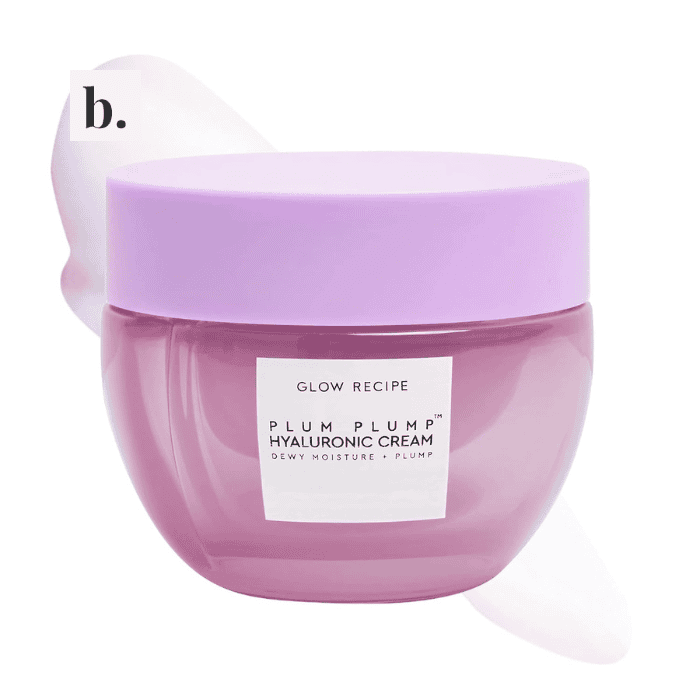
Glow Recipe
Plum Plump Hyaluronic Cream
If you want lightweight hydration, Plum Plump combines hyaluronic acid forms, glycerin and squalane for a temporarily plumper-looking finish. Its refillable format adds value, but the fragrance and limited wrinkle evidence matter…
Read the BeautyBrief
Obagi
HYDRATE LIGHT® Weightless Gel Cream
If you want a light moisturizer that layers easily under makeup, this Premium gel cream offers credible hydration support and brand-reported finished-product testing. Its 24-hour result is useful but not proof of…
Read the BeautyBrief
Peach & Lily
Hydrobubble Deep Foam Cleanser
If you enjoy rich foam and built-in gentle exfoliation, Hydrobubble offers a differentiated Mid-Range cleansing option. If your skin is reactive or you already exfoliate regularly, a simpler wash is a more…
Read the BeautyBrief
Mad Hippie
Wrinkle Relaxing Eye Treatment
If your main concern is expression lines around the eyes, this treatment has useful but limited eight-week study findings. Different causes of puffiness or darkness affect your results, and topical peptides are…
Read the BeautyBrief