
Mandelic Acid in Skincare
Mandelic acid is an AHA exfoliant with some human evidence for mild acne, comedones, and superficial discoloration. Its reputation as a gentle acid is not a guarantee; concentration, pH, format, and the rest of the routine matter.
- Aliases
- DL-Mandelic Acid, 2-Hydroxy-2-phenylacetic Acid, Phenylglycolic Acid
- Ingredient category
- Exfoliant
- Most relevant for
- Acne, Clogged Pores, Dullness, Hyperpigmentation, Rough and Bumpy Skin
- Evidence strength
- Some Support for Improving mild-to-moderate acne and comedones with topical mandelic-acid formulations
- Formula matters
- Concentration, pH, buffering, free-acid level, product format, contact time, frequency, and other exfoliants shape results. Professional and combination peel studies do not establish results for home mandelic-acid products.
- Separate product needed?
- Sometimes. A separate mandelic-acid product makes sense when mild acne or texture still needs help and another acid, retinoid, or acne treatment is not doing that job.
BB takeaway
Mandelic acid is a credible exfoliant, but gentle-AHA marketing is not a performance guarantee and a higher percentage is not automatically better. Use it when it fills a real exfoliation gap rather than stacking it onto an already active routine.
Ingredient evidence does not prove the performance of every finished product containing it.
What is mandelic acid?
Mandelic acid is an alpha hydroxy acid, or AHA. It is also known as 2-hydroxy-2-phenylacetic acid and phenylglycolic acid.[1]
Like other AHAs, mandelic acid helps loosen connections between surface skin cells so they shed more easily. That can make rough skin feel smoother and dull skin look brighter.
Mandelic acid is often marketed as a gentler AHA than glycolic acid. Its larger molecular size may help explain slower penetration, but “gentle” is not guaranteed. Concentration, pH, contact time, frequency, and the rest of the formula determine how irritating a product feels.
What does mandelic acid do for skin?
Mandelic acid mainly exfoliates the skin surface.
With consistent, comfortable use, it can help rough texture, dullness, mild clogged pores, and some superficial post-blemish discoloration. Human studies also support a possible role in mild-to-moderate acne.
Its acne role is supportive rather than comprehensive. Mandelic acid does not address every cause of acne and should not be expected to control painful, widespread, nodular, or scarring breakouts by itself.
It can improve some superficial pigmentation through exfoliation, but it is less established for melasma or deeper discoloration than dedicated pigment treatments.
What the evidence says about mandelic acid skincare
Mandelic acid has some support for improving mild-to-moderate acne and comedones, but the evidence is limited and formula-specific.
A two-month open study followed 60 people with mild-to-moderate papulopustular acne using complete cosmetic creams containing either 5% or 10% mandelic acid.[2] Both groups showed reductions in acne severity, pustules, inflammatory nodules, comedones, and seborrhea.
The groups were not equivalent: participants with milder acne used the 5% cream with lemon peel extract, while those with more severe acne used the 10% cream with sweet almond proteins. Without random assignment, matched formulas, or a vehicle control, the study cannot establish which mandelic-acid concentration works better. The manufacturer funded the study.
Professional-peel research adds support but cannot be transferred directly to home serums. In one comparative study, a peel combining 20% salicylic acid with 10% mandelic acid improved active acne and post-acne hyperpigmentation more than a 35% glycolic acid peel on several measures.[3] Because the peel combined salicylic and mandelic acids, the study cannot isolate mandelic acid’s contribution.
A systematic review of randomized chemical-peel trials found that peels can improve mild-to-moderate acne but concluded that the evidence was too limited and heterogeneous to establish one peel as clearly superior.[4]
Evidence for pigmentation is also preparation-specific. A 2025 study of professional 30% mandelic acid and 30% lactic acid peels for periorbital hyperpigmentation found that both groups improved, but lactic acid performed better overall and irritation was more frequent in the mandelic-acid group.[5]
For your routine, mandelic acid is a credible exfoliant with some acne and pigmentation support—not proof that it is the gentlest or most effective AHA.
How mandelic acid form and formulation affect results
A cleanser, leave-on serum, toner, and professional peel do not perform the same way.
A leave-on product gives mandelic acid more contact time than a cleanser. Professional peels use much higher concentrations and controlled application, so peel-study results should not be used to promise that a home serum will deliver the same outcome.
Concentration is only one part of strength. Product pH, buffering, free-acid level, contact time, frequency, and other exfoliating ingredients all affect how aggressively a formula behaves.
Combination formulas deserve extra attention. Mandelic acid paired with salicylic acid, glycolic acid, lactic acid, retinoids, or another exfoliant can raise the irritation burden even when the front label emphasizes “gentle exfoliation.”
Do not treat 5%, 10%, or a professional-peel percentage as a quality score. A lower-strength formula you can use consistently can be more useful than a stronger one that repeatedly leaves skin inflamed.
Who may benefit from mandelic acid skincare?
Mandelic acid can make sense when rough texture, dullness, mild clogged pores, superficial post-blemish marks, or mild acne is the main concern.
It can also be worth considering if you want an AHA but have not tolerated some glycolic-acid formulas well. That is a product-selection reason, not proof that all mandelic-acid products are inherently milder.
You may not need it if your routine already contains another AHA, salicylic acid, benzoyl peroxide, a prescription acne treatment, or a retinoid that already addresses the same concern.
If skin is burning, peeling, cracked, sunburned, inflamed, or recovering from a procedure, adding another exfoliant is usually the wrong move.
Mandelic acid side effects and irritation risk
Mandelic acid can cause stinging, burning, redness, dryness, flaking, itching, tenderness, or increased sensitivity, especially when a product is strong or used too often.
In the 5% and 10% home-use study, temporary redness, flaking, itching, and other irritation occurred in both groups.[2] The 2025 professional-peel study also reported irritation with 30% mandelic acid, reinforcing that the ingredient is not irritation-proof.[5]
FDA advises that topical AHA cosmetics may increase skin sensitivity to the sun while they are used and for up to a week after stopping.[6] Use broad-spectrum sunscreen, protective clothing, and sensible sun exposure while using an AHA.
Too much exfoliation can also worsen post-inflammatory hyperpigmentation by creating more inflammation. Stop using the product if you develop swelling, blistering, severe redness, or persistent pain.
How to use mandelic acid in your skincare routine
Follow the directions on the exact product.
For a leave-on formula, starting less frequently makes it easier to judge tolerance before increasing use.
Apply it as directed, then use a comfortable moisturizer if needed. Broad-spectrum sunscreen belongs in the morning routine whenever you use an AHA.
Introduce mandelic acid when the rest of the routine is stable. Starting it during the same week as a new retinoid, peel, scrub, benzoyl peroxide treatment, or another acid makes irritation harder to identify.
More tingling does not mean better exfoliation.
How long does mandelic acid take to work?
Surface smoothness can improve after several uses, but changes in acne, clogged pores, or post-blemish discoloration usually take longer.
The home-use acne study measured improvement over one to two months.[2] That makes several weeks a more realistic decision window than expecting a major change after a few nights.
Those timelines are not universal. Results depend on the formula, frequency, concern being treated, sunscreen use, and whether irritation is creating new marks.
What can you use with mandelic acid?
Mandelic acid fits best beside simple support products: a gentle cleanser, moisturizer, and sunscreen.
Hydrating ingredients such as glycerin, hyaluronic acid, and panthenol can improve comfort. Ceramides, squalane, dimethicone, and petrolatum can help when dryness becomes a problem.
Niacinamide can generally be used in the same routine when both products are well tolerated.
Use more caution with other exfoliating acids, retinoids, benzoyl peroxide, scrubs, peel pads, and strong masks. These products are not automatically incompatible, but stacking them increases the chance of overexfoliation.
How to choose a mandelic acid product
Start with the format, directions, and the rest of your routine rather than the percentage alone.
A leave-on serum or toner should explain how often to use it. A peel should give clear application time, removal instructions, and safety warnings.
Do not assume a lower percentage is weak or a higher percentage is better. The study’s 5% and 10% creams were tested in groups with different starting acne severity and supporting ingredients, so their results do not establish which strength works better.[2]
Be cautious with “professional peel results,” “no irritation,” “safe for sensitive skin,” and claims that mandelic acid treats all types of acne or pigmentation.
Mandelic acid alone does not justify Premium pricing. Pay more only when the finished product offers a meaningful advantage in formulation, tolerability, packaging, directions, or credible product-level evidence.
Do you need a separate mandelic acid serum?
Sometimes.
A dedicated leave-on mandelic-acid product can make sense when your routine is otherwise simple and you specifically need help with texture, mild clogged pores, dullness, superficial post-blemish marks, or mild acne.
Skip it when another AHA, salicylic acid, retinoid, acne treatment, exfoliating toner, or peel already covers the same job. More exfoliation is not automatically better skincare.
The BB Perspective
Mandelic acid is a useful AHA with some human evidence for mild acne, comedones, and superficial discoloration.
The evidence is not strong enough to make it a first-line acne treatment or to support the idea that mandelic acid is always gentler than other AHAs. Formula strength, pH, contact time, frequency, and the rest of the routine matter more than the ingredient’s reputation.
Choose mandelic acid when it fills a real exfoliation gap and stays comfortable enough to use consistently. Do not add it simply because “gentle AHA” sounds safer than the exfoliants already in your routine.
Last reviewed: September 2026
Sources
National Library of Medicine PubChem. Mandelic Acid.
PubChem identifies mandelic acid as 2-hydroxy-2-phenylacetic acid and lists phenylglycolic acid among recognized names. This supports ingredient identity rather than finished-product efficacy. Return to citation.
Dębowska RM, Kaszuba A, Michalak I, et al. Evaluation of the efficacy and tolerability of mandelic acid-containing cosmetic formulations for acne skin care. Dermatology Review/Przegląd Dermatologiczny. 2015;102(4):316-321. doi:10.5114/dr.2015.53419.
This open two-month study followed 60 people with mild-to-moderate papulopustular acne using complete creams containing 5% or 10% mandelic acid. The 5% and 10% groups differed in acne severity and supporting ingredients, with no vehicle control, so this was not a controlled test of acid strength. Dr Irena Eris Cosmetic Laboratories funded the study, prepared the creams, approved the clinical methods, and paid the testing institution. Return to citation.
Garg VK, Sinha S, Sarkar R. Glycolic acid peels versus salicylic-mandelic acid peels in active acne vulgaris and post-acne scarring and hyperpigmentation: A comparative study. Dermatologic Surgery. 2009;35(1):59-65. doi:10.1111/j.1524-4725.2008.34383.x. PMID:19076192.
This professional-peel study compared 35% glycolic acid with a combination of 20% salicylic acid and 10% mandelic acid in 44 people. The combination performed better on several acne and pigmentation measures, but mandelic acid’s contribution cannot be separated from salicylic acid and the protocol does not represent ordinary home-use skincare. Return to citation.
Chen X, Wang S, Yang M, Li L. Chemical peels for acne vulgaris: A systematic review of randomised controlled trials. BMJ Open. 2018;8(4):e019607. doi:10.1136/bmjopen-2017-019607. PMID:29705755. PMCID:PMC5931279.
This systematic review found that several professional chemical peels improved mild-to-moderate acne, but study quality and clinical heterogeneity prevented a robust conclusion about which peel was best. It provides context for mandelic-acid-containing peels rather than proof for a specific home serum. The review was funded by the Sichuan Provincial Science and Technology Department (grant 2017JY0277). The authors declared no competing interests and reported that the funder had no role in the study. Return to citation.
Malviya A, Shrivastava S, Pancholi S, et al. A Prospective Study Comparing Clinical Efficacy of 30% Mandelic Acid Peel Versus 30% Lactic Acid Peel in Periorbital Melanosis. Indian Dermatology Online Journal. 2025;16(6):916-920. doi:10.4103/idoj.idoj_1051_24. PMID:41051381. PMCID:PMC12622926.
This prospective study randomized 70 patients to three sessions of 30% mandelic acid or 30% lactic acid peel for periorbital hyperpigmentation. Both groups improved, but lactic acid produced greater overall improvement and irritation was more frequent with mandelic acid. The high-strength professional eye-area protocol should not be generalized to ordinary home serums. Nine of the 70 enrolled participants did not complete the study; the findings reflect a six-week professional eye-area peel protocol, not ordinary home use. The study was self-funded and the authors reported no conflicts of interest. Return to citation.
U.S. Food and Drug Administration. Alpha Hydroxy Acids. Current September 2026.
FDA advises that topical AHA cosmetics can increase skin sensitivity to ultraviolet radiation during use and for up to a week after stopping and recommends sun protection. The underlying human studies focused mainly on glycolic acid, so the guidance is a class-level precaution rather than mandelic-acid-specific efficacy evidence. Return to citation.
Products featuring Mandelic Acid
These evaluated products list Mandelic Acid among the Key Ingredients that meaningfully shape the formula. Inclusion here reflects ingredient relevance, not an endorsement or rating.
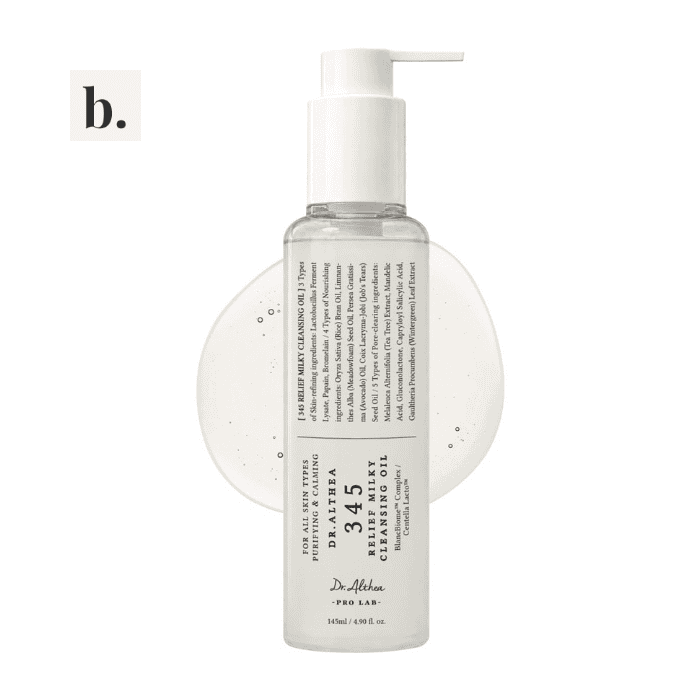
Dr.Althea
345 Relief Milky Cleansing Oil
This is best aligned with normal, combination, oily, or acne-prone skin that wants an emulsifying first cleanse for makeup, sunscreen, sebum, and pore buildup. The cleansing system is the main strength, while…
Read the BeautyBrief
Differin
Daily Oil-Free Hydrating Cleanser
If your combination, oily or acne-prone skin needs a hydrating wash with some acid-based smoothing, this Budget cleanser offers a useful option. Its rinse-off format does not make it an acne treatment,…
Read the BeautyBrief
Medicube
Zero Pore Capsule Cleansing Foam
If your oily or combination skin needs exfoliation during cleansing, you get salicylic acid, AHA/PHA ingredients and silica in one wash. Fragrance and cumulative exfoliation limit its fit for reactive skin. At…
Read the BeautyBrief
Cetaphil
Gentle Exfoliating SA Cleanser
If you want light exfoliation while cleansing, Cetaphil combines gluconolactone, salicylic acid and mandelic acid. The unreported percentages do not establish an acne-medication dose or intensive resurfacing, and added exfoliants can challenge…
Read the BeautyBrief