
Betaine in Skincare
Betaine is a well-established humectant and conditioning ingredient that supports hydration and can improve the comfort of some cleansers. It is useful but highly replaceable.
- Aliases
- Trimethylglycine, Glycine Betaine, TMG
- Ingredient category
- Conditioning Agent, Humectant
- Most relevant for
- Dryness
- Evidence strength
- Well Supported for Supporting skin hydration as a humectant
- Formula matters
- Betaine works as part of the complete moisturizing or cleansing system; the surrounding humectants, emollients, occlusives, or surfactants matter more than its percentage or ingredient-list position.
- Separate product needed?
- Usually No. A dedicated betaine product is usually unnecessary because other well-formulated hydrating products can fill the same routine need.
BB takeaway
Betaine is credible hydration support and can improve the comfort of some cleansing formulas. Choose the complete product rather than seeking out Betaine specifically or paying more for a highlighted percentage.
Ingredient evidence does not prove the performance of every finished product containing it.
What is betaine?
Betaine is a small, water-soluble compound also called trimethylglycine or glycine betaine. In skincare, it works mainly as a humectant and conditioning ingredient that helps formulas support hydration and skin comfort.[1]
Do not confuse Betaine with Cocamidopropyl Betaine, a cleansing surfactant, or Betaine Salicylate, a salicylate-containing ingredient. They do different jobs.
What does betaine do for skin?
Betaine’s clearest role is hydration support. It helps a formula hold water in the outer skin layer, which can make dry or tight-feeling skin more comfortable.
It can also support cleanser comfort. Human studies found less irritation when betaine was added to detergent or soap systems, although betaine cannot make every cleanser gentle.[2][3]
Betaine is not a stand-alone acne, wrinkle, exfoliating, or brightening treatment.
What the evidence says about betaine skincare
Betaine is well established as a humectant and conditioning ingredient.[1] Human cleanser studies also support a role in reducing irritation from some surfactant systems.
In one study of 21 adults, adding betaine reduced irritation from sodium lauryl sulfate and cocamidopropyl betaine during patch testing.[2] Another study of 28 adults found that soaps containing betaine were among the least irritating, but higher betaine concentrations did not keep improving the result.[3]
Laboratory and ex vivo research suggests betaine also affects proteins involved in skin-barrier function.[4] That is interesting mechanistic evidence, but it does not prove that a retail betaine serum repairs a damaged barrier in people.
What this means for you: betaine is credible hydration support and can improve the comfort of some cleansing formulas. Broader barrier-repair or sensitive-skin claims need evidence from the finished product.
How betaine form and formulation affect results
Betaine usually works as one part of a larger formula. In leave-on products, ingredients such as glycerin, hyaluronic acid, panthenol, emollients, and occlusives also shape hydration and skin feel.
In cleansers, the surfactant blend, pH, contact time, and other conditioning ingredients matter more than betaine alone. A cleanser can contain betaine and still feel too stripping.
There is no reason to shop for the highest betaine percentage. Human research does not show a simple more-is-better relationship.[3]
Who may benefit from betaine skincare?
Betaine fits well in products for dry, dehydrated, normal, combination, or oily skin when you want extra hydration without making it the main treatment step.
It can also be useful in a cleanser designed to feel less stripping. If your current products already keep your skin comfortable, there is no need to add another product specifically for betaine.
Betaine side effects and irritation risk
Betaine is generally considered suitable for cosmetic use under the conditions reviewed by the Cosmetic Ingredient Review.[1]
That does not guarantee every betaine product will suit your skin. Fragrance, preservatives, exfoliating acids, retinoids, surfactants, and other formula components can still cause irritation.
Do not transfer concerns about Cocamidopropyl Betaine to Betaine simply because the names overlap. They are different ingredients.
How to use betaine in your skincare routine
Betaine does not need a special application method. Use the product according to its format: rinse off a cleanser, or use a toner, serum, or moisturizer in its normal place in your routine.
You do not need to layer several betaine products. If your skin already feels comfortably hydrated, more betaine is unlikely to add much.
How long does betaine take to work?
A well-formulated hydrating product can make skin feel more comfortable quickly, but that result comes from the complete formula rather than betaine alone.
There is no established betaine timeline for repairing the skin barrier, fading discoloration, reducing wrinkles, or treating a skin condition.
What can you use with betaine?
Betaine fits easily with glycerin, hyaluronic acid, panthenol, ceramides, emollients, and occlusives. It can also appear alongside treatment ingredients such as retinoids or exfoliating acids.
A humectant does not cancel irritation from an overly aggressive routine. If stronger actives repeatedly leave your skin uncomfortable, adjusting those steps matters more than adding another hydrating ingredient.
How to choose a betaine product
Choose the product for the job you need it to do, not simply because Betaine appears on the label.
For a moisturizer or serum, consider the complete moisturizing system, texture, finish, fragrance, and supporting ingredients. For a cleanser, focus on the surfactant system and how your skin feels after rinsing.
Betaine alone does not justify Premium pricing. A higher price makes sense only when the complete product gives you a meaningful advantage.
Do you need a separate betaine serum?
Usually no. Betaine is most useful as a supporting ingredient already included in a moisturizer, toner, serum, or cleanser.
A dedicated betaine product makes sense when the complete formula fills a hydration gap in your routine. Betaine itself is not uniquely necessary.
The BB Perspective
Betaine is a useful supporting ingredient with a clear role in hydration and some human evidence for improving cleanser comfort. It does not need an elaborate marketing story to be worthwhile.
It is also highly replaceable. Look at the complete formula rather than seeking out Betaine specifically or paying more for a highlighted percentage.
Last reviewed: September 2026
Sources
Burnett CL, Bergfeld WF, Belsito DV, et al. Safety Assessment of Alkyl Betaines as Used in Cosmetics. International Journal of Toxicology. 2018;37(1 Suppl):28S-46S.
The Cosmetic Ingredient Review assessment identifies betaine as trimethylglycine and describes its conditioning function and safety when formulated to be non-irritating. CIR is funded by the Personal Care Products Council, a cosmetics-industry trade association. Return to citation.
Nicander I, Rantanen I, Rozell BL, Soderling E, Ollmar S. The ability of betaine to reduce the irritating effects of detergents. Skin Research and Technology. 2003;9(1):50-58.
Twenty-one adults underwent detergent patch testing; adding betaine reduced measured irritation. Return to citation.
Nicander I, Aberg P, Ollmar S. The use of different concentrations of betaine as a reducing irritation agent in soaps. Skin Research and Technology. 2003;9(1):43-49.
In 28 adults, betaine-containing soaps were among the least irritating, but increasing betaine did not keep reducing irritation. Return to citation.
El-Chami C, Foster AR, Johnson C, et al. Organic osmolytes increase expression of specific tight junction proteins in skin and alter barrier function in keratinocytes. British Journal of Dermatology. 2021;184(3):482-494.
Ex vivo and laboratory research supports a possible barrier mechanism but does not establish barrier repair from retail betaine products in people. The authors represented universities, hospitals, and TRI Princeton; an independently verified study-funding disclosure was not available in the accessible abstract. Return to citation.
Products featuring Betaine
These evaluated products list Betaine among the Key Ingredients that meaningfully shape the formula. Inclusion here reflects ingredient relevance, not an endorsement or rating.
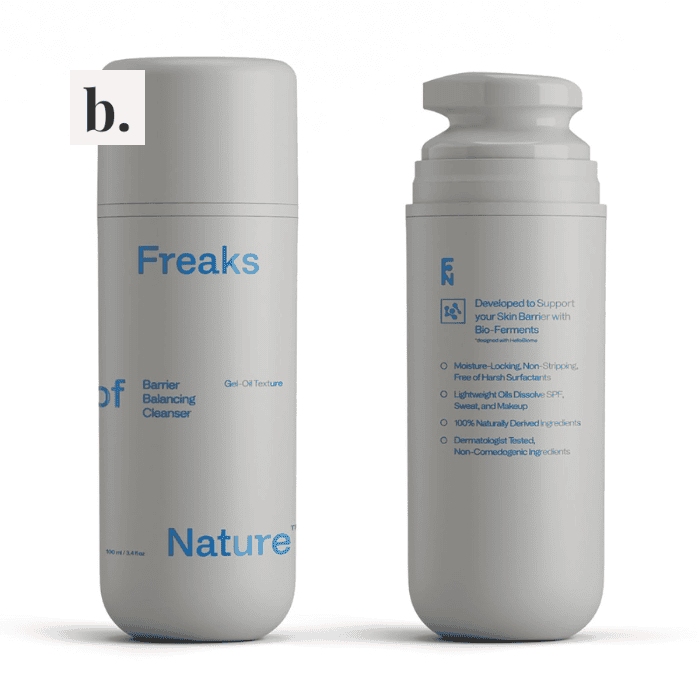
Freaks of Nature
Barrier Balancing Face Wash
If you want a gel-to-oil face wash for sunscreen and daily buildup, this Mid-Range cleanser offers a distinctive milky texture with supportive oils and humectants. Its consumer survey does not establish measured…
Read the BeautyBrief
Beverly Hills MD
Ultra-Firm Lifting Eye Mask
If you want smoother-looking skin around your eyes for a short time, the wraparound hydrogel patches offer hydration and more coverage. Their lifting promise is cosmetic, and the gelatin-containing formula is not…
Read the BeautyBrief
Alchemy 21/12
Barrier Cleanser
If your skin often feels tight after washing, Barrier Cleanser offers a soft-foaming, fragrance-free system with multiple comfort ingredients. Its microbiome positioning is not backed by finished-product outcomes, so its value rests…
Read the BeautyBrief
Beverly Hills MD
Ageless Volume Hyaluronic Face Mask
If you want a quick moisture boost, Ageless Volume offers multiple humectants in a sheet mask. Its temporary plumping does not restore facial volume, and added fragrance may limit sensitive-skin fit.
Read the BeautyBrief
The INKEY List
Milk Cleanser
If you want gentle-feeling cream-to-milk cleansing with measured hydration support, this offers useful Budget value. If you prefer strong foam or a dedicated waterproof-makeup remover, another format may suit you.
Read the BeautyBrief
The INKEY List
Omega Water Cream
If your skin is oily or combination and likes lighter moisture, Omega Water Cream offers strong Budget value. If you need more occlusive comfort, compare a richer cream.
Read the BeautyBrief