

The Ordinary Natural Moisturizing Factors + PhytoCeramides Review
BeautyBrief™
Brand
The Ordinary
Product
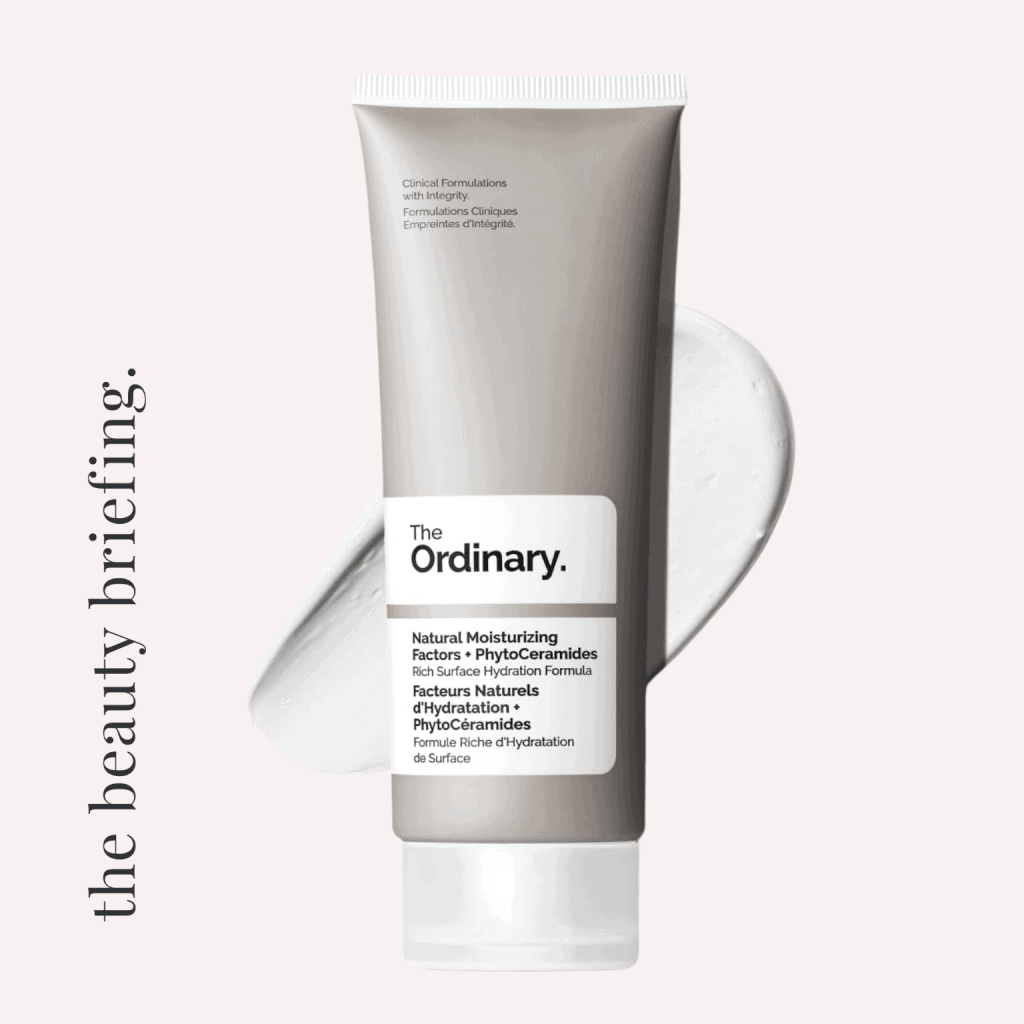
Natural Moisturizing Factors + PhytoCeramides
Claims check
You get a rich NMF-and-lipid moisturizer with brand-reported 30-person evidence for immediate hydration and independent eczema-suitability listing, but neither establishes eczema treatment or specific barrier-repair outcomes.
Shopper fit
- Dry
- Normal
- Combination
- Sensitive
Formula flags
- None identified
Shopper preferences
- Vegan
- Cruelty-Free
Key ingredients
| Glycerin | Provides core humectant support within the broader natural-moisturizing-factor system. |
|---|---|
| Glycosphingolipids | Add barrier-relevant lipid support within the richer moisturizer base. |
| Linoleic Acid | Contributes to the fatty-acid portion of the formula's skin-lipid support. |
| Urea | Adds established humectant support as part of the formula's natural-moisturizing-factor blend. |
| Sodium Hyaluronate | Adds further water-binding support alongside glycerin, PCA, lactate, sugars, and amino acids. |
Price tier
$ Budget
Value check
At the Budget tier, you pay for a wide mixture of water-binding ingredients and emollient lipids backed by short-term hydration testing, making the formula most useful when you need a richer cream.
Where to buy
We may earn a commission through these links at no additional cost to you. This does not affect our BeautyBrief.
Bottom line
If your skin is dry and you want substantial hydration without a Premium price, this offers a rich Budget blend of humectants and plant-derived lipids. If you prefer a lightweight finish or need medical eczema treatment, a different moisturizer or care approach will fit better.
If you have dry skin and lightweight lotions are not enough, The Ordinary Natural Moisturizing Factors + PhytoCeramides gives you a richer cream with multiple humectants, plant-derived lipids and skin-conditioning emollients. For a Budget moisturizer, its combination of glycerin, urea, amino acids, sodium PCA, lactate, glycolipids and fatty acids offers a meaningful alternative to formulas built around only one moisturizing ingredient.
Its biggest advantage is the moisture system, not a promise to treat eczema. The cream’s richer feel is the main tradeoff: if your skin is oily or you prefer a lightweight gel, this may be more emollient than you want.
What it claims
The Ordinary calls this its most nourishing moisturizer, formulated with nearly four times more moisturizing emollients and twice as many humectants as its Natural Moisturizing Factors + HA product. The brand claims an immediate 68% increase in skin hydration, all-day moisture and support for the skin barrier, and positions the rich cream for dry skin. Its published clinical-testing footnote identifies 30 participants after one application.[1]
The U.S. page also identifies the product as vegan, cruelty-free, alcohol-free and silicone-free, and displays the National Eczema Association Seal of Acceptance. The National Eczema Association separately lists this exact product in its directory.[2]
Claims vs. formula
The hydration system resembles components of the skin’s natural moisturizing factor (NMF): amino acids, sodium PCA, PCA, sodium lactate, urea and sugars work alongside glycerin, propanediol and sodium hyaluronate to help bind and retain water. A scientific review of NMFs explains their role in keeping the outer skin layer hydrated, flexible and functioning normally. That research supports the formulation logic, but it is not a test of this exact moisturizer.[3]
The formula also contains caprylic/capric triglyceride, cetyl ethylhexanoate, isodecyl neopentanoate and hydrogenated vegetable oil. These emollients help soften rough-feeling skin and create the rich finish. Glycosphingolipids, glycolipids, phytosteryl canola glycerides, lecithin, triolein and fatty acids, including linoleic acid, provide an additional lipid-focused component.
The “PhytoCeramides” name refers to the brand’s plant-derived lipid complex. The accepted INCI specifically lists glycosphingolipids and glycolipids, not the individually named ceramides NP, AP or EOP. You should not assume that all products marketed around ceramides have identical lipid compositions or barrier outcomes.
The Ordinary’s 68% result directly addresses finished-product hydration after one application, but the public summary does not give the full test protocol, a comparison product or evidence that every user’s hydration increases by the same percentage. It also does not separately quantify the contribution of the plant-derived lipids or demonstrate treatment of a skin disease.
Ingredients that matter
Glycerin supplies familiar humectant support, while sodium hyaluronate adds another water-binding ingredient. Urea, sodium PCA, lactate and amino acids make the NMF story more substantive than a single hydration claim. The independent NMF review supports their relevance, but their individual concentrations in this formula are not disclosed.[3]
Glycosphingolipids and glycolipids are central to the plant-derived lipid blend; linoleic acid and related fatty acids add further skin-conditioning context. Their presence is relevant to a barrier-focused product, but the actual formula’s clinical effect cannot be calculated by counting lipid ingredients.
Urea is also a component of normal skin NMF. A dermatology review distinguishes its moisturizing role in lower-concentration formulas from more pronounced keratolytic effects at higher levels. Because The Ordinary does not disclose the urea percentage here, you should view this product primarily as a moisturizer, not an exfoliating urea treatment.[4]

Glycerin
If your skin feels dry or tight, glycerin helps your skin hold moisture. You don't need a high percentage or a separate serum when your moisturizer already works well.
Read the IngredientBrief
Linoleic Acid
Linoleic acid is an essential omega-6 fatty acid used as an emollient and involved in normal barrier-lipid biology. Human benefits are strongest in complete moisturizers rather than isolated linoleic acid.
Read the IngredientBrief
Urea
Urea is a well-supported humectant for dry skin that becomes more keratolytic at higher strengths. The right concentration depends on whether you need hydration or targeted smoothing.
Read the IngredientBrief
Hyaluronic Acid
If your skin feels dry or tight, hyaluronic acid helps your skin hold moisture. You don't need several HA forms or a separate serum when your moisturizer already hydrates well.
Read the IngredientBriefSafety and regulatory context
The National Eczema Association Seal of Acceptance means the product has been accepted through that program’s review process; it does not mean the cream treats eczema or that you are guaranteed not to react to an ingredient. The association asks people with eczema or sensitive skin to check their own triggers before using accepted products.[2]
The brand recommends applying a small amount morning and evening as the moisturizing step of your routine, with sunscreen afterward during the day. If you have very reactive skin, introduce new products cautiously rather than relying solely on a seal or an ingredient category.[1]
What to expect in the short term
You get a rich cream intended to leave skin softer and more moisturized than a lightweight gel. The brand-reported 30-person test offers specific support for increased hydration after one application, although the 68% figure is a group-level performance claim, not your personal expected result.
What to expect over time
With regular use, you can expect ongoing moisture support from the combination of water-binding ingredients and emollient lipids. The all-day hydration claim is useful brand context, but public evidence does not establish how the formula compares head-to-head with other Budget moisturizers or whether it repairs a clinically impaired barrier.
If your skin remains dry despite moisturizing consistently, consider whether you need a different texture or a broader approach to your routine rather than assuming more ingredients will necessarily solve the problem.
Who it fits
This makes the most sense if your skin is dry, normal-to-dry or combination with dry areas, and you want substantial moisture without a Premium price. Its lack of added fragrance, alcohol and silicones, plus the National Eczema Association acceptance, gives you additional information if your skin is sensitive and you prefer a richer cream.
If your skin is oily or you dislike a substantial finish, a lighter Natural Moisturizing Factors formula may be easier to wear. If you need treatment for an active skin condition, do not substitute this cosmetic cream for appropriate medical care.
Compare before you buy
Choose Natural Moisturizing Factors + PhytoCeramides when dry skin and moisture retention are your priorities. The Budget value comes from a dense emollient base, a broad NMF blend and direct short-term hydration testing rather than an expensive signature treatment ingredient.
Choose The Ordinary’s lighter Natural Moisturizing Factors + HA or another straightforward lotion when you want hydration without this cream’s richer finish. A lightweight product that you enjoy applying consistently can be the better purchase if the extra emollients feel excessive.
Final Assessment
The Ordinary Natural Moisturizing Factors + PhytoCeramides offers strong Budget value for dry skin through a genuinely broad mixture of NMF humectants, emollients and plant-derived lipids. The official 30-person study supports immediate hydration and the National Eczema Association lists the product as accepted, but neither establishes eczema treatment or superiority over every simpler moisturizer; the rich texture is the main reason to choose it—or choose something lighter.
Where to buy
Choose a retailer to view current pricing and availability.
We may earn a commission through these links at no additional cost to you.
Last reviewed: October 2026
Sources
- The Ordinary. Natural Moisturizing Factors + PhytoCeramides. Official U.S. product page, full INCI, claims, preferences and 30-person hydration testing note. Accessed October 14, 2026.
- National Eczema Association. The Ordinary Natural Moisturizing Factors + PhytoCeramides. Product-specific Seal of Acceptance listing and safety guidance. Accessed October 14, 2026.
- Baldwin H, Del Rosso J. Going Beyond Ceramides in Moisturizers: The Role of Natural Moisturizing Factors. Journal of Drugs in Dermatology. 2024;23(6):466–471. General NMF review; not a finished-product clinical trial.
- Celleno L. Topical urea in skincare: A review. Dermatologic Therapy. 2018;31(6):e12690. Discusses concentration-dependent urea functions, not the concentration or clinical effects of this product.


