Skin Union The Balm Review
BeautyBrief™
Brand
Skin Union
Product
The Balm
Claims check
You get a concentrated emollient-and-lanolin balm for dry patches, but the ongoing study does not prove treatment-level healing.
Shopper fit
- Dry
- Normal
- Sensitive
Formula flags
- Contains lanolin (wool-derived).
Shopper preferences
- None Found
Key ingredients
| Helianthus Annuus (Sunflower) Seed Oil | At the disclosed 43%, helps soften your skin within the rich, moisture-retaining base. |
|---|---|
| Butyrospermum Parkii (Shea) Butter | At the disclosed 15%, adds rich emollience for your dry or rough areas. |
| Calendula Officinalis Flower Extract | At the disclosed 3%, adds botanical skin-conditioning support without proven wound healing. |
| Lanolin | Reduces moisture escape, but is wool-derived and unsuitable if you avoid animal ingredients or have a lanolin allergy. |
| Madecassoside | Adds soothing-oriented skin-conditioning context; it does not prove clinical healing of your skin. |
Price tier
$ Budget
Value check
At its current price tier, you get concentrated moisture sealing for targeted patches, with lanolin and texture as fit considerations.
Bottom line
If your lips or dry patches need extra protection, The Balm supplies a rich sunflower-and-shea base with lanolin. It is not vegan, and its clinical healing claims remain unestablished while testing is underway.
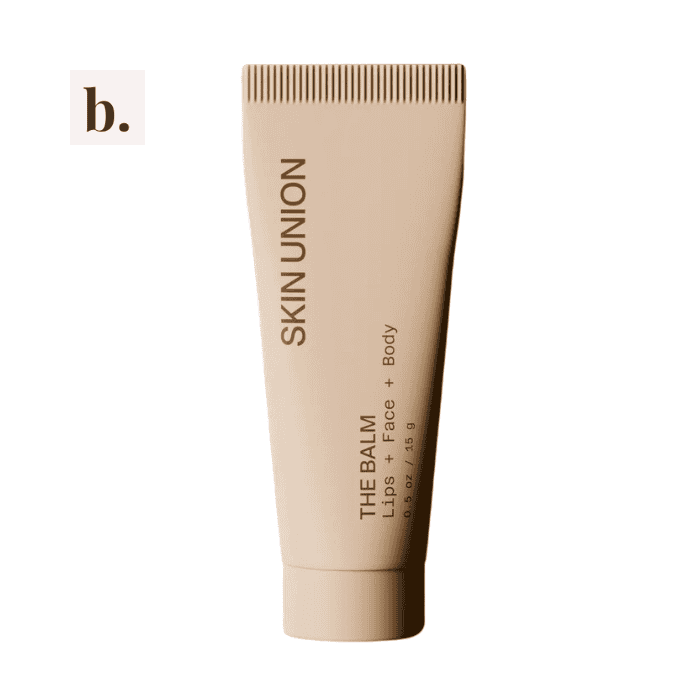
If your lips, hands or small dry patches need a concentrated moisture-sealing layer, Skin Union The Balm blends sunflower seed oil, shea butter, calendula and lanolin. The brand discloses 43% sunflower oil, 15% shea butter and 3% calendula extract, while a home-use study is still in progress.[1]
What it claims
Skin Union markets The Balm for your lips, face, and body when dryness, cracking, irritation, or moisture loss makes a richer moisturizer useful. The brand describes it as fragrance-free and toxicologist-reviewed, and directs you to apply it to your lips or skin as needed.[1] It highlights madecassoside for skin comfort, along with the three disclosed oil, butter, and botanical percentages. These are brand claims and formula disclosures rather than results of published finished-product effectiveness trials.
The company says The Balm is undergoing a 28-day home-use study involving people receiving chemotherapy and radiation and describes that research as ethics-approved. Because the study is still ongoing on the current official page, no finished-product benefit or safety outcome from it can yet be assessed independently.[1]
Claims vs. formula
The best-supported job for this balm is softening your skin and slowing surface moisture loss. Sunflower seed oil and shea butter provide a substantial emollient base, while lanolin, sunflower seed wax, jojoba esters, coconut oil, and soybean oil contribute to its protective texture. Glycerin adds water-binding support, and madecassoside supplies a skin-conditioning component. The official Skin Union glossary lists these as The Balm ingredients but displays the full list alphabetically, not in concentration order. Only the three expressly disclosed percentages can be treated as known concentrations.[2]
The formula’s rich feel is a deliberate advantage if your hands, lips, elbows, or other localized areas become uncomfortably dry. It is less compelling if you prefer a fast-absorbing, weightless facial moisturizer. The American Academy of Dermatology recommends fragrance-free creams and ointments for very dry skin and notes that ingredients such as lanolin, glycerin, shea butter, and petrolatum commonly serve this purpose. That supports the general moisturizing approach, not an independent clinical result for The Balm.[3]
Lanolin matters: Lanolin comes from sheep’s wool, so this product is not suitable if you require a vegan formula. Its moisturizing role is established, but it is also a potential contact allergen. DermNet notes that allergic reactions are relatively uncommon in the general population yet more relevant among people with some existing skin conditions or compromised skin. If you have a confirmed lanolin allergy, avoid The Balm; lanolin is not a reason to assume that everyone will react.[4]
Hypoallergenic is not independently established: Skin Union uses the word “hypoallergenic” in its broader brand positioning, but the exact product page does not explicitly document it for The Balm; it instead identifies fragrance-free and toxicologist-reviewed attributes. BB does not assign the controlled Hypoallergenic Shopper Preference based only on that broader brand language. The FDA also explains that “hypoallergenic” has no standardized federal meaning and cannot promise that a product causes no allergic reactions.[5]
Ingredients that matter
Sunflower Seed Oil and Shea Butter provide the bulk of the emollient base, complemented by calendula and Madecassoside for conditioning support. Lanolin supplies a heavier, moisture-sealing lipid, although it is animal-derived and can be a contact allergen for some users. This concentrated format can reduce a dry feeling; it does not demonstrate treatment of underlying inflammatory skin disease.

Shea Butter
Shea butter is a well-established emollient and occlusive used to soften dry-feeling skin and add richness to moisturizers. Its value depends on the complete formula, not the ingredient name alone.
Read the IngredientBrief
Madecassoside
Madecassoside is a Centella-derived skin-conditioning ingredient used in soothing and barrier-focused formulas. Human evidence is promising but does not clearly isolate madecassoside from the complete products tested.
Read the IngredientBrief
Glycerin
If your skin feels dry or tight, glycerin helps your skin hold moisture. You don't need a high percentage or a separate serum when your moisturizer already works well.
Read the IngredientBriefSafety and regulatory context
The lanolin in this formula comes from sheep’s wool and may be unsuitable if you are allergic to lanolin or avoiding animal-derived ingredients. This is a product-specific formula concern, not evidence that lanolin is unsafe for everyone.
If you are receiving cancer treatment: The brand’s oncology-focused positioning and ongoing study do not establish that The Balm is appropriate for every area affected by treatment. The American Academy of Dermatology advises using only moisturizers recommended by your cancer care team on radiation-treated skin and not applying moisturizer directly to a wound. Ask your oncology team before putting any new balm on an actively treated, blistered, or open area.[6]
What to expect in the short term
You can expect a richer, more protective finish than a typical light lotion, based on the formula and the brand’s intended balm format rather than BB hands-on wear testing. Use a small amount where you need extra moisture support, following Skin Union’s as-needed directions. For routine very dry skin, dermatologists recommend applying a fragrance-free cream or ointment while your skin is still slightly damp after washing.[3] If the thick feel is uncomfortable on your whole face, keep it for specific dry areas instead.
What to expect over time
Continued use is most likely to help maintain comfort by repeatedly softening dry areas and reducing moisture escape. Skin Union’s disclosed concentrations help explain why you would expect a rich balm, but they do not establish a fixed timeline for resolving cracking, eczema, radiation-related skin changes, or another medical condition. There are no completed, publicly detailed Skin Union Balm study outcomes on the official product page that justify promising those results.[1]
Who it fits
If you want a fragrance-free spot balm for lips, face or body and tolerate lanolin, The Balm targets areas that need extra occlusion. Because lanolin comes from wool, it is not a vegan formula; discontinue use if your skin reacts. The brand’s in-progress trial is not yet a basis for claims of proven healing.
Compare before you buy
At the Budget tier, Skin Union’s currently listed brand-direct price makes The Balm an accessible way to try a concentrated multi-area format with unusually specific ingredient-percentage disclosures. You are not necessarily buying more effective moisture retention than an ordinary petrolatum ointment: a simpler fragrance-free, lanolin-free product can offer a protective layer for less and avoids the wool-derived ingredient. If you want the brand’s less substantial all-over moisturizer instead, its separately listed The Cream is a different format for a different job.[1]
Final Assessment
If you need concentrated moisture for rough spots, Skin Union The Balm offers an emollient base with shea butter, sunflower oil and lanolin. Its barrier-comfort rationale is stronger than any pending clinical outcome, and lanolin limits vegan and allergy-related fit. Its value is highest for localized dry areas rather than all-over lightweight moisturization.
Last reviewed: October 2026
Sources
Skin Union. The Balm. Official exact-product page. Accessed October 11, 2026.
Used for product identity, application directions, currently listed brand-direct price, fragrance-free and toxicologist-reviewed positioning, disclosed percentages, and the stated ongoing 28-day home-use study. No finished-product results are reported.
Skin Union. Ingredient glossary. Official product-specific ingredient mapping and alphabetical full ingredient list, accessed October 11, 2026.
American Academy of Dermatology Association. Dermatologists’ top tips for relieving dry skin. Accessed October 11, 2026.
Provides the independent general guidance on moisturizers and practical use for very dry skin; it does not evaluate The Balm.
DermNet. Contact reactions to lanolin. Clinician-reviewed educational resource, last reviewed March 2023. Accessed October 11, 2026.
Used for the wool origin, potential contact allergy, and the distinction between possible sensitivity and universal intolerance.
U.S. Food and Drug Administration. Cosmetics Safety Q&A: Hypoallergenic. Accessed October 11, 2026.
Used to explain the absence of a federal standardized definition for the word hypoallergenic.
American Academy of Dermatology Association. How to care for your skin during and after radiation therapy. Accessed October 11, 2026.
Used for independent skin-care guidance during radiation treatment and the limits of recommending a balm for wounds or medically treated skin.