

PanOxyl Acne Foaming Wash Review
BeautyBrief™
Brand
PanOxyl
Product
Acne Foaming Wash
Claims check
If you need a 10% benzoyl-peroxide wash, this is labeled acne treatment, but the 15-second bacterial test does not prove faster clearance of your breakouts.
Shopper fit
- Oily
- Acne-Prone
Formula flags
- Drying alcohols
- Silicones
- Benzoyl Peroxide 10%
Shopper preferences
- None Found
Key ingredients
| Benzoyl Peroxide 10% | Provides the labeled 10% OTC acne treatment, with meaningful irritation and bleaching cautions. |
|---|---|
| Glycerin | Offers water-binding support without preventing irritation from the acne active. |
| Propanediol | Adds humectant support around the acne active. |
| Dimethicone | Adds slip within the medicated wash rather than establishing mildness. |
| Decyl Glucoside | Helps remove surface oil, sweat, and everyday buildup. |
Price tier
$ Budget
Value check
At the Budget tier, you get 10% benzoyl-peroxide acne treatment for face and body, not proof that maximum strength is best for your skin.
Where to buy
We may earn a commission through these links at no additional cost to you. This does not affect our BeautyBrief.
Bottom line
If you already tolerate strong benzoyl peroxide, PanOxyl Acne Foaming Wash delivers a labeled 10% treatment for acne on the face or body. A 15-second bacteria claim does not establish faster visible clearing, and dryness or bleaching can limit your fit. At the Budget tier, choose it only when the stronger acne-treatment option makes sense for your routine.
If you want a face-and-body acne wash with maximum-strength benzoyl peroxide, PanOxyl Acne Foaming Wash gives you 10% benzoyl peroxide at the Budget tier. That strength makes the most sense when stubborn inflammatory or body acne is the problem and your skin already tolerates benzoyl peroxide well.
What it claims
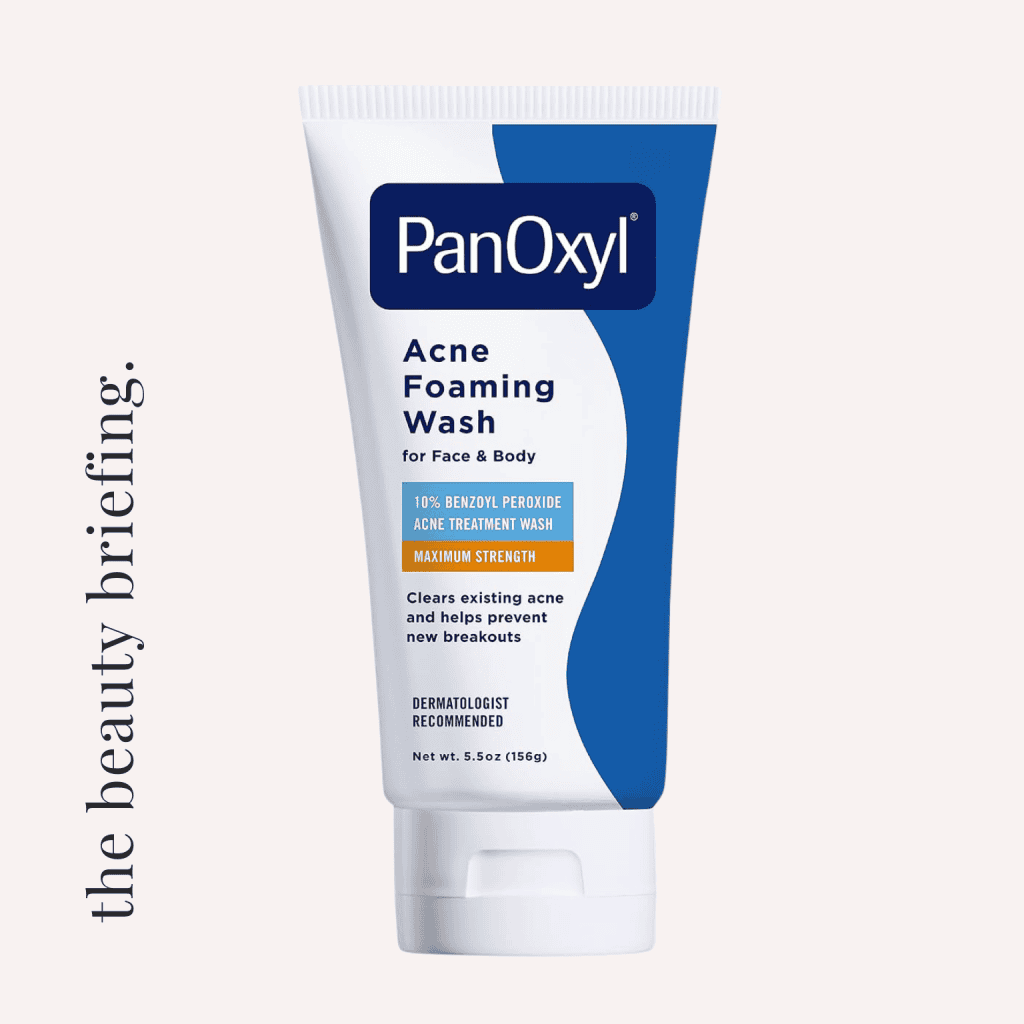
PanOxyl describes Acne Foaming Wash as a maximum-strength daily acne treatment for the face and body. The current U.S. page identifies 10% benzoyl peroxide, says the wash clears, treats, and prevents breakouts, unclogs pores on the face, chest, and back, and says it kills more than 99% of acne-causing bacteria in 15 seconds based on an independent laboratory study on file.[1]
The directions tell you to massage the wash over wet skin for one to two minutes, rinse thoroughly, start once daily, and gradually increase to twice daily if needed or directed by your dermatologist.[1]
Claims vs. formula
Your acne-treatment active is benzoyl peroxide at 10%. That makes this an actual OTC acne treatment, not simply a cleanser marketed to acne-prone skin. A wash format is especially practical when you need to cover larger areas such as your chest, back, or shoulders.
Decyl glucoside, dioctyl sodium sulfosuccinate, and sodium laurylglucosides hydroxypropylsulfonate provide the cleansing action. Glycerin and propanediol add moisture support, while dimethicone and fatty ingredients add slip around the medicated base.
The stored formula includes dimethicone and t-butyl alcohol, which explains the Silicones and Drying Alcohols flags. Those ingredients do not make the product automatically unsuitable, but if your face is already dry, peeling, or irritated, 10% benzoyl peroxide leaves you less room for additional dryness.
That matters even more if your routine already includes retinoids or salicylic acid. The current Drug Facts label warns that irritation and dryness are more likely when you use another topical acne medication at the same time.[2]
The “more than 99% in 15 seconds” claim is laboratory bactericidal data, not a clinical clearing-time result. PanOxyl does not publish enough method or comparative outcome detail on the product page to show that this 15-second finding means you will clear acne faster or better than you would with a lower-strength benzoyl peroxide wash.[1]
Ingredients that matter
Benzoyl peroxide at 10% is the labeled OTC acne-treatment active. Decyl glucoside and sodium laurylglucosides hydroxypropylsulfonate provide the cleansing system, while glycerin and propanediol add humectant support. Dimethicone contributes slip but does not guarantee an irritation-free 10% benzoyl-peroxide wash.
The brand’s 15-second result refers to bacterial reduction under its stated test conditions, not visible clearing of your acne after 15 seconds. A higher active percentage does not demonstrate that this product clears your breakouts more effectively than a lower-strength option for your skin. Regular application and tolerability remain important.

Benzoyl Peroxide
If inflamed pimples are your concern, benzoyl peroxide has strong acne evidence. Choose the wash or leave-on treatment your skin tolerates; a higher percentage is not automatically better.
Read the IngredientBrief
Glycerin
If your skin feels dry or tight, glycerin helps your skin hold moisture. You don't need a high percentage or a separate serum when your moisturizer already works well.
Read the IngredientBrief
Propanediol
Propanediol is a common solvent and moisture-supporting ingredient that helps formulas spread and feel lighter. It is useful but highly replaceable, so the complete formula matters more than the ingredient…
Read the IngredientBrief
Dimethicone
Dimethicone is a well-supported silicone emollient and skin-protecting ingredient that improves slip, smoothness, and surface comfort. Its real moisture benefit depends on the complete moisturizer or skin-protectant formula.
Read the IngredientBriefSafety and regulatory context
The current Drug Facts label lists benzoyl peroxide 10% as the acne medication. Do not use it if you have very sensitive skin or are sensitive to benzoyl peroxide. The label also warns about irritation and dryness, unnecessary sun exposure, eye/lip/mouth contact, and bleaching of hair and dyed fabrics. If irritation becomes severe, stop use and ask a doctor.[2]
PanOxyl directs you to massage the wash for one to two minutes and gradually increase use only if needed. The drug-label cautions matter even if the cleanser includes glycerin: avoid the eyes and lips, expect potential bleaching of hair and fabrics, and account for irritation if you also use topical acne medicines.[1]
What to expect in the short term
You get a creamy foaming wash plus a strong acne active during the one-to-two-minute contact period. On larger body areas, that makes treatment easy to spread and rinse away.
On your face, 10% can become too drying quickly if you are new to benzoyl peroxide or already dealing with peeling and irritation. Using more or washing more often is not a substitute for tolerability.
What to expect over time
Consistent benzoyl peroxide use can help treat inflammatory acne and prevent new breakouts. Maximum strength only helps if your skin tolerates it well enough for consistent use; the Drug Facts label specifically notes that irritation can be reduced by using the product less often or in a lower concentration.[2]
At the Budget tier, you get a clearly dosed 10% OTC acne treatment that works across both face and body. The value is strongest when you genuinely need that treatment intensity rather than simply assuming the highest percentage is automatically better.
Who it fits
This makes the most sense if your skin is oily, resilient, acne-prone, and dealing with stubborn inflammatory breakouts, especially on the back, chest, or shoulders. It can also fit facial acne when you already know you tolerate benzoyl peroxide well and need more treatment intensity.
If your facial skin is dry, sensitive, eczema-prone, peeling, or treatment-stressed, a lower-strength option is easier to justify. If blackheads and clogged pores are your main issue rather than inflamed pimples, a salicylic-acid treatment may be better aligned with that concern.
Compare before you buy

Choose PanOxyl Acne Creamy Wash when you want 4% benzoyl peroxide and a lower-strength starting point.
Read the BeautyBrief
Choose CeraVe Acne Foaming Cream Cleanser when you want another 4% benzoyl peroxide option for facial acne.
Read the BeautyBriefFinal Assessment
If your face or body acne requires a benzoyl-peroxide wash and you already tolerate stronger treatments, PanOxyl provides a labeled 10% option. Its 15-second laboratory bacteria claim does not prove visibly faster acne improvement, while dryness and bleaching remain practical downsides. At the Budget tier, its value depends on the need for maximum strength rather than choosing the largest concentration by default.
Where to buy
Choose a retailer to view current pricing and availability.
We may earn a commission through these links at no additional cost to you.
Last reviewed: October 2026
Sources
PanOxyl. Acne Foaming Wash. Official U.S. product page, accessed October 14, 2026; formula, directions and product claims.
DailyMed. PanOxyl Acne Foaming Wash Drug Facts. U.S. OTC acne Drug Facts, active concentration and safety warnings.

