

Eucerin Radiant Tone Cleansing Gel Review
BeautyBrief™
Brand
Eucerin
Product
Radiant Tone Cleansing Gel
Claims check
You get credible rinse-off exfoliating potential from a combined 2% lactic-and-glycolic-acid complex, but the undisclosed pH and second-listed denatured alcohol limit predictability and sensitive-skin fit.
Shopper fit
- Normal
- Combination
- Oily
- Sensitive
Formula flags
- Drying alcohols
- Exfoliating acids
Shopper preferences
- None Found
Key ingredients
| Lactic Acid | One part of the 2% AHA Complex, supporting mild surface exfoliation and smoother-looking skin. |
|---|---|
| Glycolic Acid | Adds further surface-exfoliating and radiance support within the rinse-off AHA complex. |
| Glycerin | Adds established humectant support around the exfoliating cleansing step. |
| Sodium Cocoamphoacetate | Provides much of the cleanser's everyday wash action. |
| Glyceryl Glucoside | Adds additional humectant support in the rinse-off formula. |
Price tier
$$ Mid-Range
Value check
At the Mid-Range tier, you pay for a defined 2% AHA cleansing step whose value is strongest when you need rinse-off exfoliation rather than another acid in an already active routine.
Where to buy
We may earn a commission through these links at no additional cost to you. This does not affect our BeautyBrief.
Bottom line
If you want gentle surface exfoliation built into cleansing, this provides a disclosed 2% AHA complex at a Mid-Range price tier. If your skin reacts to alcohol-rich or acid-based products, a simple cleanser fits more comfortably.
If dullness is your main concern and you want exfoliation built into cleansing, Eucerin Radiant Tone Cleansing Gel combines lactic and glycolic acids in a brand-disclosed 2% AHA complex. That gives the wash a more specific purpose than a plain cleanser, while glycerin and glyceryl glucoside add water-binding support.
The tradeoff is formula tolerance. Alcohol Denat. is second in the ingredient list, and the wash also contains exfoliating acids. You do not need to add both to your routine if an existing treatment already handles surface texture.
What it claims
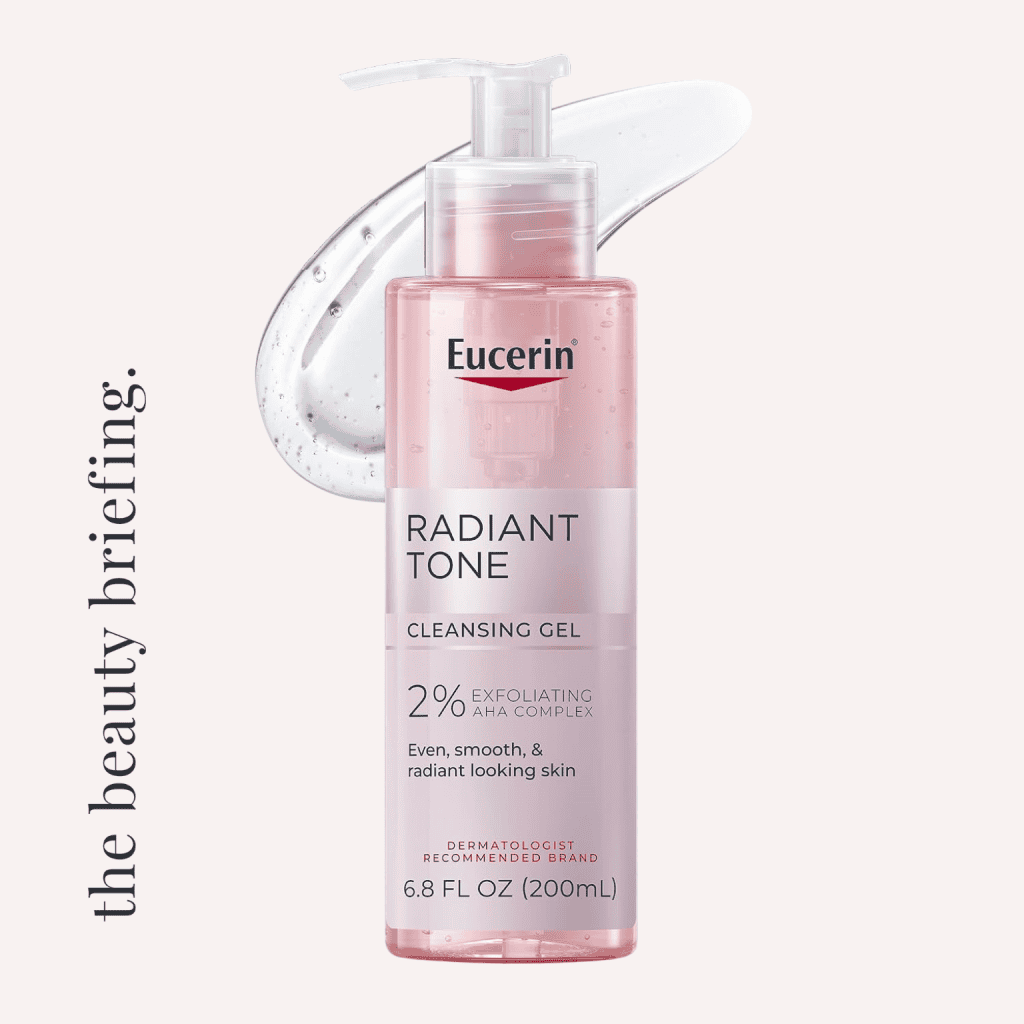
Eucerin says Radiant Tone Cleansing Gel gently removes dull surface buildup and improves the appearance of clarity and radiance. The brand describes a combined 2% alpha hydroxy acid (AHA) complex made from lactic acid and glycolic acid. It also reports that 99% of users noticed improved clarity and radiance with regular use and describes the finished formula as clinically proven, suitable for daily cleansing, and safe for sensitive skin.[1]
The reported 99% figure is a brand statement without publicly detailed participant counts, controls or testing methods on the product page. It is not an independently verified prediction of the result you will get.
Claims vs. formula
Sodium cocoamphoacetate and coco-betaine handle the primary cleansing action. Lactic acid and glycolic acid give the formula a credible exfoliating purpose, but 2% refers to their combined complex, not 2% of each acid.
Concentration is only one part of the performance picture. Research on AHAs explains that pH and available free acid influence how strongly a formula acts on skin. Eucerin does not disclose the finished cleanser’s pH on its U.S. page, and you rinse it off after massaging. Those limits prevent the percentage alone from establishing treatment-level results for uneven tone.[2]
Glycerin and glyceryl glucoside add humectant support around cleansing. They help explain the hydrating positioning, but a rinse-off wash is not a substitute for a leave-on moisturizer.
Alcohol Denat. is the second ingredient in your supplied current U.S. formula. Its placement makes it an important compatibility consideration, but it does not prove that the finished cleanser is drying for everyone. Eucerin’s sensitive-skin positioning and your individual reaction to an acid-and-alcohol wash both matter.
Ingredients that matter
This is primarily a cleansing system with an added exfoliating goal: the surfactants remove daily residue, the lactic-and-glycolic-acid complex is intended to help loosen dull surface buildup, and glycerin with glyceryl glucoside supports a more comfortable rinse. What you get depends on the complete formula and its short contact time.
The acids are not interchangeable with the more sustained exposure of leave-on exfoliants. Their combined 2% disclosure is useful when comparing cleanser formats, but it is not a measure of visible dark-spot correction or a reason to expect rapid resurfacing.

Lactic Acid
If roughness or dullness bothers you, lactic acid is a proven exfoliant. Choose a formula with a pH and strength your skin tolerates; a higher percentage isn't automatically better.
Read the IngredientBrief
Glycolic Acid
If rough texture or dullness bothers you, glycolic acid has evidence for smoother-looking skin. Choose a formula your skin tolerates; concentration and pH matter more than a high percentage.
Read the IngredientBrief
Glycerin
If your skin feels dry or tight, glycerin helps your skin hold moisture. You don't need a high percentage or a separate serum when your moisturizer already works well.
Read the IngredientBrief
Sodium Cocoamphoacetate
Sodium cocoamphoacetate is a cleansing surfactant used in rinse-off formulas. The full cleanser determines cleansing strength and mildness.
Read the IngredientBriefSafety and regulatory context
This product carries an AHA sunburn warning. FDA guidance advises sunscreen, protective clothing and limiting sun exposure while using AHA-containing cosmetics and for one week afterward. The guidance also covers rinse-off products; do not assume that brief application makes the warning irrelevant.[3]
Use Eucerin’s directions: massage onto your wet face and neck, rinse, avoid your eyes and discontinue use if irritation occurs.[1] The American Academy of Dermatology also advises extra care when exfoliating alongside retinoids or other products that increase peeling and sensitivity.[4]
What to expect in the short term
You get a rinse-off gel cleanser with a defined AHA component rather than a leave-on peel. A smoother after-feel and less surface dullness are plausible, but Eucerin’s stated immediate radiance benefit has not been independently quantified for this exact formula.
What to expect over time
Regular use may help manage dull surface buildup if your skin tolerates the formula. Do not count on a cleansing step to reproduce the stronger discoloration or texture outcomes studied with leave-on acids; the format, contact time and lack of published finished-product methods limit that comparison.
Who it fits
This is most relevant if your skin is normal, combination or oily and you want light AHA exfoliation during cleansing without adding a separate step. Eucerin also markets it as suitable for sensitive skin, but that is not a guarantee if your skin reacts to acids or high-alcohol formulations.
If your skin is dry, easily irritated, already peeling or stressed by retinoids or other exfoliants, a simple non-exfoliating cleanser is easier to work into your routine. Avoid pushing through persistent stinging to obtain more radiance.
Compare before you buy
Choose Eucerin when combining daily cleansing and a disclosed 2% AHA complex is the function you want. At the Mid-Range tier, its best value is that specific convenience rather than an assumed clinical advantage over every simpler cleanser.
Choose a basic cleanser if exfoliation is already covered elsewhere. For persistent dark spots or more noticeable texture changes, compare leave-on treatments with relevant evidence rather than expecting this rinse-off acid blend to do the same job.
Final Assessment
Eucerin Radiant Tone Cleansing Gel offers a defined 2% lactic-and-glycolic-acid complex for shoppers who want surface exfoliation built into a gel cleanser. Its Mid-Range value depends on whether that short-contact step adds something useful to your routine; second-listed denatured alcohol, acid tolerance and modest evidence for finished-product radiance remain important limitations.
Where to buy
Choose a retailer to view current pricing and availability.
We may earn a commission through these links at no additional cost to you.
Last reviewed: October 2026
Sources
- Eucerin. Radiant Tone Cleansing Gel. Official U.S. product page, claims, directions and sunburn alert. Accessed October 14, 2026.
- Kneedler JA, Sky SS, Sexton LR. Understanding alpha-hydroxy acids. Dermatology Nursing. 1998;10(4):247–254, 259–262. Explains AHA concentration, pH and free acid as performance factors; not a trial of this cleanser.
- U.S. Food and Drug Administration. Guidance for Industry: Labeling for Cosmetics Containing Alpha Hydroxy Acids. January 2005. Includes sun-sensitivity precautions and rinse-off use conditions.
- American Academy of Dermatology. How to safely exfoliate at home. Updated February 6, 2026. Guidance on skin-type fit and overlapping exfoliants.
