

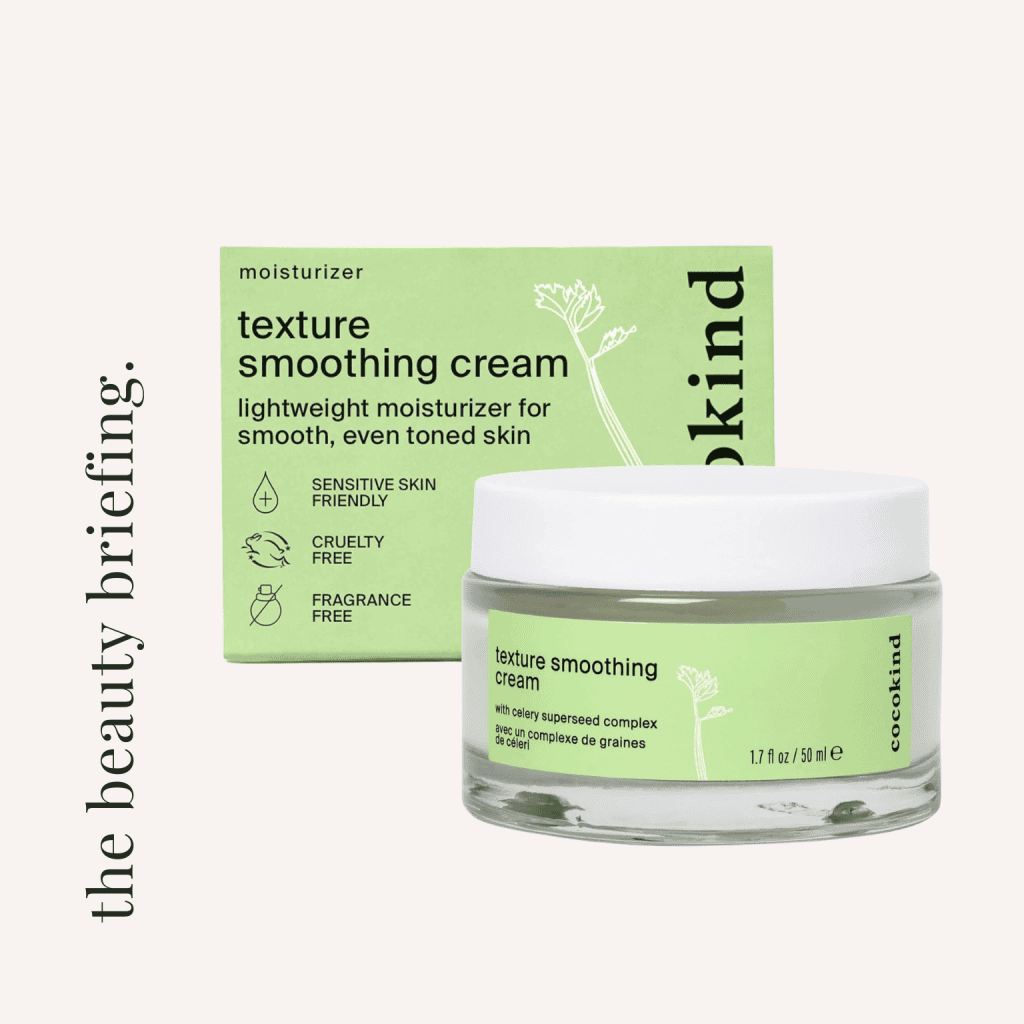
cocokind Texture Smoothing Cream Review
BeautyBrief™
Brand
cocokind
Product
Texture Smoothing Cream
Claims check
You get credible satin-finish moisturization from squalane and other emollients, but the brand's pore, tone and firmness claims lack published finished-product clinical support.
Shopper fit
- Dry
- Normal
- Combination
Formula flags
- None identified
Shopper preferences
- Vegan
- Cruelty-Free
Key ingredients
| Squalane | Supplies lightweight emollience near the top of the formula and helps reduce moisture loss. |
|---|---|
| Butyrospermum Parkii (Shea) Butter | Adds richer occlusive and emollient support without turning the cream into a dense balm. |
| Glycerin | Adds humectant support, although the formula facts place humectants below the main emollient and occlusive systems. |
| Helianthus Annuus (Sunflower) Seed Oil | Adds lipid-rich emollience and contributes to the barrier-supportive feel. |
| Apium Graveolens (Celery) Seed Extract | Forms part of the texture-focused celery superseed complex without independently proving the finished-product pore or firming claims. |
Price tier
$$ Mid-Range
Value check
At the Mid-Range tier, you get an emollient-forward cream and a transparent formula breakdown, but a simpler moisturizer may suit you equally well for basic hydration.
Where to buy
We may earn a commission through these links at no additional cost to you. This does not affect our BeautyBrief.
Bottom line
If your normal or combination skin prefers a satin finish, this Mid-Range cream offers a practical mix of squalane, plant oils and shea butter. Its stronger claims about pores and firmness are less substantiated than moisturizing, and the aromatic extracts may not suit every sensitive routine.
If you want a soft satin finish without a heavy balm, cocokind Texture Smoothing Cream is a Mid-Range moisturizer built around squalane, sunflower seed oil, caprylic/capric triglyceride, shea butter, and a smaller amount of glycerin.[1] The formula is best understood as a light emollient cream with a satin finish rather than a humectant-heavy gel moisturizer.
The hydration case is stronger than the broader pore, firmness, and tone story. cocokind publishes unusually detailed formula facts showing hero ingredients at 6%, occlusives at 5%, emollients at 6%, and humectants at 0.2%, but the current product page does not publish finished-product clinical data establishing a specific change in pore appearance, firmness, or tone.[1]
What it claims
cocokind says Texture Smoothing Cream provides all-day lightweight hydration, improves the look of tone, texture, and firmness, minimizes the appearance of large pores, controls shine, and leaves skin with a smooth satin finish. The brand highlights a celery superseed complex, tsubaki seed oil, and squalane as the featured ingredients behind those benefits.[1]
Claims vs. formula
The moisturizing claim is well aligned with the formula. Squalane, sunflower seed oil, caprylic/capric triglyceride, glyceryl stearate, cetyl alcohol, and shea butter provide the main emollient and occlusive structure, while glycerin contributes a smaller humectant component.[1] That combination supports softness, reduced dry feel, and the cushiony satin finish the product is designed to deliver.
cocokind’s own formula facts are useful because they put the marketing in proportion: the page identifies 6% hero ingredients, 6% emollients, 5% occlusives, 0.2% humectants, and 0.06% plant extracts.[1] The celery/flax system and other botanical extracts therefore add plausible conditioning and antioxidant context, but their presence alone does not establish a clinically meaningful finished-product change in pores, firmness, or tone.
The ingredient list also contains peppermint extract and blue tansy extract, but not peppermint oil or blue tansy oil. BB therefore does not apply an Essential Oils Formula Flag based on the current INCI.
Ingredients that matter
The formula is led by squalane, sunflower seed oil, caprylic/capric triglyceride and shea butter. Together, these emollients and occlusives support a softer skin surface and help limit moisture loss. Glycerin contributes water binding, but cocokind’s formula breakdown lists it as a comparatively small part of the moisturizing system.
Celery seed and flax extracts are central to the brand’s texture-and-pore story, but the public product information does not show they improve firmness or pore appearance in a controlled trial of this finished cream. Peppermint and blue tansy extracts are listed as aromatic plant extracts, so if your skin is sensitive to scented botanicals, their presence is worth considering even though they are not listed as essential oils.

Squalane
If your skin feels dry or rough, squalane can make it feel softer and smoother. You don't need a separate oil when your moisturizer already keeps your skin comfortable.
Read the IngredientBrief
Shea Butter
Shea butter is a well-established emollient and occlusive used to soften dry-feeling skin and add richness to moisturizers. Its value depends on the complete formula, not the ingredient name alone.
Read the IngredientBrief
Glycerin
If your skin feels dry or tight, glycerin helps your skin hold moisture. You don't need a high percentage or a separate serum when your moisturizer already works well.
Read the IngredientBriefWhat to expect in the short term
You can expect a cushiony cream that spreads easily and settles to a satin finish rather than a greasy or balm-like layer. The formula is most likely to show its value quickly through softness, comfort, and reduced dry feel. cocokind directs users to apply it morning and night after cleansing and toning.[1]
What to expect over time
With consistent use, your most dependable expectation is maintained moisture and a smoother-feeling surface if you like this texture. The brand has not published enough finished-product study information to substantiate the stronger pore, firmness or tone claims as clearly as the moisturizing benefit.
The brand’s detailed formula percentages make the product easier to evaluate than many botanical moisturizers, but formula transparency is not the same as finished-product efficacy testing.
Who it fits
If your skin is normal or combination and you prefer light-medium emollient creams, this format makes sense. Mildly dry skin may appreciate the satin finish, while very dry skin may require a richer occlusive moisturizer. If you are sensitive to aromatic botanical extracts, consider a simpler formula.
cocokind lists this cream among its vegan offerings and confirms that all its products are cruelty-free. These are brand-declared attributes, not claims that every skin type will tolerate the formula.[3]
Compare before you buy
Within cocokind’s moisturizer lineup, Texture Smoothing Cream is the light-medium satin-finish option for combination skin and uneven texture. Electrolyte Water Cream is the lighter choice for oily, combination, or breakout-prone skin, while Resurrection Polypeptide Cream is the richer option for extra dryness and fine-line-focused routines.[2]
At the Mid-Range tier, Texture Smoothing Cream is most defensible for shoppers who specifically like its squalane-and-plant-oil texture, satin finish, and unusually transparent formula breakdown. Basic moisturization is available from simpler formulas, so the value case should rest on sensory fit and formula transparency rather than on assuming a clinically proven pore-minimizing or firming effect.
Final Assessment
If you want a satin-finish moisturizer with more emollience than a water gel, cocokind Texture Smoothing Cream offers practical Mid-Range hydration for normal or combination skin. Squalane, sunflower oil and shea butter form the strongest part of its formula story; the pore, tone and firmness claims are less firmly established by published finished-product testing. You get better value when you choose it for the texture and comfort rather than expecting treatment-level firming.
Compare Prices
Choose a retailer to view current pricing and availability.
We may earn a commission through these links at no additional cost to you.
Last reviewed: October 2026
Sources
- cocokind. Texture Smoothing Cream. Current official U.S. product page. Accessed October 15, 2026.
- cocokind. Which moisturizer is right for me?. Current official brand guide. Accessed October 15, 2026.
- cocokind. Frequently Asked Questions. Current official brand FAQ. Accessed October 15, 2026.


