
Beverly Hills MD Moisture Lock Botanical Essence Review
BeautyBrief™
Brand
Beverly Hills MD
Product
Moisture Lock Botanical Essence
Claims check
You get credible humectant-and-oil hydration, but the compensated 14-person perception panel does not establish tightening or measurable microbiome changes.
Shopper fit
- Dry
- Normal
- Combination
Formula flags
- Fragrance
Shopper preferences
- Cruelty-Free
Key ingredients
| Cannabis Sativa (Hemp) Seed Oil | Provides light emollient lipids in the otherwise water-rich essence. |
|---|---|
| Glycerin | Provides dependable humectant hydration and supports the product's core moisture-retention role. |
| Phospholipids | Add lipid and conditioning support within the lightweight emulsion. |
| Camellia Japonica Seed Oil | Softens skin in partnership with the humectant and phospholipid system. |
| Lactococcus Ferment Lysate | Adds postbiotic formula context, but its presence alone does not prove that the finished product measurably changes the skin microbiome. |
Price tier
$$$ Premium
Value check
At the Premium tier, you get a lightweight emollient essence, while simpler formulas provide hydration with fewer fragrance-related tradeoffs.
Where to buy
We may earn a commission through these links at no additional cost to you. This does not affect our BeautyBrief.
Bottom line
If you want a dewy hydration step, Moisture Lock combines water-binding agents with botanical oils. Its fragrance limits sensitive-skin fit, and the small non-scientific panel does not justify expecting true lifting or microbiome repair.
If your skin looks dull or dehydrated, Beverly Hills MD Moisture Lock Botanical Essence combines glycerin, glycereth-26, hemp seed oil, camellia oil and phospholipids for a lightweight, softening layer. It is an extra hydrating step rather than a replacement for a full moisturizer.[1]
The brand’s four-week panel involved 14 compensated users and is explicitly described as non-scientific, so you should not read its firmness claims as evidence that the essence tightens underlying skin or changes your microbiome.
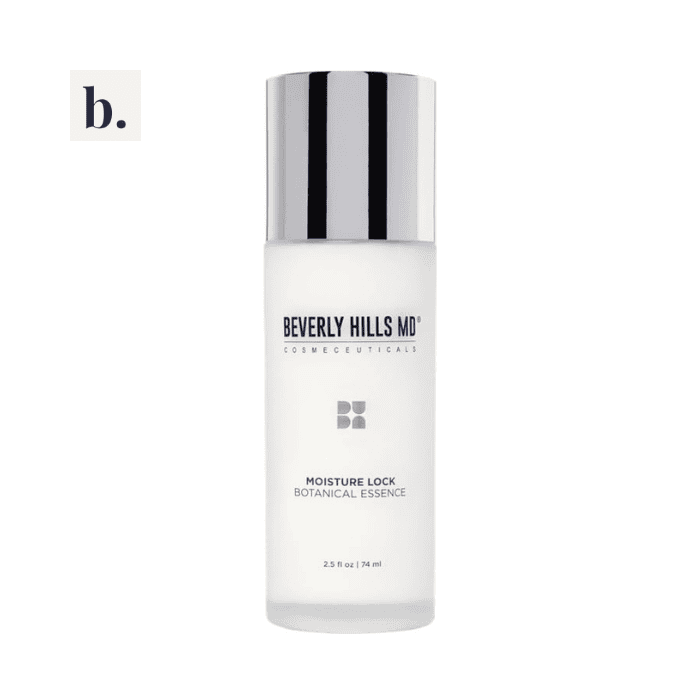
What it claims
Beverly Hills MD says Moisture Lock Botanical Essence helps combat the visible effects of transepidermal water loss, supports moisture retention, visibly promotes elasticity and firmness, brightens the complexion, and helps balance the skin microbiome.[1] The brand also reports a four-week panel in 14 users ages 37–74 in which all participants reported improvements in wrinkles, firmness, softness, and tightness.[1]
Claims vs. formula
The hydration story is well matched to the formula. Glycerin and glycereth-26 provide humectant support, while hemp seed oil, camellia seed oil, phospholipids, glyceryl caprylate, and tocopheryl acetate add emollient and conditioning value.[1] Moisturizers that combine humectants and emollients can improve hydration and support barrier function by increasing water retention and reducing evaporative loss.[2]
The evidence for tightening is much weaker. The brand itself states that the 14-user panel was compensated and was not a scientific study.[1] Those perception results are useful for shopper context, but they do not establish structural lifting, wrinkle remodeling, or objective changes in elasticity.
The ferment lysates provide plausible postbiotic context, but microbiome-directed skincare remains an emerging area with heterogeneous methods and limited standardization. The current product page does not publish microbial-diversity testing, strain-level characterization, or a finished-product microbiome endpoint for Moisture Lock.[3]
Ingredients that matter
The useful combination is water binding from glycerin and glycereth-26 alongside emollient Cannabis Sativa (Hemp) Seed Oil and Camellia Japonica Seed Oil. Phospholipids add an additional conditioning lipid in this lightweight emulsion.
Lactococcus Ferment Lysate and Bacillus Ferment contribute to the microbiome-oriented positioning, but their inclusion is not proof that the essence changes microbial balance. Fragrance, limonene, linalool, citronellol and hydroxycitronellal make this less appealing if you are sensitive to scented leave-on products.

What to expect in the short term
You can expect a lightweight, dewy layer that leaves skin feeling softer and more conditioned without the weight of a traditional cream. Humectants and emollient oils can make dehydration lines look temporarily less pronounced as the surface becomes better hydrated.
What to expect over time
Regular use can support ongoing hydration and reduce the visible severity of dryness-related texture. The formula may also help skin look more supple and luminous, but the current evidence does not establish meaningful structural tightening or wrinkle remodeling.
Who it fits
If your skin is dry, normal or combination, you are the clearest fit when a lightweight hydrating step is wanted before serum or moisturizer. Oily skin may prefer to use it selectively depending on routine weight, while fragrance-sensitive skin has a clear reason for caution because the formula contains parfum plus limonene, linalool, citronellol, and hydroxycitronellal.[1]
Compare before you buy
At the Premium tier, Moisture Lock offers more emollient and lipid support than a simple hydrating toner, but its strongest proven function remains moisturization. If you are paying primarily for the microbiome, tightening or anti-wrinkle claims, weigh the very small non-scientific user panel against lower-tier hydrating essences and moisturizers that can deliver the same basic moisture benefit.
Final Assessment
If you want an extra hydrating essence, Moisture Lock gives you humectants, plant oils and phospholipids for a softer, plumper-looking finish. Its Premium value is weaker if you expect structural tightening or measurable microbiome change, because the brand’s 14-user panel was not a scientific study.
Where to buy
Choose a retailer to view current pricing and availability.
We may earn a commission through these links at no additional cost to you.
Last reviewed: October 2026
Sources
Beverly Hills MD. Moisture Lock Botanical Essence. Current official U.S. product page. Accessed October 15, 2026.
Draelos ZD. The Skin Barrier and Moisturization: Function, Disruption, and Mechanisms of Repair. Journal of Drugs in Dermatology. 2023.
The review explains how humectants and emollients support hydration and barrier function. It does not test this Beverly Hills MD finished product.
Vieira De Almeida C, Antiga E, Lulli M. Oral and Topical Probiotics and Postbiotics in Skincare and Dermatological Therapy: A Concise Review. Microorganisms. 2023;11(6):1420.
The review provides context for emerging topical probiotic and postbiotic evidence. It does not establish that Moisture Lock changes the skin microbiome or validate the finished-product microbiome claim.


