
Salicylic Acid in Skincare
If blackheads or mild breakouts are your concern, salicylic acid can help unclog pores. Choose one cleanser or leave-on treatment your skin tolerates; 2% isn't automatically better.
- Aliases
- 2-Hydroxybenzoic Acid, o-Hydroxybenzoic Acid, 2-Carboxyphenol
- Ingredient category
- Exfoliant
- Most relevant for
- Acne, Clogged Pores
- Evidence strength
- Well Supported for Treating mild acne and clogged pores
- Formula matters
- Concentration, cleanser versus leave-on format, contact time, pH, vehicle, frequency, moisturizing support, and other acne actives determine results and irritation; 2% is not automatically better.
- Separate product needed?
- Sometimes. A separate salicylic acid product can be useful when blackheads, whiteheads, or recurring congestion remains a clear routine need.
BB takeaway
Salicylic acid is a credible acne treatment, especially for clogged pores, but 2% is not a quality score. Choose one well-tolerated format that fills a real routine need.
Ingredient evidence does not prove the performance of every finished product containing it.
What is salicylic acid?
Salicylic acid is a keratolytic ingredient that helps loosen and shed excess surface skin cells. It is also known as 2-hydroxybenzoic acid, o-hydroxybenzoic acid, and 2-carboxyphenol.[1]
In skincare, salicylic acid is commonly described as a beta hydroxy acid, or BHA. Those are class labels rather than aliases for the ingredient.
You can find salicylic acid in cleansers, leave-on liquids, gels, serums, medicated pads, masks, body treatments, and scalp products. In the United States, qualifying over-the-counter acne medicines can contain 0.5% to 2% salicylic acid.[2]
What does salicylic acid do for skin?
Salicylic acid helps treat mild acne, especially when blackheads, whiteheads, and clogged pores are part of the problem.
Its keratolytic action helps loosen excess surface buildup and material within clogged follicles. It can also make rough or flaky surface texture feel smoother when buildup is contributing to the problem.
Salicylic acid does not permanently shrink pores, stop oil production, correct hormonal acne, remove indented acne scars, or guarantee that post-blemish marks will fade.
Deep, painful, scarring, widespread, or persistent acne usually needs more than an exfoliant alone.
What the evidence says about salicylic acid skincare
Salicylic acid is well supported for treating mild acne with topical products, but it is not the strongest first-line option for every acne pattern.
The 2024 American Academy of Dermatology acne guideline conditionally recommends topical salicylic acid based on moderate-certainty evidence. Benzoyl peroxide and topical retinoids receive strong recommendations, which puts salicylic acid’s role in context.[3]
The guideline cites a 12-week vehicle-controlled trial in which 0.5% salicylic acid reduced inflammatory lesions and open comedones more than vehicle, but did not outperform vehicle for closed comedones.[3]
A 2024 multicenter randomized study of 500 adults with mild-to-moderate facial acne compared a specialized 2% supramolecular salicylic acid hydrogel with adapalene gel. Both groups improved, and the reported improvement rate at 12 weeks was not statistically different between groups.[4]
That trial tested one commercial delivery system rather than an ordinary 2% cleanser or serum. It was supported by Shanghai Ruizhi Pharmaceutical Co., Ltd., which supplied the salicylic acid hydrogel and standardized skincare used in the study. The result therefore belongs to the tested system rather than every product labeled 2% salicylic acid.
For you, salicylic acid is a credible acne treatment for clogged pores and mild breakouts. The evidence does not support permanent pore reduction, major oil suppression, scar removal, or choosing the highest percentage simply because it sounds stronger.
How salicylic acid form and formulation affect results
Salicylic acid is highly formulation-dependent.
In qualifying U.S. OTC acne medicines, 0.5% to 2% is the permitted range.[2] That does not make 2% the ideal strength for you.
Format changes exposure. A cleanser is rinsed away after brief contact, while a leave-on liquid, gel, pad, or serum remains on the skin longer. A leave-on treatment can provide more continuous exfoliation, but it can also cause more dryness, tightness, and stinging.
Formula pH, solvents, delivery systems, moisturizers, contact time, frequency, and other active ingredients can also change performance and tolerability. Two products labeled 2% salicylic acid are not necessarily interchangeable.
Related ingredients are not the same thing. Capryloyl salicylic acid, often called LHA, is a separate ingredient. Sodium salicylate and other salicylates are also distinct materials, so evidence and concentration limits for salicylic acid should not automatically be transferred to them.
Who may benefit from salicylic acid skincare?
Salicylic acid can make sense when blackheads, whiteheads, recurring clogged pores, or mild acne are the main concerns.
A cleanser may be a practical option if you already use adapalene, tretinoin, benzoyl peroxide, or another leave-on acne treatment. A leave-on BHA may be more useful when congestion remains a clear gap and your skin tolerates exfoliation well.
Dry or sensitive skin is not automatically excluded, but a lower strength, wash-off format, reduced frequency, or more moisturizing formula may be easier to tolerate.
If your acne is deep, painful, widespread, persistent, or leaving scars, do not rely on salicylic acid alone instead of appropriate medical care.
Salicylic acid side effects and irritation risk
The most common practical problems are dryness, tightness, peeling, redness, and stinging.
FDA’s OTC acne monograph warns that irritation and dryness are more likely when another topical acne medicine is used at the same time. If irritation occurs, the labeling advises using only one topical acne medicine at a time.[2]
Using several salicylic acid products can also raise total exposure without giving a matching benefit. Check cleansers, toners, serums, pads, body products, and scalp treatments before adding another BHA step.
Keep salicylic acid away from the eyes and avoid applying a strong leave-on product to broken or severely irritated skin.
Children need separate caution. In its 2025 cosmetic-safety opinion for ages 3 to 10, the European SCCS concluded that a proposed aggregate-use scenario using 0.5% salicylic acid in rinse-off products, 0.15% in leave-on products, and 0.1% in oral-care products would be considered safe. The opinion applies specifically to salicylic acid, not automatically to other salicylates or salicylic-acid salts.[5]
For a child, follow age-specific product labeling rather than applying an adult exfoliating routine by default.
How to use salicylic acid in your skincare routine
Follow the directions for the exact product.
For applicable leave-on OTC acne medicines, FDA labeling directs users to clean the skin, cover the affected area with a thin layer, and begin with one application daily. Use can be increased only if needed and tolerated, while bothersome dryness or peeling is a reason to reduce frequency.[2]
That does not mean you should work up to multiple applications a day. If once-daily or every-other-day use controls congestion without irritation, there is no benefit in chasing more peeling.
Start with one salicylic acid product. Add moisturizer when needed, and avoid introducing another exfoliating acid at the same time unless there is a clear reason.
Salicylic acid can be used morning or evening. During the day, use sunscreen because acne marks can darken with sun exposure and irritated skin can become less comfortable.
How long does salicylic acid take to work?
Salicylic acid is not an overnight acne treatment.
The AAD guideline evidence includes a 12-week vehicle-controlled acne trial, and the 2024 supramolecular hydrogel study also evaluated meaningful change over several weeks.[3][4]
Skin may feel smoother before blackheads or recurring breakouts noticeably improve. More peeling does not mean faster results; it can simply mean the formula or frequency is too aggressive.
A realistic goal is fewer or less noticeable clogged pores and improvement in mild acne—not permanently poreless skin.
What can you use with salicylic acid?
Salicylic acid fits well with moisturizing ingredients such as glycerin, hyaluronic acid, ceramides, panthenol, squalane, and dimethicone.
It can also be used in a routine with benzoyl peroxide, azelaic acid, or retinoids, but compatibility does not mean everything needs to be layered in the same application.
If you already use a strong leave-on acne treatment, a salicylic acid cleanser may be easier to manage than a second leave-on active.
A moisturizer cannot make an overly aggressive routine harmless. If skin is persistently burning or peeling, reducing the irritation burden matters more than adding another soothing serum.
How to choose a salicylic acid product
Start with the acne pattern and your existing routine.
For blackheads, whiteheads, and mild congestion, either a cleanser or leave-on product can make sense. Choose the format that gives enough benefit without making the routine harder to tolerate.
Use percentage as one clue, not a quality score. A 2% leave-on is not automatically superior to a lower-strength product, especially when another acne treatment is already doing part of the work.
Look at the full formula for drying alcohol, fragrance, additional acids, retinoids, or other ingredients that could increase irritation. Moisturizing support and an easy-to-use texture can matter more than a “maximum strength” claim.
Be cautious with claims such as “shrinks pores,” “controls oil all day,” “purges congestion,” or “medical grade BHA” unless the finished product has evidence that matches the claim.
Salicylic acid alone does not justify Premium or Luxury pricing. Pay more only when the complete product gives you a meaningful advantage in tolerability, delivery, packaging, texture, or credible finished-product testing.
Do you need a separate salicylic acid product?
Sometimes.
A separate salicylic acid product can make sense when blackheads, whiteheads, or recurring congestion remain a clear gap in your routine.
Check your cleanser, toner, serum, pads, acne treatment, body care, and scalp products before adding another BHA step. If your current routine already controls clogged pores and breakouts, another salicylic acid product is unlikely to add much.
The BB Perspective
Salicylic acid is a legitimate, guideline-supported acne ingredient that is especially useful for clogged pores and mild breakouts.
The main shopping mistake is treating 2% as automatically better. Cleanser versus leave-on format, formula design, frequency, and the rest of the acne routine can matter just as much as concentration.
You usually need one well-chosen salicylic acid product, not an entire BHA routine. Choose the format you can use consistently without excessive dryness, and let the complete product—not the headline percentage—earn its place.
Last reviewed: September 2026
Sources
National Library of Medicine PubChem. Salicylic Acid.
PubChem identifies salicylic acid as C7H6O3 and lists recognized synonyms including 2-hydroxybenzoic acid, o-hydroxybenzoic acid, and 2-carboxyphenol. “BHA” and “beta hydroxy acid” are class descriptions rather than true aliases. This source supports ingredient identity rather than acne efficacy. Return to citation.
U.S. Food and Drug Administration. OTC Monograph M006: Topical Acne Drug Products for Over-the-Counter Human Use. Posted November 23, 2021. Accessed September 2026.
The monograph permits salicylic acid at 0.5% to 2% in qualifying OTC acne medicines and establishes permitted acne claims, warnings, and directions. It regulates eligible OTC drug products rather than every cosmetic exfoliant containing salicylic acid. Return to citation.
Reynolds RV, Yeung H, Cheng CE, et al. Guidelines of care for the management of acne vulgaris. Journal of the American Academy of Dermatology. 2024;90(5):1006.e1-1006.e30. doi:10.1016/j.jaad.2023.12.017. PMID: 38300170.
The 2024 guideline conditionally recommends topical salicylic acid for acne based on moderate-certainty evidence. The guideline cites one 12-week vehicle-controlled trial using 0.5% salicylic acid in an alcohol-detergent vehicle. It showed reductions in inflammatory lesions and open comedones but no difference from vehicle for closed comedones. Benzoyl peroxide and topical retinoids receive stronger recommendations, which places salicylic acid’s role in context. The guideline was funded through internal American Academy of Dermatology funds. Several authors disclosed relationships with pharmaceutical or skincare companies. Return to citation.
Ye CX, Yi J, Su Z, et al. 2% supramolecular salicylic acid hydrogel vs. adapalene gel in mild to moderate acne vulgaris treatment: A multicenter, randomized, evaluator-blind, parallel-controlled trial. Journal of Cosmetic Dermatology. 2024;23(6):2125-2134. doi:10.1111/jocd.16238. PMID: 38590107.
This study enrolled 500 adults with mild-to-moderate facial acne and compared one specialized 2% supramolecular salicylic acid hydrogel with adapalene gel. Both groups improved, with no statistically significant difference in the reported improvement rate at 12 weeks. The study was supported by Shanghai Ruizhi Pharmaceutical Co., Ltd., which supplied the salicylic acid hydrogel and standardized skincare products. The result therefore belongs to the tested system rather than every 2% salicylic acid product. Return to citation.
Scientific Committee on Consumer Safety. Opinion on Salicylic Acid — Children’s Exposure. SCCS/1675/25. Final opinion adopted April 30, 2025; published May 2, 2025. Accessed September 2026.
The SCCS assessed cosmetic salicylic acid exposure in children ages 3 to 10. In the aggregate-use scenario proposed during public consultation, 0.5% in rinse-off products, 0.15% in leave-on products, and 0.1% in oral-care products were considered safe. The opinion applies to salicylic acid specifically rather than other salicylates or salicylic-acid salts. This is European cosmetic-safety guidance, not an acne-efficacy recommendation or a U.S. concentration limit. Return to citation.
Products featuring Salicylic Acid
These evaluated products list Salicylic Acid among the Key Ingredients that meaningfully shape the formula. Inclusion here reflects ingredient relevance, not an endorsement or rating.
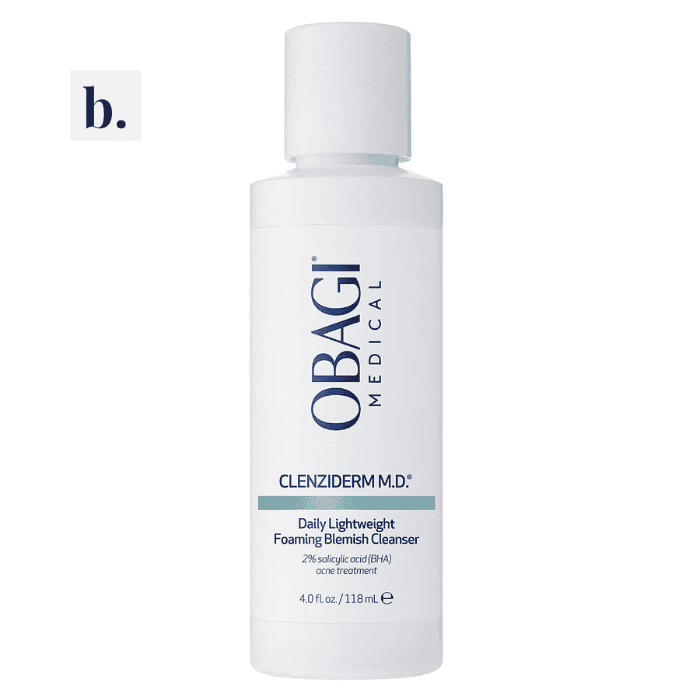
Obagi
CLENZIderm M.D.® Daily Lightweight Foaming Blemish Cleanser
If your oily or acne-prone skin tolerates high-foam cleansing, this wash offers a legitimate 2% salicylic-acid acne-treatment step. Menthol, fragrance, sulfates and a dryness warning limit its fit for reactive skin, and…
Read the BeautyBrief
Beverly Hills MD
Resurface + Restore Youth Revealing System
If your skin tolerates acids and retinol, this system provides an intensive route to smoother-looking texture and tone. The Premium value is strongest when you want both steps and accept the cumulative…
Read the BeautyBrief
Peach Slices
Acne Oil-Free Moisturizer
If you want a gentle-leaning acne active with daily moisture, this offers useful Budget convenience. If you already use acids or need a higher-strength dedicated treatment, compare your full routine first.
Read the BeautyBrief
302 Skincare
Salicylic Cleanser
If you want occasional salicylic-acid exfoliation during cleansing, this gives you a focused Budget option with a disclosed 2% concentration. If your skin is irritated or your routine already includes exfoliants, choose…
Read the BeautyBrief
Olay
Renewing Exfoliating Cleanser with Retinol
If you want affordable surface smoothing built into cleansing, this fragrance-free wash combines scrub particles and salicylic acid. If your main goal is fine-line treatment or you already exfoliate, use a simpler…
Read the BeautyBrief
Olay
Regenerating Cream Cleanser with Vitamin E
If you want an inexpensive creamy face wash with surface exfoliation, this combines scrub particles and salicylic acid in one step. If your skin is sensitive or you already exfoliate, a simpler…
Read the BeautyBrief